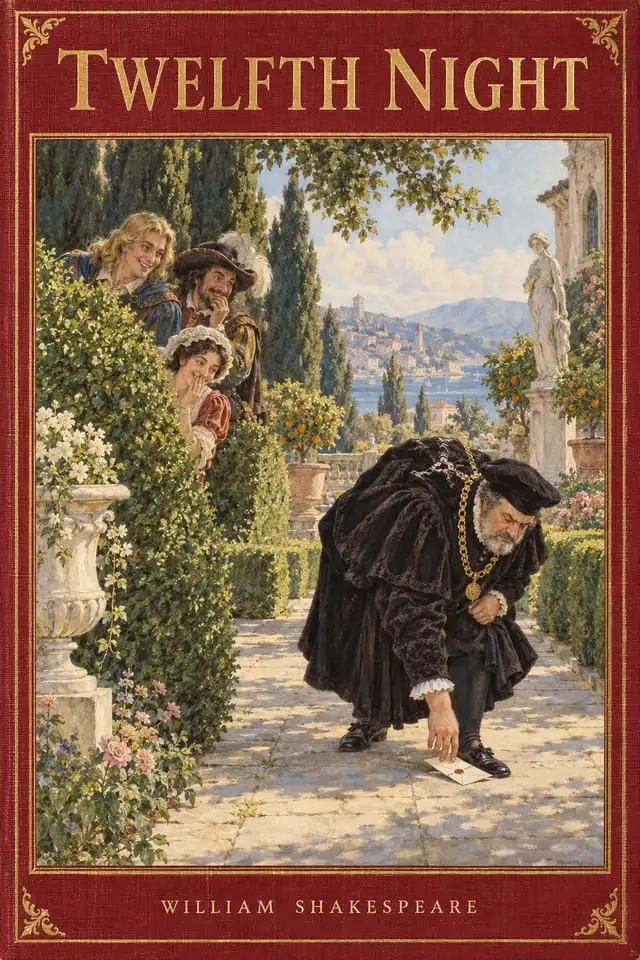
Twelfth Night Study Guide
GCSE and A-level set textEdexcel GCSEEduqas GCSEAQA A-level (Lit B)Edexcel A-level
Notes cover the whole book.
Characters
- OrsinoAfter threatening Cesario in his jealousy of Olivia, he learns Viola's identity and offers to marry her once the remaining obstacles are settled.First appears: Act 1, Scene 1
- CurioA lord attending the Duke, who asks whether he will go hunting.First appears: Act 1, Scene 1
- ValentineThe Duke's messenger, who has been refused entry to Olivia's house and brings back her handmaid's account of her mourning.First appears: Act 1, Scene 1
- ViolaStill in men's clothes, she recognises Sebastian through their shared family history, reveals her identity and reaffirms her love for Orsino, who offers her marriage.First appears: Act 1, Scene 2
- The CaptainViola reports that he holds her woman's clothes and is imprisoned at Malvolio's suit, leaving his release to be arranged.First appears: Act 1, Scene 2
- Sir Toby BelchHe arrives injured after fighting Sebastian and insults Andrew when he offers help, while Fabian later reports that he has married Maria in recompense for her letter.First appears: Act 1, Scene 3
- MariaAlthough absent from the scene, she is identified by Olivia as the writer of the forged letter and reported by Fabian to have married Sir Toby.First appears: Act 1, Scene 3
- Sir Andrew AguecheekInjured and still mistaking his attacker for Cesario, he blames Toby for setting him on and receives insults when he offers to help the wounded knight.First appears: Act 1, Scene 3
- FesteHe admits playing Sir Topas and recalls Malvolio's contempt for him as he speaks of revenge, then remains alone to end the play with a song.First appears: Act 1, Scene 5
- OliviaShe discovers that her vows bind her to Sebastian rather than Cesario, welcomes Viola as a sister and acknowledges that Malvolio has been abused.First appears: Act 1, Scene 5
- MalvolioReleased from confinement, he demands an explanation for his treatment, learns that the letter was forged and leaves threatening revenge on the whole company.First appears: Act 1, Scene 5
- SebastianHe returns after exchanging vows with Olivia, greets Antonio with affection and recognises his sister Viola through their shared memories of their father.First appears: Act 2, Scene 1
- AntonioBrought before Orsino under arrest, he defends his devotion to Sebastian and sees the twins together.First appears: Act 2, Scene 1
- FabianHe confesses his and Toby's part in the plot against Malvolio, reports Toby's marriage to Maria and argues for laughter rather than revenge.First appears: Act 2, Scene 5
- The ServantA servant who tells Olivia that Orsino's young messenger has returned and is waiting to see her.First appears: Act 3, Scene 4
- First OfficerAn officer who recognises Antonio despite his missing sea-cap and insists on taking him away.First appears: Act 3, Scene 4
- Second OfficerAn officer who arrests Antonio at Count Orsino's suit and repeatedly urges him to leave.First appears: Act 3, Scene 4
- The PriestHe confirms the ceremony of joined hands, kisses and exchanged rings that Olivia takes as proof of her bond with Cesario.First appears: Act 4, Scene 3

Themes
- Love and desire
- Disguise, gender and identity
- Grief and loss
- Wit and folly
- Order and excess
- Rank and service
Context
- A catch
- A song in which singers enter one after another with the same tune, so that their parts overlap. Act 2, Scene 3
- Cross-gartered
- Wearing garters, the bands that hold up stockings, crossed around the legs. Act 2, Scene 5
Chapter summaries
Act 1, Scene 1
The Duke listens to music with Curio and other attendants, but quickly tires of the pleasure he has just requested. He imagines love as an appetite that might be killed by overfeeding it. When Curio suggests hunting, the Duke describes himself as the hunted creature, pursued by his own desires since first seeing Olivia. Valentine brings a report from Olivia's handmaid that she will veil herself and mourn her dead brother for seven years. The Duke responds by imagining how completely she could love him, turning her grief into material for his own desires. His changing instructions and elaborate images make his experience of being in love more prominent than any knowledge of Olivia's wishes.
Act 1, Scene 2
Viola comes ashore with a Captain and sailors, uncertain whether her brother has drowned. The Captain saw him bind himself to a floating mast, so her grief is accompanied by a specific reason for hope. The Captain names the local ruler as Orsino and describes his unsuccessful courtship of Olivia. Hearing of Olivia's withdrawal after her brother's death, Viola wishes to serve her while keeping her own circumstances private, but the Captain explains that Olivia admits no requests. Viola instead plans to use her musical skills in the Duke's service and asks to be presented as a eunuch. She recognises that an attractive exterior can conceal corruption, yet chooses to trust the Captain's outward signs of honesty. His promise of silence makes her new identity a deliberate arrangement shared with the audience.
Act 1, Scene 3
Sir Toby dismisses his niece Olivia's prolonged mourning, while Maria tries to restrain his drinking and late nights. He answers her demand for order by joking about the clothes and boots he drinks in. Their disagreement extends to Sir Andrew, whose wealth and accomplishments Toby praises but whom Maria calls foolish, wasteful and cowardly. Andrew's arrival lets the audience test these competing descriptions: he mistakes the command to accost Maria for her name and cannot keep up with her jokes. His failure to understand Toby's French also undercuts Toby's claim that he speaks several languages. Andrew intends to go home because Olivia will not see him and has the Count as another suitor, but Toby reassures him that she will not marry above her rank. Andrew agrees to stay, and the scene ends with Toby urging him into a display of dancing rather than any serious attempt at courtship.
Act 1, Scene 4
Valentine tells Viola, now dressed as a man and called Cesario, that she has quickly gained the Duke's confidence. Orsino confirms this intimacy by describing his soul as a book he has opened to the youth. He orders Cesario to insist on an audience with Olivia, even if this means abandoning polite restraint. He thinks Olivia will listen more readily to a youthful messenger than to one of more solemn appearance and praises Cesario's lips and voice for resembling a woman's. The audience knows that these observations describe the person beneath the disguise, while Orsino treats them as advantages in a young male servant. Viola promises to do her best, but her aside reveals that the task conflicts with her own desire to become Orsino's wife.
Act 1, Scene 5
After Maria warns the Clown about his absence, he persuades Olivia to hear him prove that she is the fool for mourning a brother whose soul she believes is in heaven. Malvolio dismisses his wit, but Olivia accuses Malvolio of self-love and defends the freedom allowed to a fool. A drunken Sir Toby cannot give a useful account of the visitor at the gate, and Malvolio then reports that the young messenger refuses to leave without speaking to Olivia. Admitted as Cesario, Viola jokes about her prepared speech and the part she plays, giving the audience meanings that Olivia cannot recognise. In private, Olivia unveils and resists the messenger's praise, plainly stating that she cannot love Orsino despite his merits. Viola imagines how she would woo Olivia if she loved her as Orsino does, and Olivia turns from discussing Orsino to asking about Cesario's parentage and allowing another visit. Alone after Viola's departure, Olivia acknowledges her sudden attraction, summons Malvolio to pursue the messenger with a ring she claims Cesario left against her wishes, and finally appeals to fate while admitting uncertainty about her own actions.
Act 2, Scene 1
Antonio asks Sebastian to stay or let him travel with him, but Sebastian fears that his own bad fortune might harm his rescuer. Moved by Antonio's restraint, he reveals that he is Sebastian rather than Roderigo, the name he previously gave. He believes his twin sister drowned before Antonio rescued him, reports that others found her beautiful and firmly praises her character. His account recalls Viola's uncertainty about her brother after the shipwreck, while his certainty about his sister's death is not shared by the audience. Sebastian refuses Antonio's offer to become his servant and leaves, nearly moved to tears, after naming Orsino's court as his destination. Alone on stage, Antonio admits that he has enemies there but resolves to follow, making his affection stronger than his fear of danger.
Act 2, Scene 2
Malvolio delivers Olivia's ring and repeats her rejection of Orsino, saying that Cesario should return only to report his master's response. Viola refuses the ring, and Malvolio leaves it for her to pick up. Alone on stage, she states that she left no ring and interprets Olivia's distracted behaviour as evidence of attraction. Her soliloquy lets the audience hear her recognise the consequences of a disguise whose success has created a mistaken love. She describes Orsino's desire for Olivia, her own for Orsino and Olivia's for her as a problem in which neither her male appearance nor her concealed womanhood offers an answer. Although she blames disguise and speaks of women's susceptibility, she ends by appealing to time because she cannot solve the knot herself.
Act 2, Scene 3
After midnight, Sir Toby and Sir Andrew drink and pay the Clown to sing a love-song that urges enjoyment of the present. They then sing a catch, and Maria says Olivia must have summoned Malvolio to turn them out. Malvolio arrives with Olivia's warning that Sir Toby must separate himself from his disorderly habits or leave her house. Toby and the Clown answer in song, and Toby challenges the steward's right to restrict his pleasures by invoking their difference in rank. When Malvolio threatens to report Maria, she proposes to exploit his belief that everyone who sees him loves him. She can imitate Olivia's handwriting and plans to leave love letters for him to interpret while others watch. Toby admires the scheme, then urges Andrew to send for more money and reassures him about winning Olivia before proposing still more drink.
Act 2, Scene 4
With Viola, Curio and attendants at his palace, Orsino asks for a song heard the previous night, and Curio goes to fetch Feste. While the tune plays, Viola answers questions about her beloved with descriptions that point to Orsino, though he assumes she means a woman. Orsino advises Cesario that men's feelings change more readily than women's and that a man should choose a younger partner. Feste sings of a lover's death, accepts payment and leaves after comparing the Duke's mind to a changeable opal. Once the attendants retire, Viola asks whether Olivia's inability to love him should end his courtship, but Orsino insists that no woman could match his passion. Viola counters with the story of her father's daughter, whose unspoken love consumes her, using the supposed sister to describe feelings the audience knows she conceals. Viola avoids directly answering whether this supposed sister died and returns to her errand, while Orsino sends a jewel and insists that his suit cannot be refused.
Act 2, Scene 5
Fabian joins Sir Toby and Sir Andrew in the garden, eager to shame Malvolio because he blames him for losing Olivia's favour over a bear-baiting. Maria tells the three men to hide in the box-tree and places a forged letter in Malvolio's path before leaving. Even before finding it, Malvolio imagines becoming Olivia's husband, acquiring servants and rebuking Toby's drunkenness, provoking angry comments from his concealed listeners. He recognises what he thinks are Olivia's handwriting and seal, then forces the letters M, O, A, I to fit his own name despite their awkward order. The letter offers advancement and tells him to behave proudly, oppose a kinsman, be surly with servants, wear yellow stockings with crossed garters and smile. Malvolio accepts its promises and leaves determined to obey, while the watchers praise Maria's skill. On returning, Maria explains that Olivia dislikes the requested colour and fashion and that smiling will clash with her melancholy, exposing the gap between Malvolio's confidence and the knowledge shared by the plotters and audience.
Act 3, Scene 1
Viola meets Feste in Olivia's garden, where his wordplay shows how easily language can be turned to different meanings. After he leaves to announce where she has come from, she reflects that playing the fool well requires close attention to people's moods, rank and timing. Toby and Andrew greet her, and when Olivia enters with Maria, Andrew collects Viola's polished phrases to use himself. Olivia dismisses the others so that she can speak privately to Cesario. She refuses further discussion of Orsino, admits her deception over the ring and tries to read Viola's pity as a step towards love. Viola's statement that she is not what she is tells the audience a truth about her disguise that Olivia cannot understand. Olivia openly declares her love, but Viola says no woman except herself will rule her heart and takes leave, while Olivia invites another visit by suggesting she might reconsider Orsino.
Act 3, Scene 2
At Olivia's house, Andrew tells Toby and Fabian that he is leaving because Olivia has shown Cesario more favour than she has shown him. Fabian reverses the evidence, arguing that she meant to stir Andrew into a display of courage. Toby urges him to challenge Cesario and claims that a reputation for bravery is the best recommendation to a woman. Once Andrew has gone to write, Toby admits how much he has cost the knight and says it will be hard to make him fight. Fabian also sees no sign of cruelty in Cesario, so the proposed contest rests on their manipulation of two apparently unwilling opponents. Maria arrives to report Malvolio's yellow stockings, crossed garters and constant smile, inviting Toby and Fabian to enjoy the effects of another deception.
Act 3, Scene 3
In a street, Sebastian thanks Antonio for following him, though he wishes not to burden his rescuer. Antonio describes both his desire to be with Sebastian and his fear for a stranger travelling without friends or guidance. When Sebastian proposes looking at the town's sights, Antonio explains that he cannot safely walk openly because he fought against Orsino's galleys and refused the repayment others made for what they took. He nevertheless gives Sebastian his purse in case he sees something he wants to buy and arranges to meet him at the Elephant. Their separation follows an act of trust and practical generosity, showing how Antonio's affection shapes his use of money and his response to danger.
Act 3, Scene 4
Maria tells Olivia that Malvolio is possessed, and his smiles, yellow stockings and quotations from the forged letter convince Olivia that he is mad. When a servant announces Cesario's return, Olivia leaves Malvolio in her household's care, but he interprets her concern as proof of love. Toby, Maria and Fabian mock him with talk of devils, and after he leaves Toby proposes binding him in a dark room, turning the joke into a threat of confinement. Andrew brings his challenge, but Toby decides that its foolishness would frighten nobody and substitutes false reports of each opponent's fighting skill. Olivia gives Cesario her portrait and asks for another visit, while Viola continues to plead for Orsino; afterwards Toby and Fabian force Viola and Andrew to draw swords by exploiting their fear and invoking honour. Mistaking Viola for Sebastian, Antonio defends her and is arrested at Orsino's suit, then accuses her of ingratitude when she does not recognise him or have his purse, despite her offer of half her own money. His mistake gives Viola hope that her brother lives, but Toby calls Cesario dishonest, Fabian confirms the charge of cowardice, and Andrew leaves to pursue and beat the youth.
Act 4, Scene 1
Before Olivia's house, Feste takes Sebastian's denials of knowing him as deliberate pretence and insists that he is Cesario. Sebastian gives him money to leave and threatens worse treatment if he stays. Andrew enters with Toby and Fabian, strikes Sebastian and receives several blows in return, then threatens legal action while admitting he attacked first. Toby restrains Sebastian, who demands his freedom and challenges him to draw his sword if he continues. Olivia interrupts, rebukes Toby's behaviour and dismisses him and his companions, asserting her authority over the disorder around her house. Still mistaking Sebastian for Cesario, she invites him inside and asks him to be ruled by her. Sebastian wonders whether he is mad or dreaming, but the pleasure of her welcome makes him willing to accept what he cannot explain.
Act 4, Scene 2
At Olivia's house, Maria gives Feste a beard and gown so that he can visit Malvolio as Sir Topas the curate, while she fetches Toby. With the two plotters watching, Feste treats Malvolio's appeals as signs of possession and denies that his prison is dark. Malvolio asks for a rational test of his sanity, but the supposed curate refuses to recognise his sanity unless he accepts Pythagoras's belief that a human soul can inhabit a bird. Maria points out that the costume is unnecessary because Malvolio cannot see it, making voice the effective means of disguise. Toby now wants Malvolio released if possible because he fears the consequences of continuing while Olivia is angry with him. After Toby and Maria leave, Feste speaks in his own voice and impersonates a conversation with Sir Topas, keeping Malvolio dependent on an apparent helper who is also his tormentor. Malvolio describes the attempt to make him doubt his own wits and offers a reward for help in writing to Olivia, while Feste finally promises the materials and leaves singing.
Act 4, Scene 3
Alone in Olivia's garden, Sebastian uses the air, sun and pearl she has given him as evidence that his experience is real. He has looked for Antonio at the Elephant and learned that his friend went out to seek him, leaving him without the advice he wants. His soliloquy weighs the possibility of error against madness, while Olivia's orderly management of her household makes him doubt that she is mad. The audience knows the mistaken identity behind his confusion, but his reasoning cannot yet explain the favour he receives. Olivia enters with a priest and asks for a private pledge of faith in the nearby chantry to quiet her jealousy and doubts, promising secrecy until Sebastian wishes it known and then a celebration suited to her rank. Sebastian agrees to accompany them and remain true once he has sworn, accepting a commitment while the mistake itself remains unexplained.
Act 5, Scene 1
Before Olivia's house, Antonio is brought before Orsino and mistakes Viola for Sebastian, accusing her of betraying his devotion, while Olivia calls Cesario her husband and the Priest confirms that a ceremony took place. Orsino threatens the servant he believes Olivia loves, and Viola declares her love for him despite the threat. Andrew blames Cesario for his and Toby's injuries, but Sebastian's arrival puts the twins together on stage, allowing shared memories of their father to establish Viola's identity and turn their fears of loss into recognition that both survived the shipwreck. Sebastian explains Olivia's mistaken betrothal, and Orsino offers Viola his hand, changing her position from servant to future wife while she remains in men's clothes and the Captain who holds her garments remains imprisoned. Malvolio's letter brings him out of confinement, Olivia recognises Maria's handwriting in the forgery, and Fabian admits the plot and reports that Toby has married Maria. Fabian asks for laughter rather than revenge, but Feste recalls Malvolio's earlier insults and Malvolio exits threatening the whole company, leaving Orsino to request a reconciliation that is not shown. After the others leave with a joint wedding celebration still planned, Feste's song moves through childhood, adulthood, marriage and drunkenness, setting repeated rain beside its closing pledge to try to please the audience.
Key quotes
If music be the food of love, play on; Give me excess of it, that, surfeiting, The appetite may sicken, and so die.
The Duke treats love as a physical appetite and asks for excess as its cure. His wish to end desire sits beside his pleasure in feeding it.
Love and desireOrder and excess
That instant was I turn’d into a hart; And my desires, like fell and cruel hounds, E’er since pursue me.
The Duke makes himself the victim of his own desires. The hunting image gives his courtship the language of pursuit and suffering.
Love and desire
Mine own escape unfoldeth to my hope, Whereto thy speech serves for authority, The like of him.
Viola reasons from her own survival and the Captain's eyewitness account. Her hope for her brother is supported by evidence without becoming certainty.
Grief and loss
Conceal me what I am, and be my aid For such disguise as haply shall become The form of my intent.
Viola actively asks for disguise as a way to shape her circumstances. Concealment depends on the Captain's help and discretion.
Disguise, gender and identityRank and service
Ay, but you must confine yourself within the modest limits of order.
Maria speaks for restraint inside Olivia's household. Toby's refusal to accept her instruction makes order a matter of conflict between people of different ranks.
Order and excessRank and service
Good Mistress Accost, I desire better acquaintance.
Andrew mistakes an instruction for a name, exposing the weakness behind Toby's praise of his abilities. Maria's greater command of language gives her the advantage over the knight.
Wit and follyRank and service
Be clamorous and leap all civil bounds Rather than make unprofited return.
Orsino places the success of his suit above ordinary courtesy. The order makes his servant responsible for overcoming Olivia's refusal of access.
Love and desireRank and serviceOrder and excess
And all is semblative a woman’s part.
Orsino notices feminine features without recognising Viola's disguise. The audience's greater knowledge makes his confidence dramatically ironic.
Disguise, gender and identity
Whoe’er I woo, myself would be his wife.
The aside reveals the feeling Viola cannot share with her employer. Her duty to speak for his love conflicts with her own desire.
Love and desireDisguise, gender and identityRank and service
Better a witty fool, than a foolish wit.
The Clown separates the title of fool from the possession of intelligence. His exchange with Olivia tests that distinction by letting him challenge his mistress's reasoning.
Wit and follyRank and service
I am not that I play.
Viola's remark fits the discussion of acting a prepared speech and also describes her concealed identity. Olivia hears it without the audience's knowledge of the disguise.
Disguise, gender and identity
Even so quickly may one catch the plague? Methinks I feel this youth’s perfections With an invisible and subtle stealth To creep in at mine eyes.
Olivia compares her sudden attraction to an infection entering through sight. The image presents desire as an involuntary experience even as she begins arranging another meeting.
Love and desire
She is drowned already, sir, with salt water, though I seem to drown her remembrance again with more.
Sebastian turns his tears into a second drowning. The repeated image conveys grief while leaving his belief about his sister distinct from what the audience knows of Viola's survival.
Grief and loss
But, come what may, I do adore thee so, That danger shall seem sport, and I will go.
Antonio's closing decision gives his affection a practical cost. He chooses to enter danger for Sebastian even after Sebastian has refused his company.
Love and desire
I am the man: if it be so, as ’tis, Poor lady, she were better love a dream.
Viola recognises herself as the man Olivia desires while knowing that this identity is an appearance. Calling it a dream shows her pity for a love directed at the disguise.
Disguise, gender and identityLove and desire
O time! thou must untangle this, not I; It is too hard a knot for me to untie!
The knot gathers three conflicting desires into one image. Viola understands the problem but ends her private reasoning by admitting the limits of her control.
Love and desireDisguise, gender and identity
What is love? ’tis not hereafter; Present mirth hath present laughter; What’s to come is still unsure:
The Clown's song makes uncertainty a reason to enjoy love now. Its appeal to present pleasure suits the company who refuse to end their night's entertainment.
Love and desireOrder and excess
Dost thou think, because thou art virtuous, there shall be no more cakes and ale?
Toby presents Malvolio's demand for quiet as an attack on ordinary pleasures. His preceding reminder that Malvolio is a steward also makes this defence of enjoyment a claim to social authority.
Order and excessRank and service
on that vice in him will my revenge find notable cause to work.
Maria identifies Malvolio's self-love as the weakness her deception can use. Her deliberate plan turns the company's mockery into an organised act of revenge.
Wit and follyLove and desire
for thy mind is a very opal.
Feste compares Orsino's mind to a stone whose colours change. His mockery questions the Duke's claim to the constancy of a true lover.
Love and desireWit and folly
There is no woman’s sides Can bide the beating of so strong a passion As love doth give my heart;
Orsino treats the supposed limits of women's bodies as proof that his love exceeds theirs. This claim to male superiority sits uneasily beside his earlier admission that men's feelings are less steady than women's.
Love and desireDisguise, gender and identity
She never told her love, But let concealment, like a worm i’ the bud, Feed on her damask cheek:
Viola makes hidden love a force that damages the person who contains it. The story allows her to challenge Orsino's account of women while keeping her own identity concealed.
Love and desireDisguise, gender and identityGrief and loss
To be Count Malvolio!
Malvolio imagines a title before he finds the letter. His private fantasy makes social advancement part of his desire for Olivia and gives the forged promise something to work on.
Rank and serviceLove and desireWit and folly
and yet, to crush this a little, it would bow to me, for every one of these letters are in my name.
Malvolio admits that the letter needs forcing to fit him. His language of crushing and bending reveals how desire shapes what he accepts as evidence.
Wit and follyLove and desire
be not afraid of greatness: some are born great, some achieve greatness, and some have greatness thrust upon ’em.
The forged letter presents rising in rank as an opportunity Malvolio should accept. The audience knows that this promise of greatness is bait written by Maria.
Rank and serviceWit and folly
This fellow is wise enough to play the fool; And to do that well craves a kind of wit:
Viola recognises fooling as skilled work. Feste's social role gives him a way to display intelligence through apparent folly.
Wit and follyRank and service
Then think you right: I am not what I am.
Viola can speak truthfully about her disguise without revealing it to Olivia. The audience's knowledge makes the statement an instance of dramatic irony.
Disguise, gender and identity
I love thee so, that, maugre all thy pride, Nor wit nor reason can my passion hide.
Olivia presents desire as stronger than her ability to conceal it. The direct declaration exposes the feeling behind her earlier trick with the ring.
Love and desire
there is no love-broker in the world can more prevail in man’s commendation with woman than report of valour.
Toby turns Andrew's frustrated courtship into a demand for masculine courage. He claims that a reputation for bravery will win Olivia's favour, although he privately doubts Andrew can be made to fight.
Love and desireDisguise, gender and identityWit and folly
I have been dear to him, lad, some two thousand strong, or so.
Toby's joke reveals the expense of Andrew's attachment to him. His private admission gives the audience a reason to question his encouragement of Andrew's courtship.
Wit and follyRank and service
I could not stay behind you: my desire, More sharp than filed steel, did spur me forth;
Antonio gives desire a sharp physical force that drives him to follow Sebastian. His action makes affection something he accepts danger to express.
Love and desire
Haply your eye shall light upon some toy You have desire to purchase; and your store, I think, is not for idle markets, sir.
Antonio supplies money for Sebastian's pleasure as well as arranging necessities. Lending the purse makes his trust and care visible in a practical gesture.
Love and desire
Come, we’ll have him in a dark room and bound.
Toby proposes turning a trick about courtship into physical restraint. The audience knows that the supposed madness used to justify this punishment has been manufactured by the plotters.
Wit and follyOrder and excessRank and service
But O how vile an idol proves this god! Thou hast, Sebastian, done good feature shame.
Antonio's language turns devotion into bitter accusation. The audience knows that his judgement of Sebastian rests on mistaking Viola for him.
Love and desireDisguise, gender and identity
Prove true, imagination, O, prove true, That I, dear brother, be now ta’en for you!
The mistake that hurts Antonio gives Viola reason to hope. Her appeal keeps her brother's survival a possibility she longs to confirm.
Disguise, gender and identityGrief and loss
Nothing that is so is so.
Feste means to mock a man he believes is denying obvious facts. The audience knows that Sebastian's denial is truthful, so the joke exposes the fool's own mistaken certainty.
Disguise, gender and identityWit and folly
Hold, Toby; on thy life I charge thee, hold!
Olivia's direct command interrupts the threatened violence. Her authority checks the disorder that Toby has helped to create.
Order and excessRank and service
Let fancy still my sense in Lethe steep; If it be thus to dream, still let me sleep!
Sebastian welcomes an experience that seems dreamlike because it pleases him. His wish to remain in the dream suspends his effort to understand Olivia's mistaken affection.
Disguise, gender and identityLove and desire
I am not mad, Sir Topas: I say to you, this house is dark.
Malvolio answers the invented authority with a plain statement of his experience. His insistence exposes the cruelty of treating a truthful complaint as further evidence of madness.
Wit and follyOrder and excess
I would we were well rid of this knavery.
Toby's wish marks a retreat from the entertainment he encouraged. His following explanation connects it to Olivia's anger and his own safety rather than an expressed concern for Malvolio.
Order and excessRank and service
They have here propertied me; keep me in darkness, send ministers to me, asses, and do all they can to face me out of my wits.
Malvolio describes himself as something other people use and control. The sequence of actions makes the joke a sustained attack on his freedom and his confidence in his own reason.
Wit and follyOrder and excessRank and service
This is the air; that is the glorious sun; This pearl she gave me, I do feel’t and see’t;
Sebastian begins with things he can feel and see to test the reality of his good fortune. These concrete details establish that the experience is real without explaining Olivia's mistake.
Disguise, gender and identityWit and folly
That my most jealous and too doubtful soul May live at peace.
Olivia gives anxiety as her reason for seeking a vow so quickly. Her wish for certainty rests on a confidence about her companion's identity that the audience knows is mistaken.
Love and desireDisguise, gender and identity
I’ll follow this good man, and go with you; And, having sworn truth, ever will be true.
Sebastian promises lasting faith despite his uncertainty about Olivia's favour. The audience hears an apparently firm commitment made while her mistake about his identity remains unresolved.
Love and desireDisguise, gender and identity
One face, one voice, one habit, and two persons, A natural perspective, that is and is not!
Orsino sees the two people whose similar appearance has produced conflicting accounts of Cesario. Their presence together turns the audience's knowledge of the twins into a discovery shared by the characters.
Disguise, gender and identity
Here is my hand: you shall from this time be Your master’s mistress.
Orsino's wordplay marks Viola's change from serving him to becoming his intended wife. He makes this offer while she still wears the clothes in which he knew her as Cesario.
Love and desireRank and serviceDisguise, gender and identity
I’ll be revenged on the whole pack of you.
Malvolio rejects Fabian's attempt to make the abuse end in laughter. His exit leaves resentment alongside the proposed marriages, and no reconciliation takes place on stage.
Wit and follyOrder and excess