Characters
- Ursula BrangwenHas married Rupert Birkin and left her family home and teaching post.First appears: Chapter 1: Sisters
- Gudrun BrangwenAfter Gerald's death she goes to Dresden, sending Ursula no particulars of her life there.First appears: Chapter 1: Sisters
- Gerald CrichHis body has been found in the snow. Birkin grieves for him and accompanies his body to England for burial.First appears: Chapter 1: Sisters
- Hermione RoddiceAt Breadalby she strikes Birkin with a stone paperweight; afterwards she insists inwardly that her action was justified.First appears: Chapter 1: Sisters
- Rupert BirkinHe grieves for Gerald and helps arrange his return to England for burial. He still wants a lasting love with a man as well as his marriage to Ursula, who disputes that possibility.First appears: Chapter 1: Sisters
- Thomas CrichGerald's father has died after a prolonged illness.First appears: Chapter 1: Sisters
- Christiana CrichThe account of her marriage shows her resistance to Thomas's charity and her increasing withdrawal into isolation.First appears: Chapter 1: Sisters
- Pussum (Miss Darrington)After her involvement with Gerald, she seeks to secure her relationship with Halliday, whom she intends to marry.First appears: Chapter 6: Crème de Menthe
- Julius HallidayBirkin's London acquaintance, a fair-haired young man with a warm but uncertain manner, who knows Miss Darrington intimately.First appears: Chapter 6: Crème de Menthe
- Maxim LibidnikovA composed young Russian with a quiet, precise voice, and a friend of Halliday's since Eton.First appears: Chapter 6: Crème de Menthe
- PalmerAn earnest, scientifically minded electrician employed under Gerald's new scheme, known to Ursula and drawn to the local mining community.First appears: Chapter 9: Coal-Dust
- Winifred CrichGudrun teaches her drawing and modelling; her love of animals and playful, ironic manner provide a basis for their friendship.First appears: Chapter 2: Shortlands
- LoerkeA small, dark-haired sculptor among the guests at the mountain hostel, with quick, watchful eyes and a mocking manner.First appears: Chapter 29: Continental
- LeitnerLoerke's companion at the hostel, a large, fair-haired young man with an athletic build and a deferential manner.First appears: Chapter 29: Continental
Themes
- Intimacy and separateness
- Power and possession
- Social roles and convention
- Industry and the natural world
- Art and perception
- Change and fulfilment
Chapter summaries
Chapter 1: Sisters
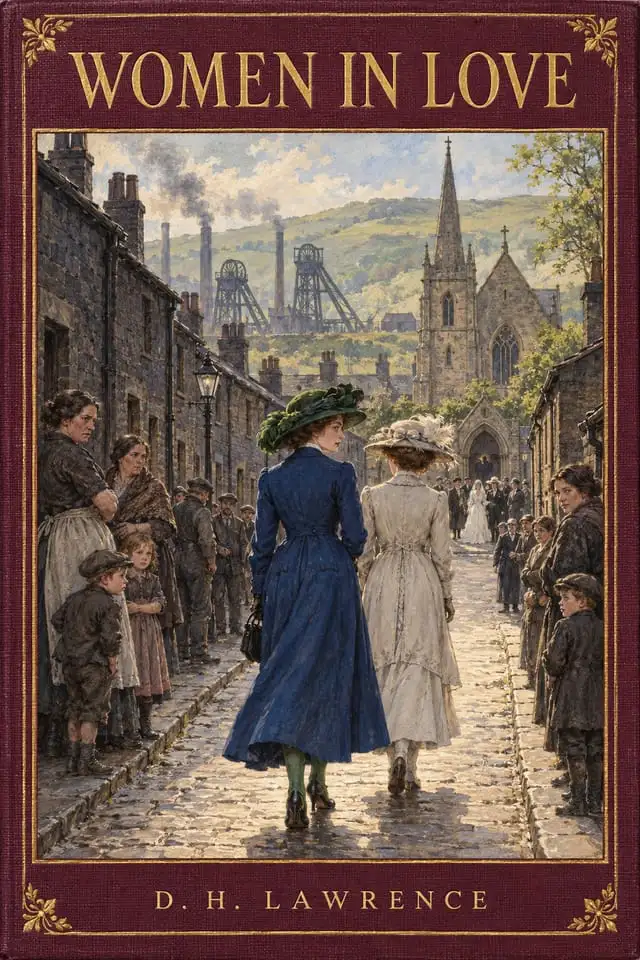
The sisters' conversation treats marriage as both a possible new experience and a possible end to experience, establishing uncertainty beneath their amusement. Their walk through the colliery district intensifies Gudrun's alienation and exposes tension between her artistic self-image and the people watching her. At the wedding, each sister finds a man who resists her usual judgement, while Hermione seeks security in Birkin's recognition. The lively pursuit of the bride contrasts with strained inward responses, and shifting viewpoints prevent the public ceremony from supplying a single, settled meaning for attachment.
Chapter 2: Shortlands
The reception reveals a household whose resistance to authority coexists with Gerald's forceful management of practical arrangements. Mrs Crich's remarks lead Birkin to reconsider whether Gerald's childhood killing of his brother can be understood as pure accident. The discussions of patriotism and hats turn abstract convictions into contests over control, while Hermione's apparent opposition to rivalry does not remove her own domineering manner. Birkin's claims about spontaneity culminate in an extreme theory of murder that Gerald explicitly rejects, and the narrator identifies suppressed attraction beneath the men's antagonism.
Chapter 3: Classroom
Birkin's arrival changes both the classroom's light and Ursula's sense of herself, interrupting the familiar rhythm of teaching. The catkins lead from practical observation to a dispute about whether knowledge enriches experience or replaces it. Birkin turns Hermione's questions into an attack on what he calls her desire to possess life mentally, but the narrator also exposes his cruelty, shame and anger. Ursula questions his account of sensual knowledge rather than simply accepting it, and Hermione's interruption restores a social advantage that leaves the encounter emotionally unresolved.
Chapter 4: Diver
Gerald enjoys the lake as a separate world, while Gudrun interprets his bodily freedom through the restrictions she feels as a woman. Her attraction does not erase differences between her and Ursula over his energy and the meaning of his childhood accident. The encounter with Hermione renews their sensitivity to rank and patronage, though Gudrun values the invitation more than Ursula does. Their mutual sharpening of disdain ends beside the repeated routine of school, which Ursula fears may consume a life she still hopes will develop beyond it.
Chapter 5: In the Train
The train conversation tests the difference between changing social arrangements and changing what people desire. Gerald defends production and material provision, while Birkin argues that possessions and public importance cannot answer what life is for. Their exchange turns from apparent intellectual disagreement to the question of whether affection includes taking the other's convictions seriously. Birkin's hostility to humanity and London remains his own troubled response, set against the attraction and intermittent warmth that continue to draw the men together.
Chapter 6: Crème de Menthe
Gerald's pleasure in the unfamiliar café grows through a fascination that repeatedly joins attraction to imagined power over Pussum. Her account of Halliday's demands exposes control and dependence beneath the group's appearance of sexual freedom. The wound turns talk about fear into actual harm, while the subsequent hospitality leaves motives and permissions deliberately uncertain. At the flat, reactions to Hasan and the African carvings reveal racialised assumptions in the characters' perceptions, and Pussum's insistence on having her own experience remains entangled with the men's arrangements.
Chapter 7: Fetish
The morning's naked bodies challenge Gerald's familiar standards of dignity, while his response to the carving connects its depicted suffering to Pussum. Birkin defends the work as a complete expression of physical experience, though his account is itself an interpretation rather than an established explanation of African culture. Gerald's attraction repeatedly takes the form of possession and cruel pity, followed by a wish for separation. The group's supposed freedom gives way to jealousy and calculation, and Pussum's own pursuit of power complicates Gerald's image of her as merely passive.
Chapter 8: Breadalby
Breadalby's beauty attracts the visitors while its carefully managed social life repeatedly feels like confinement. Debates about knowledge, work and equality reveal how assertions of freedom coexist with attempts to direct other people. Dancing creates a different medium of expression, intensifying the emerging attractions and Hermione's fear of losing Birkin. Her assault turns possessive conflict into physical violence, after which both characters offer self-justifications that should be distinguished from the narrator's account of injury. Birkin's intense contact with vegetation briefly seems to replace human attachment, but his pain and subsequent illness prevent the escape from becoming an uncomplicated liberation.
Chapter 9: Coal-Dust
The mare's terror and bleeding make Gerald's control visibly violent, while the sisters respond in sharply different ways. Ursula protests directly, whereas Gudrun's fascination passes through shock into a cold detachment. The railway, bodily force and mechanical images connect the incident to the wider industrial landscape through which they walk. Gudrun's simultaneous attraction and repulsion towards the district's male life unsettles her idea of herself as separate, and Palmer offers companionship without resolving that divided response.
Chapter 10: Sketchbook
The opening contrast between Gudrun's concentrated study of plants and Ursula's drifting attention presents different ways of experiencing the scene. Gerald's arrival intensifies Gudrun's bodily awareness and seems to offer escape from the district's oppressive attractions. The dropped book makes the struggle for precedence between Hermione and Gerald material, while Gudrun refuses to let the apology control the encounter. Her tone towards Gerald creates an alliance she experiences as power over him, even as his absorbed admiration leaves Hermione unable to regain command.
Chapter 11: An Island
Practical cooperation in launching the punt creates an intimacy that their arguments both develop and unsettle. Birkin's wish for a world without humanity is challenged by Ursula and presented partly through her response to it as a fantasy. She resists his refusal to make love absolute, while his attraction to her interrupts the very distance he asserts. The floating daisies offer a shared experience neither settles by explanation, but his invitation into the mill's future becomes uncertain when Hermione's arrival exposes unresolved attachments.
Chapter 12: Carpeting
The covered canaries introduce a scene in which management of living beings repeatedly raises questions about control. Hermione's gifts and arrangements create an intimacy that excludes the others, while Birkin's compliance contradicts the freedom he has just proposed. Ursula's protest over the mare draws out Gerald's defence of mastery and Birkin's contested analogy between women and horses. Her temporary alliance with Hermione offers relief from his arguments without resolving mistrust between the women, so the chapter closes with opposition and attachment continuing together.
Chapter 13: Mino
Ursula deliberately withholds the invitation from Gudrun so that the encounter must address her own relationship with Birkin. His description of two separate stars promises balance, yet his defence of the bullying cat gives her grounds to question whether equality conceals male authority. Their argument tests what words such as freedom, commitment and love would mean in conduct rather than accepting either speaker's definitions as final. The shift to her personal history enables a more tender communication, though the irony and submission in his closing declaration leave their conceptual disagreement unresolved.
Chapter 14: Water-Party
The public festivities expose class anxieties before the sisters discover a private freedom together away from the crowd. Gudrun's dance before the cattle and her subsequent blow to Gerald turn attraction into an unstable exchange of fear, challenge and submission. Lanterns and the drifting canoe briefly create a luminous union, but the accident returns Gerald to a sharply practical role that isolates Gudrun. His exhausted diving and refusal to leave the search resist Birkin's efforts to draw him away from accumulating painful memories. Ursula and Birkin move between disputed theories and physical passion without entirely reconciling their desires. The final scenes set communal shock beside Gudrun's imagined role as comforter and Ursula's absorption in love, exposing how differently catastrophe is experienced.
Chapter 15: Sunday Evening
The chapter follows Ursula's inward crisis through language of exhaustion, imprisonment and imagined release, rather than presenting her thoughts as a general verdict on life. Birkin's arrival fails to restore the intimacy she anticipated because each seems distant and strange to the other. His gentle exchange with Billy contrasts with her repulsion at his apparent neglect of his own body. The family's discussion of the Criches' grief further exposes competing demands for privacy and sympathy, before Ursula's hostility becomes a force she experiences without a clear account of its cause.
Chapter 16: Man to Man
Birkin's meditation rejects the closed domestic couple in favour of two distinct beings, extending the questions raised in his conversations with Ursula. Gerald's visit makes male attachment an explicit possibility, yet his fear that Birkin can detach from him complicates the proposed freedom. The invitation to pledge themselves is neither accepted nor simply dismissed: Gerald is pleased and drawn towards it while retaining his reserve. Their return to Winifred's education brings ideals of individual fulfilment into practical contact with money, employment and Gerald's uncertain reliance on social rank.
Chapter 17: The Industrial Magnate
The chapter widens the present crisis through competing memories and a sustained account of the Crich family and industry. Thomas's Christian charity is both sincere and implicated in a system of authority that he cannot surrender, while his marriage makes pity itself a means of confinement. Gerald replaces paternal benevolence with a conception of people and machines as instruments within one productive order. Technical improvement increases output but strips away older securities and treats personal needs as incidental. The workers' acceptance is narrated as part of the same destructive ideal, rather than a simple contest between one employer and unwilling victims. Once the system scarcely needs its director, Gerald's practical triumph fails to supply an enduring sense of self, and his reliance on Birkin becomes more visible.
Chapter 18: Rabbit
Accepting the work brings Gudrun closer to Gerald while allowing her to tell herself that she is only satisfying curiosity. Her rapport with Winifred depends on artistic play and recognition rather than ordinary authority. The rabbit's resistance turns that playful handling into anger and force, revealing a cruelty Gudrun had earlier witnessed in Gerald. Their shared recognition is presented as both intimate and abhorrent, while the animal's return to ordinary grazing refuses to settle into the meanings the people impose on it.
Chapter 19: Moony
The moon repeatedly re-forming on the disturbed pond gives physical shape to resistance and attempted destruction without supplying a single fixed explanation. Birkin and Ursula move from demands for surrender into a quiet closeness, then he questions whether his own prescribed ideal has obstructed what he desires. His racialised speculations about cultural dissolution belong to his anxious thought, not a verified account of human history. The proposal exposes antagonism with Will Brangwen and makes Ursula feel coerced by a question she has not chosen to answer. Her later rejection of Gudrun's reductive judgements opens another perspective, yet her wish for absolute surrender still conflicts with Birkin's insistence on distinct selves.
Chapter 20: Gladiatorial
Gerald's comparison with an unpowered machine connects his private inertia with the industrial activity that usually sustains him. Wrestling offers both men an intimacy that their conversation alone has not supplied, while the language of penetration, subjection and oneness keeps power within that encounter. Their clasped hands and admiration do not settle whether this constitutes the lasting pledge Birkin has sought. Ursula returns to Birkin's thoughts even during his closeness with Gerald, so the two attachments coexist rather than simply replacing one another. Gerald's uncertainty about love and fulfilment remains a question, and Birkin refuses to predict his life.
Chapter 21: Threshold
The promised studio offers Gudrun artistic independence through a closer attachment to the wealthy household, making freedom and dependence difficult to separate. Winifred's anxious delight in presenting flowers complicates her usual composure. Thomas Crich clings to familiar social exchanges as his strength fails, and Gudrun combines sympathy, performance, admiration and repulsion in her responses. Winifred presses for an admission that he may die, then insists that he will not, making her apparent unconcern uncertain. Gudrun and Gerald find an unsettling affinity in their desire for release amid the approaching death. Their subsequent account of Birkin's marriage ideal is an interested, mocking interpretation, while their own agreement about love does not establish what either will achieve.
Chapter 22: Woman to Woman
Hermione's warnings about marriage combine experience of Birkin with envy and a wish to preserve her own authority. Ursula briefly invites criticism of him, then recoils when Hermione presents submission and suffering as the conditions of helping him. Their inward judgements expose competing claims to understanding rather than establishing either woman's complete account as fact. Birkin's conventional efforts to entertain both women intensify Ursula's impatience, while Hermione's Italian conversation and the household objects mark a shared past. The cat becomes another focus for the delicate control that Ursula associates with Hermione and, momentarily, Gudrun. Ursula's departure expresses resistance but also the insecurity of feeling socially and emotionally displaced.
Chapter 23: Excurse
The rings move between gifts of beauty, suspected tokens of possession and a recovered pledge, so their meaning changes with the lovers' relation. Ursula attacks Birkin's claim to spiritual purity, and he acknowledges force in her criticism while resisting her demand for an absorbing emotional union. Her return with heather replaces accusation with a quieter exchange, though their differences are not simply argued away. The narrative presents bodily touch through images of darkness, electricity and unfamiliar otherness, distinguishing it from knowledge that classifies or possesses. Their resignations translate the feeling of release into practical decisions, yet Ursula imagines a home while Birkin wants wandering and relationships with others. The night fulfils both characters' desires at this moment without proving that their future wishes coincide.
Chapter 24: Death and Love
Gerald treats his father's dying as an ordeal to master, but the sustained effort exposes the limits of his will. His mother's warning challenges his assumption that he must carry the experience through by himself, and her response to the corpse unsettles the family's conventional expressions of grief. Gudrun is drawn to Gerald's need and beauty, yet experiences his dependence as a trap as well as an invitation. The walk under the railway bridge places their embrace within the same industrial landscape as the colliers' courtships, while Gudrun imagines a hierarchy of masculine power. His uninvited entry into the Brangwen house turns his desperation into an intrusion which she accepts with fascination and a sense of compulsion. The contrast between his restorative sleep and her exhausting consciousness makes their bodily closeness sharply unequal. Her continuing desire at dawn coexists with resentment and relief at his departure, preventing a simple account of either mutual happiness or complete rejection.
Chapter 25: Marriage or Not
Gerald approaches marriage as an irrevocable step without knowing what alternative he could choose. Birkin distinguishes a lasting union from legal convenience and from the narrow privacy of couples protecting their own interests. His proposed bond between men is additional to marriage, and he explicitly refuses Gerald's assumption that the two relationships must be the same. The concluding narration presents Gerald's imagined marriage as submission to an established order in which he lacks living belief. His simultaneous pleasure in the offer and greater pleasure in refusing commitment keeps attraction and resistance together.
Chapter 26: A Chair
Admiration for the chair turns into an argument about the past, materialism and whether beautiful possessions confine their owners. Ursula challenges Birkin's nostalgia, and their decision to give the chair away makes a small practical experiment of rejecting a fixed home. The gift initially produces suspicion, embarrassment and class tensions before the four share a more playful exchange. The young man's remark about the cost of changing one's mind exposes the material freedom behind Ursula and Birkin's plans. Their shared delight in imagined escape does not remove disagreement about fellowship: Ursula accepts affection that happens freely, while questioning Birkin's efforts to compel it. His final uncertainty about Gerald remains unanswered by her.
Chapter 27: Flitting
The marriage announcement turns the conflict between parental attachment and Ursula's independence into physical violence, making her departure painful as well as liberating. Birkin comforts her, though his interpretation of her father's conduct does not erase the wound she describes. Their union is presented through an intense language of renewal and oneness which complicates earlier insistence on distinct selves. The emptied house makes the sisters question the meaning of the ordinary family life it once contained. Gudrun's fierce rejection of domestic confinement is unsettled by her private wish for the stability she sees around Ursula. Her reaction to the proposed holiday similarly combines attraction with anger that the men have discussed her movements, so neither her refusal nor Ursula's reassurance gives a complete account of her wishes.
Chapter 28: Gudrun in the Pompadour
Gudrun returns to an artistic circle she despises, finding herself drawn to observe the people she wants to reject. Pussum's approach exposes Gerald's previous involvement with her and makes the cafe's mockery personally charged. The public reading turns Birkin's serious language about destruction and creative relationships into a clerical performance for ridicule. Gudrun's seizure of the letter defends him without endorsing every claim it contains, and also enacts her anger at the group's handling of intimacy. Her composed outward departure conceals overwhelming feeling, while Gerald approves the action after discovering what she has done.
Chapter 29: Continental
The journey promises a new existence, but memories and differences within each relationship accompany the travellers into the snow. Physical speed and the mountain landscape alternately offer release and an isolating finality, experienced differently by each character. Gudrun moves between fear of Gerald's power, strategies for controlling him, ambitious fantasies about his industrial abilities and cynical rejection of those fantasies. Loerke's proposed factory frieze connects art to industrial motion, while his account of poverty challenges the sisters' experience of earning a living. His insistence that an artwork has no relation to ordinary life gains Gudrun's support, but Ursula contests it and his subsequent admission of beating his young model makes the ethical question concrete. Ursula's wish to leave the frozen setting becomes a further disagreement with Gudrun about whether a new world can be reached by breaking old connections. The farewells retain affection and hostility together: Gerald calls his experience both compelling and destructive, and answers Birkin's declaration of love with scepticism.
Chapter 30: Snowed Up
Both characters speak of freedom while remaining caught in a struggle to defeat or change the other, and Gerald turns his frustrated desire into explicit murderous fantasies. Gudrun finds in Loerke a fellow craftsman's understanding and a possible escape, yet postpones any definite destination because possibility itself attracts her. Her nocturnal terror of mechanical time parallels Gerald's dread of sleeplessness, exposing distress beneath their attempts at superiority. The multilingual play with Loerke offers a different kind of intimacy without establishing a secure future for them. Gerald's assault makes the danger physical: his interpretation of Gudrun's resistance as reciprocal passion belongs to his distorted perception during strangulation. Loerke's intervention interrupts the attack, and the narrative follows Gerald's revulsion, weakness and confused ascent rather than granting him a deliberate heroic ending. The final imagery of cold, sleep and a threatening crucifix turns his wish for completion into a loss of orientation and agency.
Chapter 31: Exeunt
Gudrun's inability to perform expected grief exposes a gap between outward behaviour and the unresolved fear, irony and estrangement within her. Her description of the assault supplies details absent from Loerke's account, while her rejection of a simple romantic triangle resists reducing the conflict to rivalry alone. Birkin's repeated encounters with the frozen body move from disgust and abstraction to an uncontrollable outbreak of grief. His reflections on possible escape routes and a creative universe are attempts to think through loss, rather than authoritative explanations of Gerald's death or natural history. His belief that Gerald should have accepted his love remains challenged by Ursula's question about what difference it would have made. The final exchange preserves their intimacy alongside a disagreement that neither resolves, leaving the meaning and possibility of another kind of love open.
Key quotes
More likely to be the end of experience.
Ursula questions whether the supposedly necessary next step of marriage opens life or closes it.
Social roles and conventionChange and fulfilment
pretending nothing but ease.
Birkin's social fluency is presented as a balancing act rather than effortless belonging.
Social roles and conventionIntimacy and separateness
It was rather a resistance to authority, than liberty.
The narrator distinguishes the Crich household's disorder from positive freedom.
Power and possessionSocial roles and convention
a strange, perilous intimacy which was either hate or love, or both.
The men's argument carries an emotional closeness that their casual idea of friendship cannot accommodate.
Intimacy and separatenessPower and possession
Imprisoned within a limited, false set of concepts
Birkin distinguishes the restriction he attacks from a simple excess of intelligence or knowledge.
Change and fulfilmentArt and perception
He sounded as if he were addressing a meeting.
The narrator registers how his theory can become a public performance that distances the women he addresses.
Power and possessionIntimacy and separateness
You haven't the thousand obstacles a woman has in front of her.
Gudrun makes the swimmer's freedom an image of the unequal possibilities she experiences.
Social roles and conventionChange and fulfilment
like a knife and a whetstone, the one sharpened against the other.
The sisters' exchange intensifies critical judgement rather than simply confirming shared affection.
Intimacy and separatenessSocial roles and convention
It is artificially held together by the social mechanism.
Gerald admits uncertainty about a personal centre even while defending organised work.
Industry and the natural worldChange and fulfilment
Gerald wanted to be fond of him without taking him seriously.
Birkin experiences a gap between personal attraction and recognition of what matters to him.
Intimacy and separateness
an instinctive cherishing very near to cruelty.
The narrator places Gerald's protective pleasure beside a desire for dominance, unsettling its apparent generosity.
Power and possessionIntimacy and separateness
She was determined to have her experience.
Pussum asserts a purpose of her own even while uncertain about the position others will allow her.
Power and possessionChange and fulfilment
He wanted to keep certain illusions, certain ideas like clothing.
Gerald's resistance to the carving is linked to the protective conventions he feels threatened by.
Art and perceptionSocial roles and convention
a mordant pity, a passion almost of cruelty.
The narrator refuses to separate Gerald's desire to cherish from his pleasure in another person's vulnerability.
Power and possessionIntimacy and separateness
feeling somehow like prisoners marshalled for exercise.
The guests' agreement to walk conceals the pressure exerted by Hermione's hospitality.
Power and possessionSocial roles and convention
a curious heart-straining towards each other.
Gerald and Birkin's wish to remain separate is held beside an attachment that continues to disturb their debates.
Intimacy and separateness
with an almost mechanical relentlessness
The description links Gerald's treatment of a living animal to impersonal, machine-like control.
Power and possessionIndustry and the natural world
It has a foul kind of beauty, this place
Gudrun's contradictory judgement expresses an attraction that does not remove her revulsion.
Industry and the natural worldArt and perception
It was no use resisting Hermione's deliberate intention.
An apparently friendly request to see the drawing carries pressure that Gudrun recognises.
Power and possessionArt and perception
The bond was established between them, in that look, in her tone.
Communication depends on gesture and inflection rather than an explicit declaration of feeling.
Intimacy and separatenessPower and possession
freedom together
Birkin's brief answer names a desired relationship without supplying the declaration Ursula wants.
Intimacy and separatenessChange and fulfilment
It pleased Ursula, what he said, pleased her very much, as a fantasy.
The qualification prevents her enjoyment of his humanless world from becoming simple agreement with a programme.
Industry and the natural worldChange and fulfilment
she had one intimate, and turned all the rest of those present into onlookers.
Hermione's apparent closeness also operates as a way of ordering the social scene.
Power and possessionIntimacy and separateness
Then I'm a bolter
Ursula answers Birkin's comparison with a horse by asserting resistance rather than accepting a subordinate role.
Power and possessionSocial roles and convention
I meant two single equal stars balanced in conjunction
Birkin insists that his desired bond preserves two selves rather than making one a dependent satellite.
Intimacy and separatenessChange and fulfilment
bossiness, I call it, bossiness.
Ursula translates his elevated explanation into a practical challenge about domination.
Power and possessionIntimacy and separateness
When they were together, doing the things they enjoyed, the two sisters were quite complete in a perfect world of their own.
Their private pleasure offers a form of fulfilment distinct from the gathering and its romantic expectations.
Intimacy and separatenessChange and fulfilment
You force yourself into horrors, and put a millstone of beastly memories round your neck.
Birkin sees Gerald's determination to continue the search as a danger to his future life, though Gerald insists on seeing it through.
Intimacy and separatenessPower and possession
He had come now, now she was gone far away.
Physical arrival does not overcome the inward distance created during her waiting.
Intimacy and separatenessChange and fulfilment
Her relation was ultimate and utterly beyond words
The narration presents her hatred as experienced intensity rather than a reasoned judgement she can explain.
Intimacy and separatenessPower and possession
We'll leave it till I understand it better
Gerald defers the pledge while maintaining the relationship, leaving attraction and refusal unresolved.
Intimacy and separateness
The difference between a public servant and a private one.
Birkin identifies why a change of teaching work might alter Gudrun's independence and social position.
Social roles and conventionArt and perceptionPower and possession
As a man as of a knife: does it cut well? Nothing else mattered.
Gerald's governing idea reduces a person's value to the efficient performance of a function.
Power and possessionIndustry and the natural world
The whole system was now so perfect that Gerald was hardly necessary any more.
His achievement threatens the personal purpose that the struggle to organise the mines had provided.
Industry and the natural worldChange and fulfilment
He saw, with subtle recognition, her sullen passion of cruelty.
Gerald recognises in Gudrun an impulse that complicates any simple opposition between his dominance and her resistance.
Power and possessionIntimacy and separateness
There was a league between them, abhorrent to them both.
The scene binds them through an understanding that is disturbing rather than reassuring.
Intimacy and separatenessPower and possession
While ever either of us insists to the other, we are all wrong.
Birkin momentarily recognises that imposing an ideal can frustrate the accord he seeks.
Intimacy and separatenessPower and possession
This finality of Gudrun's, this dispatching of people and things in a sentence, it was all such a lie.
Ursula resists a judgement that makes one set of criticisms the complete truth about a person.
Intimacy and separatenessArt and perception
The wrestling had some deep meaning to them—an unfinished meaning.
The narrator grants the encounter significance without resolving its future or defining it conclusively.
Intimacy and separatenessChange and fulfilment
We are different, you and I
Birkin acknowledges a limit to understanding Gerald even after their physical closeness.
Intimacy and separateness
only an artist is free, because he lives in a creative world of his own
Winifred reports Gerald's claim in the invitation to a studio supplied by his family, exposing a tension between creative freedom and material dependence.
Art and perceptionSocial roles and convention
He never admitted that he was going to die.
The narrator distinguishes Thomas Crich's knowledge from his refusal to acknowledge it.
Change and fulfilmentPower and possession
And I don't want to suffer hourly and daily
Ursula challenges Hermione's claim that continual suffering is necessary to love Birkin.
Intimacy and separatenessPower and possession
Her convention was not their convention, their standards were not her standards.
The familiar tea setting gives Ursula's sense of exclusion a social as well as a romantic dimension.
Social roles and conventionIntimacy and separateness
He gave up his old position.
The brief sentence marks Birkin's relinquishment of his defensive stance after the quarrel.
Intimacy and separatenessChange and fulfilment
They would give each other this star-equilibrium which alone is freedom.
The image envisages intimacy as a balance between distinct beings, rather than the disappearance of one into the other.
Intimacy and separatenessPower and possession
Blind to her, thinking only of himself, he slipped his arm softly round her waist
The narrator distinguishes Gerald's need for balance from attention to Gudrun as a separate person.
Intimacy and separatenessPower and possession
But Gudrun lay wide awake, destroyed into perfect consciousness.
Her wakefulness sharply contrasts with the sleep Gerald experiences as recovery.
Intimacy and separatenessChange and fulfilment
Not the same—but equally important, equally creative, equally sacred, if you like.
Birkin insists that the proposed bond has its own value alongside marriage.
Intimacy and separatenessSocial roles and convention
Yet he was still more glad to reject it, not to be committed.
The final sentence makes Gerald's resistance to commitment coexist with his response to Birkin's offer.
Intimacy and separatenessChange and fulfilment
Cawsts something to chynge your mind
The young man's observation makes the freedom to discard a purchase depend on what one can afford.
Social roles and conventionChange and fulfilment
You always seem to think you can force the flowers to come out.
Ursula's metaphor challenges the use of will to produce freely given affection.
Intimacy and separatenessPower and possession
Yet it was not childish, it was a mortal conflict, a deep wound.
The narrator corrects the superficial impression made by Ursula's childlike tears.
Power and possessionIntimacy and separateness
She did want it, let her say what she might.
Gudrun's private desire for marriage challenges the certainty of her earlier declarations about freedom.
Social roles and conventionChange and fulfilmentIntimacy and separateness
Why does he give himself away to such canaille?
Gudrun's anger concerns the exposure of private seriousness to people she regards as unworthy of it.
Intimacy and separatenessSocial roles and convention
Yet she was frozen with overwrought feelings.
The sentence distinguishes Gudrun's apparently controlled behaviour from her inward turmoil.
Art and perceptionPower and possession
Art should interpret industry, as art once interpreted religion
Loerke proposes an industrial purpose for art before later asserting its independence from ordinary reality.
Art and perceptionIndustry and the natural world
They wanted to go apart, all of them.
The shared desire for separation complicates any account of the farewell as simply abandonment by one couple.
Intimacy and separatenessChange and fulfilment
But always it was this eternal seesaw, one destroyed that the other might exist
The image describes their relation as a contest that prevents mutual flourishing.
Intimacy and separatenessPower and possession
He had lost all his sense of place.
The ascent proceeds through disorientation rather than controlled mastery of the landscape.
Change and fulfilmentPower and possession
What should she feel?
Gudrun's question reveals uncertainty about feeling itself as well as about its expected public expression.
Intimacy and separatenessSocial roles and convention
I don't believe that
Birkin's last reply refuses Ursula's judgement that the additional love he wanted was impossible.
Intimacy and separatenessChange and fulfilment
Talking points
These questions cover the whole novel, including its ending. Compare what characters claim with what they do, and attend to the changing perspectives through which their relationships are presented.
Can intimacy preserve the separateness that Birkin desires?
Compare the image of balanced stars with the reconciliation after the quarrel over Hermione, the language of marital oneness and the final disagreement. Ask whether the novel offers one consistent model or tests several competing desires.
Look again at: Chapter 13: Mino, Chapter 23: Excurse, Chapter 27: Flitting, Chapter 31: Exeunt
How does Gerald's industrial mastery relate to his private vulnerability?
Read the retrospective account of the mines beside his boredom, his father's dying and the final mountain ascent. Distinguish practical competence from the ability to live without controlling or depending on another person.
Look again at: Chapter 17: The Industrial Magnate, Chapter 20: Gladiatorial, Chapter 24: Death and Love, Chapter 30: Snowed Up
What do encounters with animals reveal about power?
Compare the mare at the railway crossing, Birkin's account of the cats and Gudrun and Gerald's handling of the rabbit. Consider bodily vulnerability, fascination and the different explanations characters offer for force.
Look again at: Chapter 9: Coal-Dust, Chapter 13: Mino, Chapter 18: Rabbit
Does art offer freedom from ordinary life or a way of avoiding responsibility?
Compare Gudrun's sketches and studio arrangements with Loerke's factory frieze and the dispute over Lady Godiva. Examine the tension between his claim that art interprets industry and his claim that it has no relation to everyday life.
Look again at: Chapter 10: Sketchbook, Chapter 18: Rabbit, Chapter 21: Threshold, Chapter 29: Continental, Chapter 30: Snowed Up
How do material circumstances shape the freedom to reject convention?
Compare Hermione's privileged social world, Gudrun's dependence on the Crich studio and the gift of the chair to the young couple. Ask who can afford to leave work, change plans or travel, and how the narration represents people outside the central group.
Look again at: Chapter 8: Breadalby, Chapter 21: Threshold, Chapter 26: A Chair, Chapter 29: Continental
What is at stake in Birkin's proposed bond with Gerald?
Trace the proposed pledge, the wrestling, Gerald's discussion of marriage and Birkin's grief. Consider the attraction and resistance on both sides, and distinguish Birkin's belief about what love might have changed from a fact established by the ending.
Look again at: Chapter 16: Man to Man, Chapter 20: Gladiatorial, Chapter 25: Marriage or Not, Chapter 31: Exeunt
How does the snow change the meaning of escape?
Follow the journey's promise of a new world into the exhilaration of speed, Gudrun's response to the peaks, Ursula's wish to leave and Gerald's disoriented ascent. Compare their responses without treating the landscape as a single fixed symbol.
Look again at: Chapter 29: Continental, Chapter 30: Snowed Up, Chapter 31: Exeunt
How does the narration complicate the characters' confident judgements?
Compare Ursula's resistance to Gudrun's finality, Gudrun's contradictory wishes about marriage and the inward perspectives surrounding the violence and grief. Attend to changes of viewpoint, and ask when general claims about women, men or humanity belong to a character's effort to explain experience.
Look again at: Chapter 19: Moony, Chapter 27: Flitting, Chapter 30: Snowed Up, Chapter 31: Exeunt