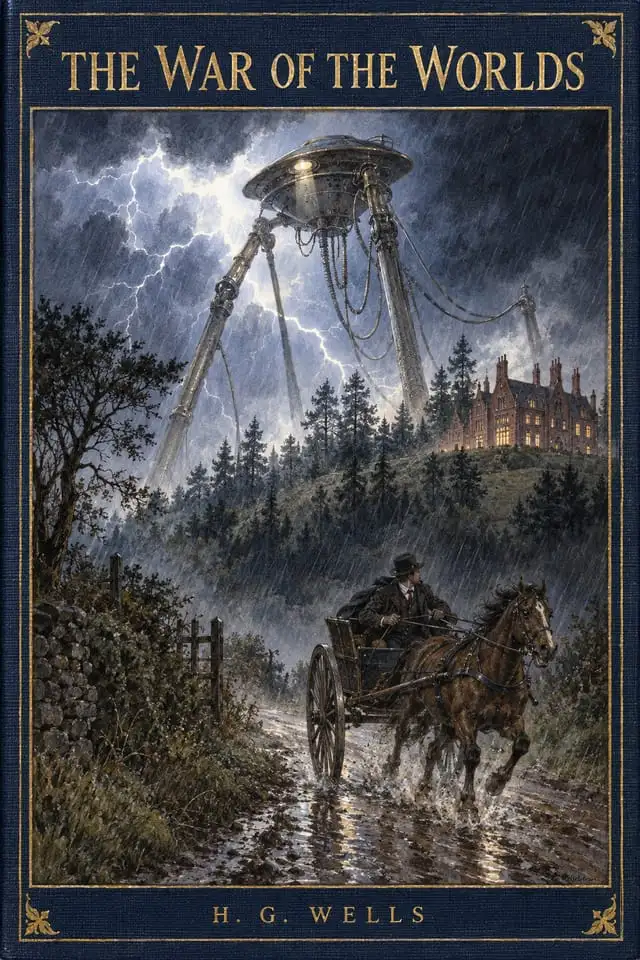
The War of the Worlds Study Guide
GCSE and A-level set textOCR GCSEEduqas GCSEEdexcel A-level
Notes cover the whole book.
Characters
- The narratorReunited with his wife, he remains troubled by nightmares, recurring memories of the destruction and uncertainty about humanity's future.First appears: Chapter 1: The Eve of the War
- The MartiansThe narrator qualifies his explanation of their deaths as probable rather than proved and warns that others may attempt another invasion.First appears: Chapter 1: The Eve of the War
- OgilvyOne of the men killed while approaching the Martians with a white flag in an attempt to communicate.First appears: Chapter 1: The Eve of the War
- The narrator's wifeShe arrives at their home with the narrator's cousin and is reunited with her husband, who catches her in his arms as she sways.First appears: Chapter 1: The Eve of the War
- HendersonThe dead journalist whose newspaper doubts his report and abandons a special edition when he cannot answer its request for confirmation.First appears: Chapter 2: The Falling Star
- StentOne of the men killed in the attempt to communicate with the Martians under a white flag.First appears: Chapter 3: On Horsell Common
- Lord HiltonThe lord of the manor whom Ogilvy asks the narrator to approach for help keeping spectators away from the excavation.First appears: Chapter 3: On Horsell Common
- The shopmanA young man the narrator thinks is a Woking shop assistant, pushed into the pit by the crowd, who struggles to escape before disappearing from sight.First appears: Chapter 4: The Cylinder Opens
- The landlord of the Spotted DogThe narrator finds him dead beside a fence on Maybury Hill, apparently with a broken neck.First appears: Chapter 9: The Fighting Begins
- The artillerymanHe proposes an underground society that excludes the weak and preserves science, but his limited digging and fondness for drink and games undermine the narrator's belief in him.First appears: Chapter 11: At the Window
- The curateHis loss of reason and loud confession of failing the poor alarm the narrator, who strikes him down before a Martian's machine drags him towards the opening.First appears: Chapter 13: How I Fell in with the Curate
- The narrator's brotherHe secures passage towards Ostend for himself and the two women, then watches the Thunder Child fight the Martians as their steamer escapes.First appears: Chapter 14: In London
- Mrs ElphinstoneFrightened of leaving England and still wanting to return to Stanmore and George, she is persuaded to board the steamer with her companions.First appears: Chapter 16: The Exodus from London
- Miss ElphinstoneShe shares the night watches with the narrator's brother, tries to reassure her sister-in-law and joins them aboard the steamer.First appears: Chapter 16: The Exodus from London
- Lord GarrickIdentified as the Chief Justice, he is carried from a carriage to the roadside, dying and desperately thirsty while a companion searches for water.First appears: Chapter 16: The Exodus from London
- The narrator's rescuersUnnamed people who find the narrator wandering in distress, shelter him despite their own difficulties and try to comfort him as he recovers.First appears: Chapter 9: Wreckage

Themes
- Human pride and complacency
- Science, knowledge and uncertainty
- Invasion, empire and cruelty
- Fear, survival and human vulnerability
- Communication, news and disbelief
- Ordinary life and social order
- Religion, suffering and belief
Context
- Telegraph
- A telegraph carried messages electrically between stations, allowing Henderson to send news to London without travelling there. Chapter 2: The Falling Star
- White flag
- A white flag conventionally signals a wish to negotiate or approach without fighting. The deputation relies on a human signal to communicate with unfamiliar beings. Chapter 5: The Heat-Ray
- Dog cart
- A small horse-drawn carriage, which the narrator hires to carry his household away from danger. Chapter 9: The Fighting Begins
- Ironclad
- A warship protected by iron armour, used here as an example of powerful human machinery. Chapter 11: At the Window
- Heliograph
- A signalling instrument that sends messages by reflecting flashes of sunlight with a mirror. Chapter 12: What I Saw of the Destruction of Weybridge and Shepperton
- Curate
- A clergyman, usually assisting the priest responsible for a parish. Chapter 13: How I Fell in with the Curate
- Sodom and Gomorrah
- Cities destroyed by divine judgement in the biblical Book of Genesis, which the curate invokes to interpret the destruction around him. Chapter 13: How I Fell in with the Curate
- Music hall
- A place of popular entertainment offering songs, comedy and other short acts. Chapter 14: In London
- Battery
- A group of artillery guns operated together, with their crews and equipment. Chapter 15: What Had Happened in Surrey
- Ram
- A ram warship has a reinforced bow intended to damage an enemy vessel by striking it. The Thunder Child uses its forward motion as a weapon against the Martian machines. Chapter 17: The Thunder Child
- Pompeii
- An ancient Roman town buried by a volcanic eruption. The narrator recalls it when he sees bodies, carts and luggage covered with black powder. Chapter 1: Under Foot
- Dropping aitches
- Leaving the initial h sound out of words was treated as a sign of lower social status. The artilleryman dismisses such distinctions of manners and speech as useless under Martian rule. Chapter 7: The Man on Putney Hill
Chapter summaries
Chapter 1: The Eve of the War
Looking back six years, the narrator contrasts human confidence with the scrutiny of more powerful minds on Mars. He presents the cooling of their planet as the pressure driving the Martians to seek Earth's resources. His comparison with European violence against the Tasmanians challenges any easy claim that humans are more merciful than their invaders. Astronomers observe flashes on Mars, and the narrator watches one with Ogilvy, who proposes natural explanations. The narrator's later understanding exposes the limits of what either man knew while observing. Cycling, writing and a peaceful walk with his wife show ordinary concerns continuing while missiles approach unnoticed.
Chapter 2: The Falling Star
The first arrival is widely mistaken for an ordinary falling star, and the narrator misses it despite sitting beside an uncovered window. Ogilvy finds the object after dawn and initially explains its internal noises as the effect of cooling. The rotating lid forces him to recognise an artificial, hollow cylinder and connect it with the flashes on Mars. His immediate concern for trapped people leads him to attempt help and then run into Woking. His disorderly appearance makes strangers dismiss him until Henderson listens, visits the cylinder and telegraphs London. The report circulating by breakfast turns an uncertain discovery into the definite story of dead men from Mars.
Chapter 3: On Horsell Common
At first the cylinder attracts a small crowd, including boys who throw stones until the narrator stops them. Its outward resemblance to familiar objects makes its significance hard for spectators to grasp. The narrator believes it came from Mars but doubts that living beings are inside, imagining manuscripts and problems of translation instead. Newspaper headlines and messages to observatories bring much greater attention by the afternoon. Stent directs the excavation, but the workmen cannot get a grip on the lid to unscrew it. Asked to seek help controlling the crowd, the narrator also welcomes the chance to become a privileged spectator. He cannot find Lord Hilton at home and goes to the station to meet him.
Chapter 4: The Cylinder Opens
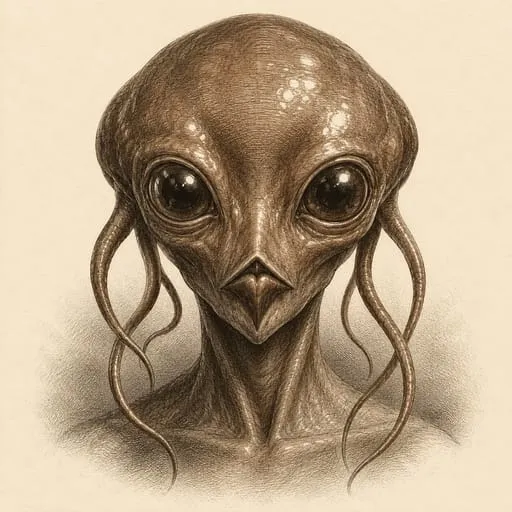
At sunset the crowd presses around the opening cylinder, pushing a young shopman into the pit and nearly forcing the narrator onto the screw. Expectation of a broadly human occupant gives way to fragments of unfamiliar movement, eyes and tentacles. The narrator's detailed description combines the Martian's bodily weakness with his own disgust and fear. As spectators run or take cover, he remains unable to look away even while retreating. From the trees he sees the shopman struggle and vanish, but his impulse to help is defeated by terror. The deserted refreshment barrow and vehicles show an ordinary outing abruptly abandoned.
Chapter 5: The Heat-Ray
Fear and curiosity keep the narrator watching the pit even as he hesitates to approach it. The apparent stillness gradually encourages spectators to move closer again. A deputation advances under a white flag to demonstrate human intelligence and attempt communication. After green smoke and a humming noise, an unseen beam burns the men and sweeps across the surrounding trees and buildings. The narrator initially struggles to understand that he is watching people die, and survives because the beam does not complete its circle. His shock gives way to a panic that makes him run away weeping.
Chapter 6: The Heat-Ray in the Chobham Road
The narrator offers a possible explanation of the Heat-Ray while admitting that its precise workings remain unproved. Its power to ignite materials and melt metal establishes the force behind the nearly forty deaths around the pit. He reconstructs the roadside crowd's experience and imagines young people using the spectacle as a chance to stroll and flirt. Stent and Ogilvy had requested soldiers to protect the Martians, showing how differently they understood the likely direction of violence. A mound shields the roadside crowd from the beam, but burning trees and damaged buildings provoke panic. The rush into a narrow road becomes another source of deadly harm as people are crushed and trampled.
Chapter 7: How I Reached Home
After collapsing beside the road, the narrator abruptly recovers his everyday sense of himself and finds the attack almost impossible to believe. Familiar trains, lights and neighbours clash with the violence he has just witnessed. The people at a gate laugh when he mentions the Martians and again when he struggles to describe what he has seen. At home his wife believes him, and her fear leads him to offer reassurance based on the creatures' slow movements and Earth's stronger gravity. Looking back, he explains that this argument ignored both the atmosphere's effects and the Martians' ability to use machinery. Food, wine and domestic comfort restore his confidence, while his comparison with a dodo exposes how little that confidence proves.
Chapter 8: Friday Night
The narrator widens his account from his own household to the district and London, where most routines remain undisturbed. Henderson's newspaper dismisses his telegram as a false report and decides against a special edition when he cannot confirm it because he has been killed. Trains continue running, and passengers interpret distant signs of destruction as a heath fire. Nearer the pit, houses burn, bodies remain on the common and some people who approach the Martians never return. The image of Earth pierced by a poisoned dart presents violence as a local wound whose effects are not yet widely felt. While the Martians work on machines, soldiers establish a cordon and further forces set out from Aldershot. The fall of a second cylinder closes the account of the night with another arrival.
Chapter 9: The Fighting Begins
Saturday begins with familiar deliveries, gardening and confidence that the troops can contain the Martians. Soldiers question the narrator about creatures they have not seen, while newspapers offer little reliable information. Military preparations revive his boyhood dreams of battle, and he imagines the invaders helpless in their pit. That confidence collapses when firing is followed by the destruction of nearby buildings and damage to his chimney. He hires the Spotted Dog landlord's horse and cart, promising to return them by midnight, and gathers his wife, servant and valuables. His admission that the landlord's safety seemed less urgent than his own exposes the limits of his concern for others under pressure.
Chapter 10: In the Storm
The journey to Leatherhead passes through peaceful countryside, but the narrator's wife remains fearful. His promise to return the cart gives him a reason to leave, while his desire to witness the invaders' defeat makes him welcome the journey. Near midnight a third falling star appears and a violent thunderstorm breaks over the road. Lightning reveals a huge tripod in fragments before a second machine approaches and he overturns the cart while trying to turn away. The horse dies, and the shocked narrator crawls through cover before making his way home rather than returning to his wife. Finding the landlord dead replaces the ordinary transaction over the cart with a direct encounter with death.
Chapter 11: At the Window
After changing his wet clothes, the narrator watches fires, a wrecked train and huge moving shapes from his study. The destruction of his familiar surroundings makes him question the relationship between the machines and the Martians he first saw. Imagining how human machinery might appear to another animal begins to reverse his usual sense of human superiority. An artilleryman enters the garden, and the narrator brings him inside, where the soldier breaks down before giving a fragmented account of the fighting. His story describes military defeat, the burning of Woking and a machine's brutal attack on a fleeing man. Telling his story calms him, and the two men share food without lighting a lamp for fear of attracting attention. Dawn reveals the widespread destruction more clearly than the night's flames had done.
Chapter 12: What I Saw of the Destruction of Weybridge and Shepperton
Determined to reach his wife and take her abroad, the narrator accepts the artilleryman's advice to carry food and avoid the direct route to Leatherhead. Their journey brings them past military preparations and civilians whose attachment to possessions delays their escape. At Weybridge and the river crossing, confusion grows while many people still assume the army will defeat the invaders. When five machines approach, the narrator enters the river to escape the Heat-Ray. Shellfire kills the Martian inside one hood, but its machine continues moving without guidance before smashing down the tower of Shepperton Church and falling into the water. His excitement briefly overrides his sense of danger as the wreck heats the river, and the remaining machines' Heat-Rays make the water still hotter. He reaches the shore helpless and survives as the four machines carry away their companion's wreckage.
Chapter 13: How I Fell in with the Curate
The narrator's wider account describes the Martians regrouping and the authorities preparing guns and signals around the approaches to London. His own escape is painfully slow as he paddles an abandoned boat downstream without oars. Fever and faintness eventually force him ashore, where he suffers from thirst and feels an anger towards his wife that he cannot explain. A curate nearby repeatedly asks why the disaster has been permitted and turns to biblical images of destruction. The narrator answers his despair with practical questions and the evidence that a Martian has been killed. Their exchange challenges the assumption that religious work should protect a community from suffering, while the narrator interprets a heliograph's flicker as evidence of continuing human effort. Distant firing interrupts them before he proposes a route northward.
Chapter 14: In London
The account shifts to the narrator's younger brother, a medical student in London who initially hopes to visit Woking and see the Martians before they are killed. Newspaper reports misrepresent their weapons and movements, while broken railway and telegraph connections leave him unable to discover what has happened to the narrator. Sunday routines continue around him, showing how little alarming news has disturbed the city's confidence in its own safety. Refugees and a fresh report of the fighting gradually make the scale of the danger clearer, though official assurances still stress military strength and the invaders' small numbers. Before dawn on Monday, police knock at doors and bells ring as news arrives that the defences have failed. An official dispatch declares that only immediate flight offers safety from the poisonous Black Smoke, and the brother gathers his money to leave. A newspaper seller charging a shilling while running with the crowd shows trade continuing within the panic.
Chapter 15: What Had Happened in Surrey
The narrator reconstructs the renewed offensive from other accounts alongside his own experience with the curate. Gunners at St George's Hill apparently damage a tripod's leg, but its companions destroy the battery and the damaged machine is repaired. The Martians then spread out with tubes that fire canisters towards possible hiding places for human guns. Although he leads the curate into a ditch for safety, excitement draws the narrator up into the hedge, where he cannot explain the Martians' shots or the silence of the human guns. His later explanation identifies a lethal, heavy vapour that flows into low ground, while admitting that its substance remains largely unknown. From a deserted house at Upper Halliford, the two men see the Martians use steam to clear the vapour, and the narrator describes the systematic defeat of the defences. The closing account explicitly imagines the fate of batteries with no survivors, marking the limits of eyewitness evidence before describing the government's warning to London.
Chapter 16: The Exodus from London
The mass flight overwhelms police and railway organisation, and people turn violently on one another while trying to escape. After failing to board a train, the narrator's brother joins the looting of a cycle shop and rides out of London before the damaged wheel breaks near Edgware. Continuing on foot, he fights men attacking two women in a pony-chaise, and Miss Elphinstone returns with a revolver to help him escape his pursuers. He joins her and her sister-in-law, Mrs Elphinstone, and proposes travelling across Essex towards Harwich because the trains offer little hope. Near Barnet they encounter a crowded road where differences of dress and occupation coexist with shared fear, thirst and exhaustion. His attempts to help others interrupt his own flight, but he cannot save a man trampled while collecting spilled gold. With Miss Elphinstone's help he gets the chaise into the traffic and eventually eastward, though their halt near East Barnet brings hunger, sleeplessness and the unsettling sight of people fleeing in the opposite direction.
Chapter 17: The Thunder Child
The narrator widens the view of London's flight before returning to his brother's journey through a countryside running short of food. The Martians destroy transport, communications and weapons, apparently seeking to break resistance rather than kill everyone immediately. At Chelmsford a local supply committee seizes the party's pony for food, and the three continue towards the crowded coast. Despite Mrs Elphinstone's fear of leaving England, they board a steamer where passage and food are expensive. The Thunder Child charges three approaching Martian machines and brings down two, its burning wreckage crushing the second while the refugees cheer and escape. Smoke conceals the remaining combat, and a later glimpse of a broad flying shape leaves the passengers with another unexplained sight.
Chapter 1: Under Foot
The narrative returns to the narrator and curate, confined at Halliford while the Black Smoke prevents escape. Anxiety about his wife makes the narrator restless, and the curate's despair drives him to seek solitude. Once a Martian clears the smoke with steam, they leave and pass through areas of destruction beside places that remain green or inhabited. Near Kew the narrator sees people being picked up rather than burned, forcing him to consider a purpose beyond killing. They find food in a house at Sheen, but the fifth cylinder's impact ruins their shelter and leaves them trapped beside it. The curate tends the injured narrator, and dawn gradually supplies enough evidence for the narrator to understand what has happened.
Chapter 2: What We Saw from the Ruined House
A view through the broken wall reveals that the kitchen and scullery have survived by chance at the edge of the Martian pit. The narrator first mistakes a handling-machine for a living creature because its movements are so flexible and coordinated. His account of the Martians' anatomy draws on both observation and knowledge gained afterwards, including their feeding by injections of living blood. He compares that feeding with human meat-eating, challenging the assumption that human disgust proves human innocence. Descriptions of red Martian plants and machines worn like bodies extend the account of an unfamiliar form of life, while his belief in Martian telepathy remains an interpretation of their silent cooperation. The curate interrupts his watching to claim the narrow slit, and the chapter returns from extended explanation to the machinery working outside their shelter.
Chapter 3: The Days of Imprisonment
Danger and isolation turn the two men's differences into physical struggles over food and the viewing slit. The narrator describes the curate with contempt but also admits using threats and blows, asking readers to judge his brutality in the light of extreme suffering. Outside, the handling-machines produce aluminium from clay, their dexterity making their living operators appear almost lifeless by comparison. A well-dressed captive is lifted from a fighting-machine's cage and disappears behind a mound before shrieking and Martian hooting begin. The narrator later witnesses the Martians feeding on a boy and tries to tunnel out, but falling earth forces him to stop. He considers waiting for the pit to be abandoned his best chance, while sounds like distant gunfire interrupt a quiet night without revealing their source.
Chapter 4: The Death of the Curate
A struggle over wine leads the narrator to divide the remaining food into rations and guard it against the curate. Their conflict grows more violent, while the narrator recognises his companion's loss of reason and admits uncertainty about his own mental state. The curate condemns his failure to speak against poverty and oppression, then raises his voice despite the danger of being heard. When he moves into the kitchen proclaiming his duty to bear witness, the narrator strikes him with the blunt end of a meat chopper. A handling-machine's tentacle reaches through the gap and drags the motionless curate towards it, while the narrator fears the mark of his blow will reveal that someone else is present. Hidden among coal and firewood, he prays and bites his hand to prevent a scream when the searching tentacle touches his boot.
Chapter 5: The Stillness
The empty pantry leaves the narrator without food and brings him to despair. Thirst eventually makes him risk using the noisy pump, and the absence of a searching tentacle provides a first sign that conditions outside may have changed. Hunger and thoughts of the curate's death disturb his sleep, while red weed growing across the opening colours the shelter's light like blood. When a dog appears, he considers killing it both for food and to prevent it attracting Martians, showing how survival has narrowed his choices. Continued silence finally encourages him to look out and discover an abandoned pit containing powder, aluminium bars and the skeletons of victims. He climbs into a ruined Sheen where red plants occupy the houses and ground, and the pleasure of fresh air offers relief without any visible human company.
Chapter 6: The Work of Fifteen Days
Emerging from the pit, the narrator finds his familiar surroundings so changed that they resemble another planet. Comparing himself to a rabbit displaced by building work, he recognises the insecurity of animals under human rule. Hunger soon takes priority over reflection, and he struggles through gardens and floodwater to find scraps of food. He explains that red weed has choked the rivers and caused flooding, then describes its later destruction by a disease believed to be bacterial. This account places a limit on the invasive plant's apparent power without restoring human control over the landscape. Near Putney, untouched houses stand beside ruins while skeletons and silence lead him to fear that he is one of the last survivors.
Chapter 7: The Man on Putney Hill
Food and a bed restore the narrator's ability to think clearly, bringing the curate's killing and his wife's fate back into focus. He denies remorse for the killing, presents the blow as the result of circumstances and asks readers to judge his account. Fear of what his wife may have suffered leads him to pray that she has died painlessly, while his own vulnerability prompts pity for animals ruled by humans. He then meets the artilleryman, who predicts that the Martians will breed captive people for food and proposes an independent society beneath London. The scheme aims to preserve scientific knowledge and eventually capture Martian machines, but it also demands obedience and the exclusion and death of those he considers weak or useless. The narrator initially accepts the soldier's authority, then questions his small tunnel, poor planning and readiness to replace work with food, drink and games. After joining in these distractions, the narrator feels ashamed of neglecting his wife and fellow humans and decides to seek information in London.
Chapter 8: Dead London
Deserted streets, dead bodies and abandoned valuables make London a place where ordinary measures of wealth and security have lost their force. A repeated Martian cry draws the narrator northward and seems to give the empty city a voice. When it stops, the silence terrifies him even more, and he flees into hiding until his courage returns before dawn. His desperate decision to approach a machine on Primrose Hill and die changes to exultation when birds feeding on its occupant reveal that the Martian is dead. He finds the great camp full of dead invaders, and his retrospective explanation attributes their defeat to bacteria rather than human weapons. At the moment of discovery, however, he does not understand the cause and briefly interprets the deaths as divine intervention. Looking across London, he imagines people returning and rebuilding, but the thought of his own lost domestic happiness interrupts his gratitude.
Chapter 9: Wreckage
The narrator's clear memory breaks off after the discovery on Primrose Hill, and he reconstructs the next three days from what others later tell him. News of the Martian defeat travels by telegraph and cyclists, bringing celebrations, returning trains and food from overseas. Strangers find him wandering in distress and shelter him despite their own difficulties, showing care surviving the collapse of ordinary life. Their report of Leatherhead's destruction deepens his belief that his wife is dead, but he eventually leaves them to revisit his home. Returning crowds, free trains and improvised railway repairs show recovery taking place amid visible hardship and wreckage. At home he finds the abandoned paper in which he had begun predicting the future development of morality, an awkward reminder of his former confidence in civilisation. His desolation is interrupted when his wife and cousin appear outside, and he catches her in his arms.
Chapter 10: The Epilogue
The narrator acknowledges his limited scientific knowledge and qualifies the bacterial explanation he has used as probable rather than proved. Unsolved questions about the Black Smoke and Heat-Ray further limit humanity's understanding of Martian power. He urges a watch on Mars and preparations to destroy another cylinder before its occupants can attack. Reports suggesting a Martian landing on Venus lead him to consider humanity's own possible movement beyond Earth, but he also fears that the invaders may yet inherit the future. He sees possible benefits in new scientific knowledge, greater concern for humanity's common welfare and the loss of complacency about Earth's safety. These broad reflections give way to intrusive memories and nightmares that make recovered streets and crowds seem unreal. The final thought of holding his wife's hand joins their reunion to the knowledge that each had believed the other dead.
Key quotes
With infinite complacency men went to and fro over this globe about their little affairs, serene in their assurance of their empire over matter.
The grand claim of an 'empire' clashes with the smallness of 'little affairs'. The narrator makes human confidence look excessive beside the larger view he now possesses.
Human pride and complacencyOrdinary life and social order
Are we such apostles of mercy as to complain if the Martians warred in the same spirit?
The rhetorical question turns judgement back on humanity after the account of European extermination. Invasion becomes a way to examine human cruelty as well as Martian aggression.
Invasion, empire and cruelty
Something within the cylinder was unscrewing the top!
The active verb replaces the earlier explanation of cooling metal with purposeful action. The exclamation marks the sudden change in Ogilvy's understanding.
Science, knowledge and uncertainty
That was the form the story took.
The narrator separates the circulating report from the evidence. People have supplied a human identity and a death for occupants they have not seen.
Communication, news and disbeliefHuman pride and complacency
“Extraterrestrial” had no meaning for most of the onlookers.
The unfamiliar word exposes a gap between seeing an object and understanding it. The narrator links this gap to the spectators' limited scientific education.
Science, knowledge and uncertaintyCommunication, news and disbelief
I was very glad to do as he asked, and so become one of the privileged spectators within the contemplated enclosure.
The narrator admits that his helpfulness includes a wish for special access. Even an educated observer treats the discovery partly as a spectacle.
Human pride and complacencyOrdinary life and social order
I think everyone expected to see a man emerge
The narrator identifies the human likeness he and others have assumed. The creature's emergence breaks that expectation before anyone can explain what they see.
Human pride and complacencyScience, knowledge and uncertainty
I had a momentary impulse to go back and help him that my fears overruled.
The narrator admits a failure of courage rather than presenting himself as a hero. The danger exposes a conflict between helping another person and protecting himself.
Fear, survival and human vulnerability
I was a battleground of fear and curiosity.
The metaphor places conflict inside the observer before the attack begins. Curiosity keeps him close to the same beings that make him want to escape.
Fear, survival and human vulnerabilityScience, knowledge and uncertainty
Then, by the light of their own destruction, I saw them staggering and falling, and their supporters turning to run.
The fire that kills the men also makes their deaths visible. The narrator records the collapse of a public attempt at contact into individual flight.
Invasion, empire and crueltyCommunication, news and disbeliefFear, survival and human vulnerability
But no one has absolutely proved these details.
The narrator qualifies his technical explanation rather than claiming full knowledge. Scientific language is presented alongside a clear limit on certainty.
Science, knowledge and uncertainty
They must have bolted as blindly as a flock of sheep.
The comparison presents the crowd's flight as a loss of judgement under pressure. 'Must have' also signals that the narrator is reconstructing their behaviour rather than describing what he saw.
Fear, survival and human vulnerabilityOrdinary life and social order
My terror had fallen from me like a garment.
The simile makes a profound emotional change seem sudden and effortless. His recovered everyday identity does not depend on any evidence that the danger has ended.
Fear, survival and human vulnerabilityOrdinary life and social order
With wine and food, the confidence of my own table, and the necessity of reassuring my wife, I grew by insensible degrees courageous and secure.
The narrator traces his confidence to comfort and emotional need. His willingness to believe himself safe grows out of his surroundings as well as his scientific argument.
Human pride and complacencyOrdinary life and social orderScience, knowledge and uncertainty
as though no planet Mars existed in the sky.
The comparison stresses how little the arrival has changed ordinary habits. Some people have heard of the cylinder, but familiar routines continue despite the violence nearby.
Ordinary life and social orderHuman pride and complacency
In the centre, sticking into the skin of our old planet Earth like a poisoned dart, was this cylinder.
The simile imagines Earth as a vulnerable body and the cylinder as an embedded weapon. It connects a small physical point of impact with the threat to the larger world.
Invasion, empire and crueltyFear, survival and human vulnerability
My imagination became belligerent, and defeated the invaders in a dozen striking ways; something of my schoolboy dreams of battle and heroism came back.
The victories occur in his imagination before he has seen the army fight. His reference to schoolboy dreams exposes the childish wish behind his confidence.
Human pride and complacencyInvasion, empire and cruelty
At the time it did not seem to me nearly so urgent that the landlord should leave his.
The narrator recognises that he gave his own escape greater importance than the landlord's. The admission makes self-preservation morally uneasy rather than simply heroic.
Fear, survival and human vulnerability
I can best express my state of mind by saying that I wanted to be in at the death.
The narrator admits that his return is driven by a wish to witness destruction as well as by his promise. His excitement makes his later helplessness more troubling.
Human pride and complacencyInvasion, empire and cruelty
So much I saw then, all vaguely for the flickering of the lightning, in blinding highlights and dense black shadows.
The light both reveals and obscures the machines. The narrator limits his account to uncertain glimpses, making the reader share his difficulty in understanding what moves towards him.
Science, knowledge and uncertaintyFear, survival and human vulnerability
I began to compare the things to human machines, to ask myself for the first time in my life how an ironclad or a steam engine would seem to an intelligent lower animal.
The comparison makes human beings experience the bewilderment their own technology might cause another creature. Understanding begins when the narrator imagines a position beneath the most powerful species.
Science, knowledge and uncertaintyHuman pride and complacencyInvasion, empire and cruelty
He grew calmer telling me and trying to make me see the things he had seen.
Describing the experience helps the soldier recover some composure. Communication offers human support as well as information about the battle.
Communication, news and disbeliefFear, survival and human vulnerability
It’s bows and arrows against the lightning, anyhow
The artilleryman's comparison makes human weapons seem hopelessly weak beside the Heat-Ray. The successful shell strike later qualifies his despair without removing the machines' greater destructive power.
Science, knowledge and uncertaintyFear, survival and human vulnerabilityInvasion, empire and cruelty
The living intelligence, the Martian within the hood, was slain and splashed to the four winds of heaven, and the Thing was now but a mere intricate device of metal whirling to destruction.
The distinction between the dead operator and the moving machine answers the narrator's earlier questions about intelligence and machinery. Killing the operator does not immediately stop the destruction.
Science, knowledge and uncertaintyInvasion, empire and cruelty
like little frogs hurrying through grass from the advance of a man
The scale of the comparison reduces the fleeing people to small animals disturbed by a human. It makes their vulnerability visible through a familiar imbalance of power.
Human pride and complacencyFear, survival and human vulnerabilityInvasion, empire and cruelty
What good is religion if it collapses under calamity?
The narrator tests faith by whether it helps someone endure suffering. His question attacks the curate's despair and expectation of protection rather than simply dismissing religious belief.
Religion, suffering and beliefFear, survival and human vulnerability
the sign of human help and effort in the sky.
The heliograph gives the narrator concrete evidence of organised human resistance. His reading of the flicker answers the curate's interpretation of the disaster through biblical prophecy.
Communication, news and disbeliefReligion, suffering and beliefFear, survival and human vulnerability
The habit of personal security, moreover, is so deeply fixed in the Londoner’s mind
Safety has become a mental habit rather than a judgement tested against the news. This helps explain why accounts of military defeat do not immediately produce fear for oneself.
Human pride and complacencyCommunication, news and disbeliefOrdinary life and social order
There is no safety from the Black Smoke but in instant flight.
The official dispatch abandons earlier reassurance and leaves the public a single urgent course of action. Authority now tells people to flee rather than trust the defences.
Communication, news and disbeliefFear, survival and human vulnerabilityInvasion, empire and cruelty
a grotesque mingling of profit and panic.
The newspaper seller continues making money while escaping the same danger as his customers. The narrator finds something disturbing in the survival of commercial habits amid collective fear.
Ordinary life and social orderFear, survival and human vulnerabilityCommunication, news and disbelief
as methodically as men might smoke out a wasps’ nest
The comparison makes the destruction of human defences resemble the routine clearing of an insect nest. It places people in the powerless position of creatures that humans treat as pests.
Invasion, empire and crueltyHuman pride and complacencyFear, survival and human vulnerability
we are still entirely ignorant of the nature of this substance.
Detailed observations of the vapour do not give the narrator a full explanation of it. Even his later account marks a limit to human scientific understanding.
Science, knowledge and uncertainty
the disintegrating organism of government was, with a last expiring effort, rousing the population of London to the necessity of flight.
Government becomes a dying body whose remaining effort is a warning. The image connects the destruction of individual lives with the collapse of organised protection.
Ordinary life and social orderCommunication, news and disbeliefFear, survival and human vulnerability
that swift liquefaction of the social body.
Society is imagined as a solid body turning into liquid. The image links the failure of institutions with the streams and torrents used to describe the fleeing crowd.
Ordinary life and social orderFear, survival and human vulnerability
They were all thirsty, weary, and footsore.
The short sentence gathers people of different occupations and social positions into one physical condition. Fear and bodily need become shared experiences across the crowd.
Fear, survival and human vulnerabilityOrdinary life and social order
He was a lucky man to have friends.
Two friends tend the injured man while the crowd keeps moving. The narrator presents personal loyalty as a form of protection amid the wider collapse of social order.
Fear, survival and human vulnerabilityOrdinary life and social order
They were hamstringing mankind.
The short sentence gives the destruction of railways and telegraphs a bodily image of disabling injury. The invasion attacks humanity's capacity to act together as well as individual lives.
Invasion, empire and crueltyOrdinary life and social orderCommunication, news and disbelief
She was alive still; the steering gear, it seems, was intact and her engines working.
Calling the burning ship 'alive' turns its continued movement into an act of endurance. The explanation of its working machinery keeps that heroic impression grounded in physical detail.
Fear, survival and human vulnerabilityScience, knowledge and uncertaintyInvasion, empire and cruelty
What was needed now was not bravery, but circumspection.
Thinking of the cousin sheltering his wife, the narrator values caution above courage. His later admission that leaving the shed was foolhardy shows how difficult it is to follow his own principle.
Fear, survival and human vulnerabilityScience, knowledge and uncertainty
It was the first time I realised that the Martians might have any other purpose than destruction with defeated humanity.
Capturing people changes the narrator's understanding of the invasion without yet explaining its purpose. The limited observation creates uncertainty rather than a complete answer.
Invasion, empire and crueltyScience, knowledge and uncertaintyFear, survival and human vulnerability
The bare idea of this is no doubt horribly repulsive to us, but at the same time I think that we should remember how repulsive our carnivorous habits would seem to an intelligent rabbit.
The imagined rabbit reverses the position from which humans judge the Martians. Being treated as food exposes the cruelty that a human eater may overlook in ordinary habits.
Human pride and complacencyInvasion, empire and crueltyOrdinary life and social order
They have become practically mere brains, wearing different bodies according to their needs
The metaphor makes the machines interchangeable extensions of the Martians' bodies. Their physical weakness and technical power can therefore exist together.
Science, knowledge and uncertaintyHuman pride and complacency
we could yet struggle bitterly for that horrible privilege of sight.
The combination of 'horrible' and 'privilege' captures the attraction of watching what terrifies them. Their struggle to see becomes another danger within the shelter.
Fear, survival and human vulnerabilityScience, knowledge and uncertainty
But those who have been under the shadow, who have gone down at last to elemental things, will have a wider charity.
The narrator directly asks for sympathy from readers who understand extreme suffering. His appeal makes the account a defence of his own conduct as well as a description of the curate's failures.
Fear, survival and human vulnerabilityOrdinary life and social order
three days before, he must have been walking the world, a man of considerable consequence.
The narrator imagines the captive's former importance from his appearance. That imagined social standing gives him no protection once he is held by the Martians.
Invasion, empire and crueltyOrdinary life and social orderHuman pride and complacency
There was poverty, sorrow; the poor were trodden in the dust, and I held my peace.
The curate's confession gives his religious distress a specific moral focus. He now condemns the silence about human suffering that marked his earlier ministry.
Religion, suffering and beliefOrdinary life and social order
With one last touch of humanity I turned the blade back and struck him with the butt.
The narrator calls his choice of the blunt end humane even while admitting a violent attack. His wording asks the reader to weigh a remaining restraint against the harm he does.
Fear, survival and human vulnerability
I whispered passionate prayers for safety.
The narrator turns to prayer while hiding from the searching tentacle. His fear and need for help complicate his earlier impatience with the curate's despair.
Religion, suffering and beliefFear, survival and human vulnerability
I thought if I could induce him to come into the place quietly I should be able, perhaps, to kill and eat him;
The narrator treats a visiting dog as a possible source of food. The admission shows hunger changing his response to a familiar animal.
Fear, survival and human vulnerabilityOrdinary life and social order
The red weed grew tumultuously in their roofless rooms.
The energetic growth occupies spaces that once belonged to human households. The sentence makes invasion visible in the altered landscape as well as in military destruction.
Invasion, empire and crueltyOrdinary life and social order
And oh! the sweetness of the air!
The brief exclamations interrupt the survey of wrecked houses with bodily relief. Fresh air has become a source of intense pleasure after confinement.
Fear, survival and human vulnerability
I was no longer a master, but an animal among the animals, under the Martian heel.
The loss of mastery places the narrator within the animal world he once regarded from above. The image of the Martian heel makes that new position one of subjection as well as danger.
Human pride and complacencyInvasion, empire and crueltyFear, survival and human vulnerability
the waters that had stimulated their early growth carried their last vestiges out to sea.
The same water that enabled the weed to spread removes its remains. The reversal shows how quickly apparently overwhelming growth can disappear through natural processes.
Science, knowledge and uncertaintyInvasion, empire and cruelty
But I set it down, and the reader must form his judgment as he will.
The narrator claims honesty by recording conduct that had no witnesses. His invitation to judge follows a defence of the killing, so disclosure and self-justification sit together.
Communication, news and disbeliefFear, survival and human vulnerability
Life is real again, and the useless and cumbersome and mischievous have to die.
The artilleryman turns his judgement of other people's usefulness into a claim that their deaths are necessary. His language exposes the cruelty within his promise to preserve humanity.
Fear, survival and human vulnerabilityInvasion, empire and crueltyOrdinary life and social order
I had my first inkling of the gulf between his dreams and his powers.
The small tunnel provides a practical measure of the soldier's grand claims. The metaphor of a gulf marks the narrator's first movement away from unquestioning admiration.
Human pride and complacencyFear, survival and human vulnerability
The silence came like a thunderclap.
The simile gives the absence of sound the force of a sudden violent noise. Losing the Martian cry makes the narrator's solitude more frightening than hearing it had been.
Fear, survival and human vulnerabilityCommunication, news and disbelief
slain, after all man’s devices had failed, by the humblest things that God, in his wisdom, has put upon this Earth.
The contrast between failed human devices and humble organisms overturns the apparent supremacy of machinery. Religious language frames the narrator's account of a biological defeat as deliverance.
Science, knowledge and uncertaintyHuman pride and complacencyReligion, suffering and belief
To me also at that time this death was incomprehensible.
The narrator separates his later explanation from his understanding on the hill. The distinction prevents the detailed scientific account from becoming knowledge he possessed at the moment of discovery.
Science, knowledge and uncertainty
I was a lonely man and a sad one, and they bore with me.
Repeating the preceding sentence's description of himself as lonely, the narrator emphasises both his distress and the strangers' patience. Their willingness to help gives a human scale to the wider restoration of the country.
Fear, survival and human vulnerabilityOrdinary life and social order
It was a paper on the probable development of Moral Ideas with the development of the civilising process;
The subject of the abandoned paper measures the distance between the narrator's earlier intellectual confidence and his experience of disaster. The unfinished prediction that follows makes his former authority look uncertain.
Human pride and complacencyOrdinary life and social orderScience, knowledge and uncertainty
But probable as this seems, it is by no means a proven conclusion.
The narrator revises the certainty of the bacterial explanation used in his narrative. His distinction between probability and proof leaves scientific enquiry unfinished even after the immediate danger has ended.
Science, knowledge and uncertainty
It may be, on the other hand, that the destruction of the Martians is only a reprieve.
The possibility of a temporary escape interrupts the vision of human life spreading through space. Survival has not restored the earlier belief that humanity's future is secure.
Fear, survival and human vulnerabilityInvasion, empire and crueltyHuman pride and complacency
And strangest of all is it to hold my wife’s hand again, and to think that I have counted her, and that she has counted me, among the dead.
The closing sentence brings the vast speculation back to a familiar physical gesture. Reunion remains inseparable from the memory of believing one another lost.
Fear, survival and human vulnerabilityOrdinary life and social order