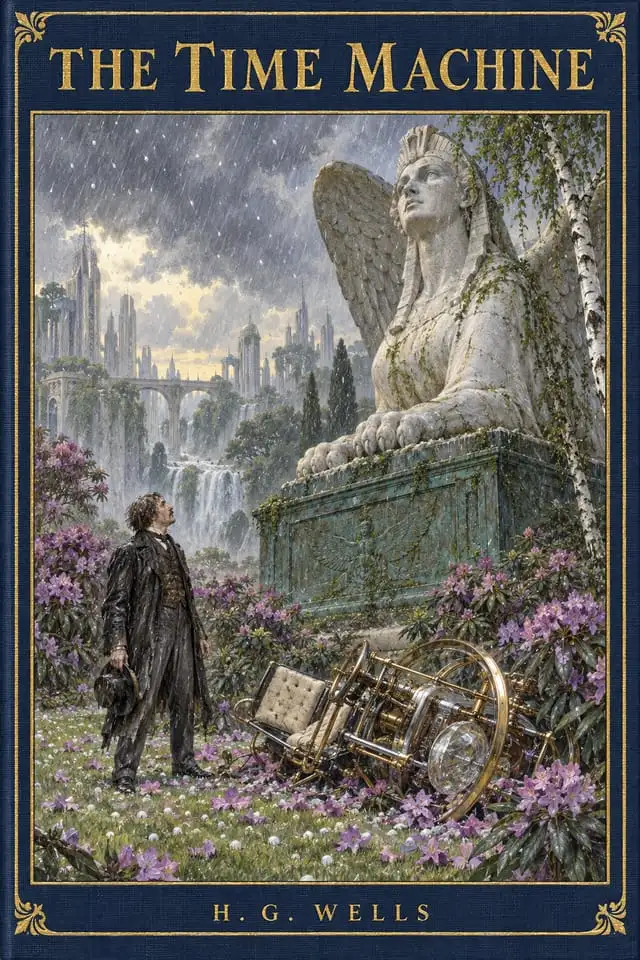
Characters
- The Time TravellerBack home, he ends his story, seems to doubt it himself until he touches the damaged machine, and the next day vanishes on it with a camera and knapsack; three years later he has not returned.First appears: Chapter 1
- The narratorHe keeps Weena's two dried white flowers, and believes we must live as though his friend's gloomy view of mankind's future were wrong.First appears: Chapter 1
- FilbyAn argumentative red-haired guest who laughs at the idea of travelling in time and says no argument will ever convince him.First appears: Chapter 1
- The PsychologistBack for the second dinner, he describes the model's vanishing as an "ingenious paradox and trick", but his face suggests he shares the narrator's view of the Time Traveller's state.First appears: Chapter 1
- The Medical ManHe examines Weena's flowers, cannot name their kind, asks to keep them, and tells the Time Traveller he is suffering from overwork.First appears: Chapter 1
- The Provincial MayorA guest who has never heard of the Fourth Dimension and struggles to follow the argument.First appears: Chapter 1
- The Very Young ManA guest who is excited by the idea of time travel and dreams of hearing Homer speak Greek or of making money in the future.First appears: Chapter 1
- The EditorHe treats the Time Traveller's account as a story, says it is a pity he is not a writer, and calls it a "gaudy lie" on the way home.First appears: Chapter 2
- The JournalistA journalist among the guests at the second dinner, described by the narrator as joyous and irreverent.First appears: Chapter 2
- The Silent ManA quiet, shy man with a beard, attending the second dinner.First appears: Chapter 2
- Mrs WatchettSeen again as the machine returns, gliding backwards up the laboratory with every motion the reverse of before.First appears: Chapter 3
- The EloiHelpless and afraid of the dark, they are, the Time Traveller decides, kept and preyed upon by the Morlocks like fatted cattle.First appears: Chapter 3
- WeenaShe faints when the Morlocks attack in the dark forest and is gone when the fire drives them off, and the Time Traveller believes she is dead.First appears: Chapter 5
- The MorlocksThey have cleaned and oiled the Time Machine, and shut the Time Traveller in with it inside the sphinx, but he escapes.First appears: Chapter 5
Themes
- Science, invention and time
- Progress and degeneration
- Class and a divided society
- Theory, evidence and doubt
- Fear and the dark
- What makes us human
Chapter summaries
Chapter 1
The book opens with an after-dinner gathering of educated guests, most of them known only by their jobs or types: the Psychologist, the Medical Man, the Provincial Mayor, the Very Young Man, the argumentative Filby and the narrator. The Time Traveller argues that any real object has length, breadth, thickness and duration, so time is a fourth dimension, and the only difference is that our minds move along it. His guests object, joke and doubt. He then makes a model machine, two years in the making, disappear under bright light, with the Psychologist's own finger on the lever. The narrator insists that no trick could have been played under those conditions. The guests still do not know what to believe, and the chapter ends on Filby's solemn wink.
Chapter 2
The narrator explains that the guests doubted the Time Traveller because he was too clever: a plain man like Filby would have been believed more easily. A week later the Medical Man has a note asking the guests to start dinner without their host. The Time Traveller's arrival is a shock: his coat is dirty and smeared with green, his hair seems greyer, his chin is cut and he limps in tattered, bloodstained socks. The new guests, the Editor and the Journalist, mock the idea of time travel, but the narrator and the Psychologist suspect that his state has to do with the machine. After eating hungrily, the Time Traveller insists on telling his story without interruption, admitting that most of it will sound like lying. The narrator explains that the story has been written down here, and that pen and ink cannot capture the speaker's white, sincere face.
Chapter 3
The Time Traveller's story begins: he finished the machine that morning and set off at ten o'clock. Time travel feels horribly unpleasant, like a helpless headlong fall, as night and day blur into grey and huge buildings rise and pass like dreams. A growing curiosity about what humanity might have become turns into dread, and in a fit of nerves and impatience he stops, overturning the machine. In the hail he sees a weatherworn white sphinx and fears that people may have become cruel, inhuman and powerful. As the sun breaks through and great buildings appear, his terror shows how alone and exposed he is, "naked in a strange world", and as he wrestles to turn the machine upright it strikes his chin, which explains the cut his guests saw. Then a slight, beautiful, frail creature about four feet high comes towards him, and at the sight of him the Time Traveller lets go of the machine.
Chapter 4
The little people are beautiful and gentle but show no fear and little interest, and when one asks whether he came from the sun in a thunderstorm, the Time Traveller is deeply disappointed. He wisely removes the levers from his machine before going with them. Their great hall is grand but broken and dusty, they eat only fruit, and they soon tire of his language lessons. He notices that there are no single houses or cottages and that men and women look and dress alike. From a hilltop at sunset he builds a theory: humanity conquered Nature, made life safe, and then, with no need for strength or cleverness, slowly declined into feebleness. The account challenges the expectation that human capacities must improve with time. The Time Traveller himself warns that this was only a half-truth.
Chapter 5
Losing the machine strips the Time Traveller of his calm: he runs, raves and shakes the sleeping little people, then recovers with daylight and reasons his way to the hollow pedestal. His own behaviour, nearly violent and then ashamed, shows how thin his civilised self-control can be. He notices puzzles his first theory cannot explain: deep wells with the thud of engines, no sign of old or sick people or graves, and no sign of how anything is made. He saves Weena from drowning while the other little people do nothing, and her terror of the dark, along with his sight of a pale, spider-like creature in a well, leads him to a new theory. He first thinks of the gap between Capitalist and Labourer in his own day, and imagines that the rich kept the surface for themselves while industry, and the workers with it, went deeper and deeper underground. His explanation projects the class divisions he knows into a speculative biological future. The Time Traveller again admits that his theory may be wrong.
Chapter 6
The Time Traveller admits he shrinks from the cold, pale Morlocks, and that his interest in the distant Palace of Green Porcelain was partly a way of putting off the descent. Weena pulls at him to stop him, but he shakes her off and climbs some two hundred yards down metal bars made for smaller bodies. Below, he finds a cavern of great machines, a smell of blood and a table laid with meat, which shows that the Morlocks eat flesh. He realises how badly prepared he is: he assumed the future would be far ahead of his own time, and brought no weapon, no medicine and few matches. In the dark the Morlocks handle him, try to take the matchbox from his hand and try to haul him back, and he escapes only by striking his last matches and kicking free. His terror and disgust show how far the Morlocks seem from the humanity he knows.
Chapter 7
The Time Traveller now feels like a beast in a trap, and he understands why the Eloi fear the dark. He drops his second theory: the Eloi may once have been the masters, but now the Morlocks, the brother man pushed underground long ago, are coming back changed. He sets off with Weena to find a refuge, and at the dinner table he lays down two withered flowers that she put in his pockets. On the hill at night the changed stars make him think how completely Man as he knew him has been swept away, and he concludes that the meat was the flesh of the Eloi. He tries to see this as a fit punishment for human selfishness, but cannot, because the Eloi are still too human for him not to pity them. He plans weapons, fire and a way to break into the sphinx, and resolves to take Weena back to his own time.
Chapter 8
The palace is a museum of a lost intellectual age, a "latter-day South Kensington" where even the fossils are slowly decaying. Weena cannot help him read an inscription because she has never had the idea of writing, yet he finds her affection very human. Footprints and pattering in a dark gallery remind him of the Morlocks, and with his new iron mace he longs to kill one, though he admits that this may sound inhuman. In the library the rotted books strike him as an enormous waste of labour, and he thinks of his own seventeen scientific papers. Finding matches lifts his spirits so much that he dances for Weena, while the dummy dynamite is a sharp disappointment. The museum shows that human knowledge, however great, does not last.
Chapter 9
Tired and feverish, the Time Traveller pushes into the dark wood rather than wait, and lights his gathered sticks to amaze the Morlocks behind him, a move he calls an "atrocious folly". Fire is new and strange to Weena, who would have thrown herself into it. In the forest the Morlocks attack, Weena faints, and he loses his bearings, then falls asleep by a camp fire and wakes in the dark with the Morlocks pulling him down and his matchbox gone. Fighting with his iron bar, he feels a strange exultation, until the forest fire drives the Morlocks past him. Seeing them blinded and moaning in the glare, he stops striking them, which shows that his pity can overcome his rage. Weena's loss leaves him terribly alone and longing for home.
Chapter 10
Back at the yellow seat, the Time Traveller laughs bitterly at the confident theory he made on his first evening. He now sees the beautiful people as cattle in a field, and calls the human intellect's long aim of comfort and security a kind of suicide. His law of nature is that intelligence comes only from change, danger and need, so a perfectly safe life breeds weakness. In this account the Morlocks, still working with machines, kept more initiative, and when their food ran short they turned on the Eloi. He adds that this may be as wrong an explanation as any. The open sphinx is a trap, which he expected, but his new matches will light only on the box, and he escapes only after a fierce fight in the dark.
Chapter 11
The Time Traveller discovers that his escape has carried him further forward rather than home. He describes the disappearance of familiar day and night, a huge red sun and a desolate shore. Giant crablike creatures threaten him, and he moves through further intervals to watch a world with dwindling life and increasing cold. Even at the furthest stop he sees vegetation and a moving tentacled creature, so the scene depicts the approach of extinction rather than a wholly dead earth. An eclipse removes the remaining light, and the absence of familiar sounds makes the loss of the human world intensely perceptible. Cold, thin air and fear finally overcome his curiosity, and he climbs back onto the machine.
Chapter 12
The return journey brings the Time Traveller back to the evening of the dinner, and he challenges his guests to take his tale as a lie, a prophecy or a story. Only small pieces of evidence remain: the strange white flowers, the scars on his knuckles and the bent, stained machine. The guests react in different ways: the Editor calls it a "gaudy lie", the Medical Man thinks of overwork and the narrator cannot decide. Even the Time Traveller seems to doubt his memory until he touches the machine. The next day he goes to fetch photographs and specimens as proof, and disappears in a gust of air. The ending leaves the question of belief open to the reader.
Epilogue
The narrator imagines the Time Traveller lost among prehistoric beasts, or arrived in an age where men are still men and today's problems are solved. He sets his own hope against his friend's view that civilisation would one day fall back on and destroy its makers. He does not claim to know the answer, and calls the future "black and blank". He ends with Weena's two flowers, now brown and brittle, as a sign that kindness lasted even when mind and strength had gone. The book closes on hope and human feeling rather than on the dying earth.
Key quotes
There is no difference between Time and any of the three dimensions of Space except that our consciousness moves along it.
The whole story rests on this idea. Wells gives his fantasy a scientific basis by making time sound like one more direction to travel in.
Science, invention and time
It appears incredible to me that any kind of trick, however subtly conceived and however adroitly done, could have been played upon us under these conditions.
The narrator acts as a careful witness, setting out where everyone sat and how bright the room was, so that the reader is more ready to believe what follows.
Theory, evidence and doubt
"Upon that machine," said the Time Traveller, holding the lamp aloft, "I intend to explore time. Is that plain? I was never more serious in my life."
The Time Traveller presents himself as an explorer, and his seriousness sets him apart from his joking guests.
Science, invention and timeTheory, evidence and doubt
the Time Traveller was one of those men who are too clever to be believed: you never felt that you saw all round him; you always suspected some subtle reserve, some ingenuity in ambush, behind his lucid frankness.
His cleverness works against him: his friends cannot trust him, which makes belief in his story a real question for the reader too.
Theory, evidence and doubt
He had nothing on them but a pair of tattered, bloodstained socks.
Physical details like this act as evidence. Before he says a word, his body suggests that something real and painful has happened to him.
Theory, evidence and doubt
Most of it will sound like lying. So be it!
The Time Traveller admits his story will be hard to believe, which challenges both his listeners and the reader to judge it for themselves.
Theory, evidence and doubt
What if in this interval the race had lost its manliness and had developed into something inhuman, unsympathetic, and overwhelmingly powerful?
The Time Traveller's fear shows that progress is not guaranteed: the future human race might have changed into something cruel and frightening.
What makes us humanFear and the darkProgress and degeneration
It was greatly weatherworn, and that imparted an unpleasant suggestion of disease.
The first object he sees in the future is a great statue that is decaying. It sets up a world of grand things gone to ruin.
Progress and degeneration
He struck me as being a very beautiful and graceful creature, but indescribably frail.
The first future human is lovely but weak, which unsettles the hope that people would grow stronger and wiser over time.
Progress and degenerationWhat makes us human
It seemed to me that I had happened upon humanity upon the wane.
The sunset becomes a picture of the end of mankind. It reverses the usual idea that the future must be better than the present.
Progress and degeneration
Strength is the outcome of need; security sets a premium on feebleness.
This sums up the Time Traveller's first theory: without danger and struggle, people lose the strength and intelligence that hardship gave them.
Progress and degenerationScience, invention and time
Very simple was my explanation, and plausible enough—as most wrong theories are!
The Time Traveller warns his listeners not to trust a neat explanation. He is a scientist testing ideas against evidence, not a guide who knows everything.
Theory, evidence and doubt
this bleached, obscene, nocturnal Thing, which had flashed before me, was also heir to all the ages.
The Time Traveller is horrified to admit that this creature is human too. The future of humanity is not only the pretty Eloi but this as well.
What makes us humanFear and the dark
So, in the end, above ground you must have the Haves, pursuing pleasure and comfort and beauty, and below ground the Have-nots, the Workers getting continually adapted to the conditions of their labour.
The Time Traveller projects the social divisions of his own world into a biological split. His language of adaptation connects unequal working conditions with physical change.
Class and a divided societyProgress and degeneration
Its triumph had not been simply a triumph over Nature, but a triumph over Nature and the fellowman.
The Time Traveller revises his first theory: the comfortable world above was won by exploiting other people, not by everyone working together.
Class and a divided societyTheory, evidence and doubt
The Morlocks at any rate were carnivorous!
The meal establishes a difference between the fruit-eating Eloi and the Morlocks. The sight is brief and indistinct, leaving the identity of the meat uncertain.
Fear and the darkWhat makes us human
I had started with the absurd assumption that the men of the Future would certainly be infinitely ahead of ourselves in all their appliances.
The scientist admits that his own belief in progress was a mistake. He expected the future to be more advanced, and so came unprepared.
Science, invention and timeProgress and degenerationTheory, evidence and doubt
You can scarce imagine how nauseatingly inhuman they looked
Seen close up by match light, the Morlocks horrify him. His disgust makes it hard for him to see them as human at all.
What makes us humanFear and the dark
Ages ago, thousands of generations ago, man had thrust his brother man out of the ease and the sunshine. And now that brother was coming back changed!
The Time Traveller interprets present danger as the consequence of an earlier social injustice. His image of a returning brother also acknowledges a kinship that his disgust resists.
Class and a divided societyProgress and degeneration
These Eloi were mere fatted cattle, which the ant-like Morlocks preserved and preyed upon
In his new interpretation, comfort resembles captivity rather than freedom. The cattle image makes his change of theory both an economic argument and a source of horror.
Class and a divided societyProgress and degenerationWhat makes us human
However great their intellectual degradation, the Eloi had kept too much of the human form not to claim my sympathy, and to make me perforce a sharer in their degradation and their Fear.
He cannot look on coldly as a scientist. Their human shape makes him feel their fate as his own.
What makes us humanFear and the dark
Clearly we stood among the ruins of some latter-day South Kensington!
A museum of the future has itself become a ruin. The great store of human knowledge has been left to decay.
Progress and degenerationTheory, evidence and doubt
the thing that struck me with keenest force was the enormous waste of labour to which this sombre wilderness of rotting paper testified.
The rotted library shows that all human learning, his own papers included, can be lost.
Progress and degenerationTheory, evidence and doubtScience, invention and time
Very inhuman, you may think, to want to go killing one's own descendants! But it was impossible, somehow, to feel any humanity in the things.
The Time Traveller's urge to kill raises the question of who is behaving inhumanly. He knows the Morlocks descend from his own kind, yet he cannot feel it.
What makes us humanFear and the dark
I was to discover the atrocious folly of this proceeding, but it came to my mind as an ingenious move for covering our retreat.
Fire, the great human tool, gets out of his control. The clever man's plan turns against him.
Science, invention and timeTheory, evidence and doubt
I knew that both I and Weena were lost, but I determined to make the Morlocks pay for their meat.
Facing death, the civilised scientist turns fighter. His grim joke shows his hatred of the Morlocks as eaters of the Eloi.
Fear and the darkWhat makes us human
I was assured of their absolute helplessness and misery in the glare, and I struck no more of them.
Recognition of suffering interrupts his violence. The passage qualifies his dehumanising descriptions of the Morlocks, without making his fear or anger disappear.
What makes us humanFear and the dark
I grieved to think how brief the dream of the human intellect had been. It had committed suicide.
The Time Traveller interprets the pursuit of security as self-destruction. The personification turns his theory of declining intelligence into a lament for human achievement.
Progress and degenerationWhat makes us human
There is no intelligence where there is no change and no need of change.
The Time Traveller presents intelligence as a response to changing demands. This is the principle behind his explanation, which he immediately qualifies as potentially mistaken.
Science, invention and timeProgress and degeneration
It may be as wrong an explanation as mortal wit could invent.
Even his final theory is offered with doubt. The reader is left to judge the evidence too.
Theory, evidence and doubt
The earth had come to rest with one face to the sun, even as in our own time the moon faces the earth.
The Traveller explains the strange sky through a proposed change in the earth's movement. The account places human history within a physical timescale far beyond individual life.
Science, invention and time
All the sounds of man, the bleating of sheep, the cries of birds, the hum of insects, the stir that makes the background of our lives
The list of everyday sounds makes their absence from this shore felt. Familiar human and animal life no longer provides the background to his experience.
What makes us humanProgress and degeneration
A horror of this great darkness came on me.
The eclipse extends fear of darkness from the Eloi's immediate danger to the scale of a dying world. The Traveller's physical terror interrupts his attempt to observe it.
Fear and the dark
What a pity it is you're not a writer of stories!
The Editor praises the tale as fiction while rejecting it as fact. Wells jokes about his own book, which is a story.
Theory, evidence and doubt
The story was so fantastic and incredible, the telling so credible and sober.
The narrator sums up the reader's own problem. The tale is hard to believe, yet the teller seems honest.
Theory, evidence and doubt
The Time Traveller vanished three years ago. And, as everybody knows now, he has never returned.
The flat ending gives no answer. The disappearance is itself a piece of evidence that the story may be true.
Theory, evidence and doubtScience, invention and time
If that is so, it remains for us to live as though it were not so.
The narrator answers despair with a choice. Even if decline is certain, people should act as if it were not.
Progress and degenerationWhat makes us human
But to me the future is still black and blank
After all the theories, the narrator admits that he cannot know the future. The book ends in doubt, not certainty.
Theory, evidence and doubt
to witness that even when mind and strength had gone, gratitude and a mutual tenderness still lived on in the heart of man.
Weena's flowers suggest that what makes us human is feeling as well as intellect. Kindness outlasts cleverness.
What makes us human
Talking points
These questions discuss the whole novel, including the final journey and the epilogue. Use the suggested chapters to test interpretations against the Traveller's observations and the narrator's uncertainties.
How does the frame narrative shape belief in the journey?
Compare the guests' reactions to the model, the Traveller's appearance at dinner and the evidence examined after his account. Consider what the narrator can witness directly.
Look again at: Chapter 1, Chapter 2, Chapter 12
How do the Traveller's changing theories affect his authority?
Trace the first explanation of the surface world through the discovery of underground life to the final interpretation on the yellow seat. Distinguish observation, inference and admission of doubt.
Look again at: Chapter 4, Chapter 5, Chapter 7, Chapter 10
What does the division between Eloi and Morlocks suggest about class?
Examine the account of the Haves and Have-nots, the reversal of service and the comparison with cattle. Consider the assumptions about labour and leisure behind each explanation.
Look again at: Chapter 5, Chapter 7, Chapter 10
How far does the Traveller recognise humanity in those he encounters?
Compare his first judgement of the frail surface people with his account of Weena and his changing responses to the Morlocks. Attend to animal comparisons, disgust and sympathy.
What does the novel suggest about the relationship between knowledge and power?
Look at the invention, the difficulties of communication, the ruined museum and the use of fire. Consider the difference between understanding an object and controlling its effects.
How does Weena change the meaning of the journey?
Trace the rescue, the flowers, the plan to bring her home and her disappearance in the forest. Consider how personal attachment interacts with scientific curiosity.
Why does the narrative move beyond the world of the Eloi and Morlocks?
Compare the social explanations on the yellow seat with the later shore, changing sun and eclipse. Consider the effect of shifting from human conflict to much longer physical timescales.
Look again at: Chapter 10, Chapter 11
How much hope does the ending leave?
Set the uncertain second departure beside the narrator's imagined alternatives and his response to the two flowers. Consider whether the final emphasis on tenderness answers the journey's darker visions.
Look again at: Chapter 11, Chapter 12, Epilogue