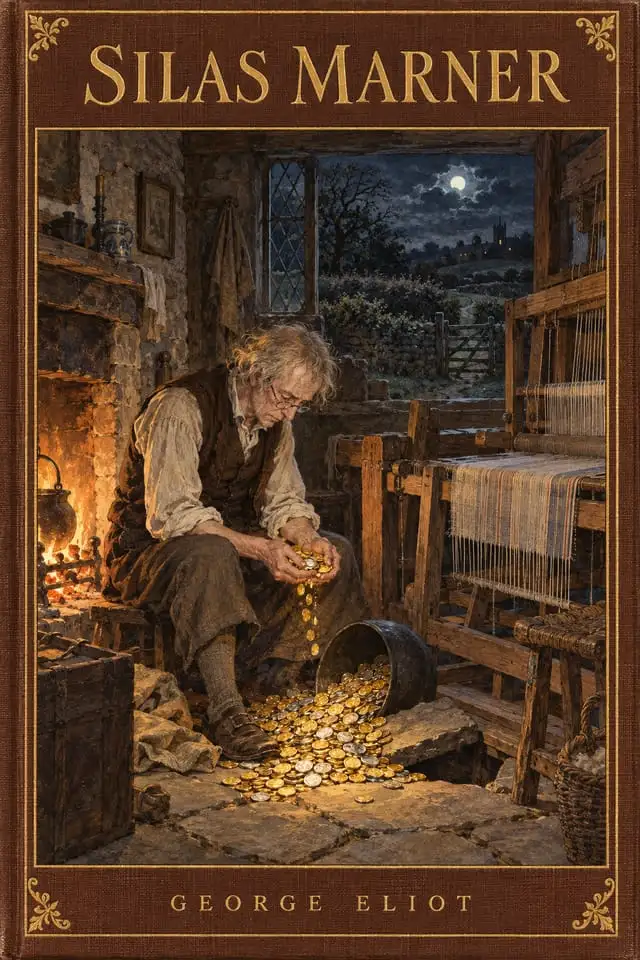
Characters
- Silas MarnerAccepted and celebrated by his neighbours, he gains Aaron as a son when Eppie marries and keeps the Stone-pits cottage as their shared home.First appears: Chapter 1
- Jem RodneyAccused by Silas of taking his gold, he is cleared by Snell's account that he was at the Rainbow throughout Silas's errand.First appears: Chapter 1
- Mr MaceyHe visits Silas with awkward reassurances of his improved reputation and urges him to buy a Sunday suit from Tookey and attend church.First appears: Chapter 1
- Sally OatesA Raveloe woman whose symptoms Silas has relieved, encouraging neighbours to credit him with mysterious powers of healing.First appears: Chapter 1
- Squire CassHe has died during the intervening sixteen years, and the division of his inheritance has ended the family's local use of the title Squire.First appears: Chapter 1
- William DaneSilas's trusted friend at Lantern Yard, whom Silas accuses of framing him for theft and who marries Sarah after she breaks her engagement to Silas.First appears: Chapter 1
- SarahA young servant-woman who ends her engagement to Silas after the accusation against him and marries William Dane little more than a month later.First appears: Chapter 1
- Mr PastonThe former Lantern Yard minister whom Silas hopes to consult about the accusation and the lots, but whose whereabouts he cannot discover on returning.First appears: Chapter 1
- The senior deaconAn elderly widower nursed by members of Lantern Yard, whose death is followed by the discovery that church money kept beside his bed is missing.First appears: Chapter 1
- Mrs OsgoodA customer who pays Silas five guineas for table-linen soon after he settles in Raveloe.First appears: Chapter 2
- Doctor KimbleDespite resenting the interruption to his evening, he goes with Silas to the cottage and confirms that the child's mother is dead.First appears: Chapter 1
- Mr OsgoodThe owner of the farm he occupies, whose household at the Orchards entertains guests after Squire Cass's feasts begin to run down.First appears: Chapter 3
- Godfrey CassAbsent from Eppie's wedding, he provides the feast and pays for changes to the cottage to accommodate Silas's larger family.First appears: Chapter 3
- Dunstan CassHis skeleton is found in the drained Stone-pit with Silas's stolen money and possessions that identify him, revealing where he has lain for sixteen years.First appears: Chapter 3
- Mrs Godfrey CassShe accepts that Eppie must not be forced to join them and hopes Godfrey can be content with their marriage, while welcoming the decision not to expose the past to her family.First appears: Chapter 3
- Molly FarrenKimble confirms her death, and Godfrey recognises her body but conceals their marriage from those helping her child.First appears: Chapter 3
- FowlerA tenant whose rent Godfrey has collected and passed to Dunstan, leaving him threatened with the seizure of his goods for apparent non-payment.First appears: Chapter 3
- BryceThe intended buyer of Wildfire, who tells Godfrey that the horse is dead and that Dunstan has not been seen at Batherley.First appears: Chapter 3
- Miss Priscilla LammeterManaging her ageing father and his farm, she urges Nancy to find occupation in dairying and resents Godfrey's dissatisfaction with their childless marriage.First appears: Chapter 5
- Mr SnellActing as deputy-constable, he finds a tinderbox near Silas's cottage and links it to a visiting pedlar through increasingly suspicious recollections.First appears: Chapter 6
- Mr DowlasAfter first sharing the company's fright at Silas's arrival, he argues for a human thief and agrees to accompany Silas and Snell to the constable.First appears: Chapter 6
- Mr TookeyHe questions whether the mysterious robbery should be investigated at all, earning a rebuke from Macey for going too far.First appears: Chapter 6
- Ben WinthropA wheelwright and the church choir's leader, who mocks Tookey's singing and praises the musical gift of his own young son Aaron.First appears: Chapter 1
- Bob LundyThe good-humoured butcher and Snell's cousin, who admires the cow he has bought and repeatedly declares that he wants no quarrel.First appears: Chapter 6
- Aaron WinthropHe marries Eppie and joins her and Silas in their home at the Stone-pits.First appears: Chapter 6
- The pedlarA travelling seller who visited Raveloe about a month before the robbery and is suspected after Snell links his mention of a tinderbox with one found near Silas's cottage.First appears: Chapter 8
- Mrs Dolly WinthropEppie's godmother and a trusted adviser to Silas, she has heard his account of Lantern Yard and urged him to trust in goodness while admitting that she cannot explain his unjust treatment.First appears: Chapter 10
- EppieMarried to Aaron, she keeps Silas beside her in their altered cottage at the Stone-pits and declares that nobody could be happier.First appears: Chapter 12
- JaneA servant at the Red House whose report of people hurrying along the road makes Nancy anxious for Godfrey's return.First appears: Chapter 17









Themes
- Isolation and community
- Faith and superstition
- Trust and betrayal
- Money and work
- Class and reputation
- Choice and responsibility
Context
- Drawing lots
- Drawing lots means settling a question by a random selection, such as choosing marked slips; the Lantern Yard congregation treats the result as a judgement from God. Chapter 1
- Security
- Security for a loan is an asset or guarantee intended to protect the lender against non-payment; Dunstan instead thinks of it as a way to deceive the lender. Chapter 4
- The parish clerk
- A parish clerk assisted the clergyman during church services, including making responses; Macey's office also gives him standing among his neighbours. Chapter 6
- Tinderbox
- A tinderbox held materials for starting a fire, using sparks struck from flint and steel to ignite dry tinder. Chapter 8
- Entail
- An entail restricts how property can pass to future owners; the Squire says his land has no such restriction, so Godfrey cannot rely on inheriting it. Chapter 9
- Church and chapel
- Here church means the established parish church, while chapel means a place of worship outside it; Dolly does not recognise Silas's former chapel life as a familiar form of religion. Chapter 10
- Christening
- Christening is baptism, here performed on a child; Silas does not recognise Dolly's word and has only seen adults baptised. Chapter 14
- Dame school
- A small school, often held in a woman's home, where children learned basic skills such as reading. Chapter 16
- Poor-rate
- A local tax used to support poor people; its rising cost is part of the landowners' conversation about difficult times. Chapter 17
Chapter summaries
Chapter 1
Raveloe's villagers regard the short-sighted linen-weaver Silas Marner as an outsider, interpreting his skilled work, herbal knowledge and trances as signs of hidden powers. The narrator turns to Silas's earlier life to show that he once belonged to a close religious community in Lantern Yard. He trusts his friend William Dane and is engaged to Sarah, but church money disappears while he is watching over a dying deacon. His knife is found where the money lay, and William finds the empty bag in Silas's room. The congregation draws lots to establish guilt, and its verdict against Silas destroys a faith that he cannot separate from the practices of his church. After the verdict, Silas says he last remembers using his knife to cut a strap for William and accuses his friend of framing him. Sarah's marriage to William and Silas's departure complete the loss of the relationships on which his life depended.
Chapter 2
Silas finds no connection between Raveloe's comfortable habits and the intense religious life he has lost. Weaving gives him a routine when neither past nor future offers comfort, and gold gradually becomes an object of pleasure with no purpose beyond accumulation. Pity for Sally Oates briefly restores a link with his mother and his former capacity to help others, but the villagers interpret her relief as evidence of magical powers. When Silas refuses to sell charms or claim powers he does not possess, disappointed applicants blame him for their misfortunes, cutting him off more completely. The narrator compares his habits to an insect's and his narrowed body to a handle or tube, yet his grief over the broken water pot reveals a surviving capacity for attachment. By the fifteenth year, his savings fill two leather bags, and he imagines coins still to be earned as unborn children, directing affection towards money.
Chapter 3
Raveloe respects Squire Cass's household for its land, wealth and family standing, although the Red House is wasteful and his sons live idly. Godfrey, the eldest son, has handed Dunstan a tenant's rent and has told the Squire it remains unpaid, leaving the tenant under threat of having his goods seized. Dunstan controls his brother by threatening to reveal Godfrey's marriage to Molly Farren, a secret which endangers both his inheritance and his hopes of Nancy Lammeter. Godfrey threatens to confess but retreats because he believes this would cost him both his inheritance and Nancy. He agrees to let Dunstan take Wildfire to the next day's hunt to sell him, preferring to see Nancy at Mrs Osgood's birthday dance and avoid the area near Molly's home. The narrator recognises his longing for affection and an orderly home while showing how his wish to avoid consequences breeds bitterness and leaves Dunstan in control.
Chapter 4
Passing Silas's cottage, Dunstan thinks of making the weaver lend Godfrey money, but continues towards the hunt because he enjoys selling the horse and denying his brother relief. Bryce agrees to buy Wildfire for a hundred and twenty pounds, payable when the horse is delivered safe and sound. Dunstan chooses to hunt rather than secure the money, and Wildfire dies after striking a hedge-stake. His concern centres on avoiding witnesses and embarrassment rather than the loss he has caused. On his walk home, the light from Silas's cottage draws him to the unlocked door. He supposes that the absent weaver may have fallen into the quarry and treats this convenient possibility as a reason to take his money. Finding a patch of sand marked by fingers near the loom, he lifts the bricks, removes both bags and leaves, turning a proposed loan into outright theft.
Chapter 5
The narrator explains that Silas left his cottage unlocked because its key was holding the string for his roasting pork, and long habit made him feel safe. He has gone for twine needed for the next morning's weaving, putting work ahead of comfort. Returning to his familiar room, he unknowingly obscures Dunstan's footprints with his own and sits down to tend the roasting meat. The empty hiding-place destroys his contentment, and repeated searches show his struggle to accept the loss. His attachment to gold is presented as a concentration of his need to love, while the narrator insists that he has remained harmless and truthful. He fears that a cruel power has made him desolate again, but clings to the thought of a human thief because it offers hope of recovery. His suspicion settles on Jem Rodney without proof, and his need for help carries him out of isolation towards the Rainbow.
Chapter 6
The narrative returns to the Rainbow conversation before Silas's arrival, showing the familiar social world he is about to enter. Differences of drink, clothing and seating establish ranks within the company. A discussion of a cow becomes a dispute over Dowlas's knowledge, while jokes about Tookey's singing defend Macey's standing against his deputy. Macey's account of the Lammeters' wedding turns a mistake in the service into an anxious question about what makes a marriage binding. His listeners enjoy the familiar telling as they would a favourite tune, suggesting the importance of shared memory to village life. The story of Cliff, a tailor ashamed of his trade who tried to make his son a gentleman through riding, exposes anxieties about social position. When the conversation reaches the supposedly haunted stables, Dowlas demands a wager and Snell tries to reconcile incompatible opinions, leaving the question unsettled.
Chapter 7
Silas enters just after the discussion of ghosts, and even Dowlas briefly takes him for an apparition. Silas appeals directly to Jem Rodney, offering to spare him prosecution and give him a guinea if he returns the money. Snell then seats Silas by the fire, where the men's fear gives way to curiosity as they hear his account. The plainness of Silas's distress persuades the company that he is truthful, though some now explain the theft through supernatural interference. Snell supplies Jem's alibi, and Macey's warning against accusing the innocent stirs Silas's memory and prompts him to admit his mistake. The narrator presents the unfamiliar warmth of another hearth and the presence of possible helpers as influences on Silas beyond his immediate awareness. Dowlas's wish to act officially causes another dispute, but he and Snell eventually leave with Silas to seek the constable.
Chapter 8
A tinderbox found near Silas's cottage becomes the centre of the village inquiry, and Snell links it to a visiting pedlar whose appearance and supposed foreignness attract suspicion. Crackenthorp's question about earrings prompts villagers to turn imagined details into confident memories, while Godfrey's objection to their judgement of the man's looks is dismissed. Silas himself reports only that the pedlar called and left without entering, despite his eagerness to believe his gold can be found in the man's box. Growing anxiety about Dunstan sends Godfrey towards Batherley, but he meets Bryce on the road and learns of Wildfire's death. Without the sale money, he resolves to confess to his father, rejecting the further lie that he spent Fowler's rent for his own pleasure. He rehearses a full disclosure of his marriage, weighing the Squire's harshness against his concern for the family's name. By morning, fear of disgrace and losing Nancy restores his preference for waiting and trying to soften his father's anger against Dunstan.
Chapter 9
The Squire's authority rests on inherited standing and unquestioned local respect, although he lives as idly as his sons. Godfrey reports Wildfire's death and admits that Fowler paid the hundred pounds which he then handed to Dunstan. His father's accurate guess that he has been bribing his brother to keep a secret drives him into further evasion. The Squire threatens to turn his sons out and reminds Godfrey that he can dispose of his property as he chooses. Godfrey feels that his father's indulgence has failed to provide the discipline he needed. When the Squire offers to arrange a proposal to Nancy, Godfrey uses her displeasure and the difficulty of finding a suitable home as reasons to delay rather than reveal his marriage. The narrator uses Godfrey's reliance on good luck to criticise people who worship Chance instead of accepting responsibility for their actions.
Chapter 10
Weeks pass without a result from the inquiry, and the narrator suggests that respect for the Cass family would discourage anyone from suspecting Dunstan. Without his gold, Silas has lost the purpose and evening pleasure that sustained his working life. His misfortune softens his neighbours' suspicion and encourages their pity, but their attempts at consolation often carry self-importance or blame. Dolly Winthrop brings lard-cakes stamped with church letters and gently urges him to attend Christmas worship. Although neither can explain the letters, Silas recognises her wish to comfort him and shows gratitude by offering cake to her son Aaron. Dolly's account of churchgoing and Aaron's carol fail to reach his buried religious memories, and Christmas leaves him alone in grief while the village celebrates. The return to Godfrey's hopes for Nancy at the coming dance presents his anxiety as a persistent speaking companion which pleasure and drink cannot silence.
Chapter 11
Nancy arrives determined not to marry Godfrey because of his conduct, although her attraction to him remains strong. The Miss Gunns judge her country speech and working hands, while the narrator locates her claim to be a lady in honesty, honour and consideration for others. Nancy insists that Priscilla wear matching clothes as a sign of sisterhood, revealing how affection can become a rigid rule. Priscilla's blunt talk values independence and a secure home over anxiety about men, but she also wants Nancy to marry rather than remain attached to a disappointing lover. Tea, compliments and the opening dance reaffirm the village's familiar social order, with selected villagers watching the wealthier guests. After the Squire tears Nancy's dress by stepping on it, Godfrey takes her aside and asks whether changed behaviour could win her forgiveness. Nancy refuses to make herself responsible for encouraging his improvement, while Godfrey chooses to enjoy the evening without thinking about tomorrow.
Chapter 12
While Godfrey enjoys Nancy's company, Molly struggles through the snow with their child, intending to reveal the marriage he refuses to acknowledge. The narrator presents her bitterness alongside the power of her opium dependence and her surviving tenderness towards her daughter. She hesitates over taking the drug because she wants to remain conscious of the child, but takes it and eventually sinks into the snow. Released from her mother's slackening arms, the girl follows the light from Silas's open door to his warm hearth, entering unnoticed during his fit. When Silas recovers, he mistakes her golden hair for his lost coins, then finds that her presence recalls his little sister and stirs tenderness and religious awe. Feeding her and removing her wet boots draw him into practical care, and the boots prompt him to follow her tracks back to her mother.
Chapter 13
Silas brings the child into the Red House to seek medical help, exposing Godfrey's hidden life to his own gaze without revealing it to the company. Godfrey denies knowing whose child she is, while Silas's refusal to part with her makes his attachment clear even to himself. Kimble leaves the party to attend the woman, and Godfrey fetches Dolly, whose praise of his kindness overlooks his desperate concern for his own future. Waiting outside, Godfrey knows that he ought to acknowledge his wife and child, but hopes Molly's death will free him to marry Nancy. Once her death is confirmed, he looks at her body and feels both regret and joy when their daughter turns towards Silas without recognising him. Silas identifies with the girl's loneliness and means to keep her, while Godfrey gives money for clothes and conceals the truth from Kimble. Back at the party, Godfrey treats his good fortune as a reason to preserve his secret and imagines fulfilling his duty through support without admitting that he is the father.
Chapter 14
Molly receives a pauper's burial, while Silas's decision to keep her child awakens active interest among the village women. Dolly supplies clothes and teaches him how to care for the girl, reassuring him when he fears that accepting help might cost him her affection. At Dolly's urging he has the child christened Hephzibah, shortened to Eppie, and attends church because he wants to do what is right for her. The narrator contrasts the unchanging demands of gold with Eppie's growing needs, which renew his attention to nature, his memories and his hopes for the future. When she cuts her tether and wanders away, his terror gives way to joy on finding her, and the coal-hole punishment becomes another game for her. Silas chooses to bear the trouble she causes rather than hurt her, while Dolly advises him to keep dangerous things out of reach. Taking Eppie on his visits makes him welcome among his neighbours and gives his work a loving purpose beyond the accumulation of money.
Chapter 15
Godfrey's interest in Eppie remains hidden behind the occasional small gift that others can understand as ordinary kindness. He reassures himself that her life with Silas may be happier than a wealthy upbringing, so her loss of her birthright causes him little present uneasiness. The narrator's questions about a ring that pricks its owner for neglecting duty challenge the comfort of a conscience absorbed in getting what it wants. Dunstan has not returned, and respect for the Cass family discourages detailed inquiries into his absence. With Dunstan no longer overshadowing his hopes, Godfrey's pursuit of Nancy gives him the appearance of firmness, and the village approves his improvement. His imagined family happiness places children around his own hearth while leaving Eppie outside it, reducing his responsibility towards her to material provision.
Chapter 16
The narrative moves forward sixteen years and opens outside church, where the order of departure still displays the village's social ranks. Godfrey and Nancy are married, while eighteen-year-old Eppie walks home with an ageing Silas and accepts Aaron's offer to help make a garden. Godfrey has improved and furnished the cottage, and the villagers regard his gifts as deserved support for a man who has raised an orphan. Looking back over Eppie's childhood, the narrator shows how caring for her restored Silas's participation in village customs and allowed him to tell Dolly about Lantern Yard. Dolly cannot explain the false verdict of the lots, but her belief that divine goodness exceeds human understanding helps him trust again without solving the old injustice. Eppie knows how her mother died and how Silas found her, keeps her mother's wedding-ring and wants the garden to include the furze bush beside which her mother lay. After noticing the falling water in the pit, she tells Silas about Aaron's proposal, and their discussion balances her wish to preserve their happy life with his concern that she will need support as he grows older.
Chapter 17
Nancy's orderly household shows the care she has brought to the Red House, while Priscilla recommends dairying as an occupation to relieve her sadness. Left alone, Nancy recalls the loss of her baby and questions whether she has done enough to ease Godfrey's disappointment at having no children. Her refusal to adopt Eppie rests on a sincere but rigid belief that seeking a child would resist Providence. The narrator distinguishes her unselfish motives from the limited experience and reasoning behind her rules. Godfrey assumes that wealth and social advancement would make Silas willing to part with Eppie, revealing how little he understands their attachment. He still believes confession would destroy Nancy's affection, and the account of their shared unhappiness exposes the cost of his concealment. The quiet afternoon ends with Nancy's uneasiness after Jane reports unexplained activity in the village.
Chapter 18
Godfrey returns shaken by the discovery of Dunstan's skeleton and the money he stole from Silas. The exposure of one family secret makes him fear that his own will eventually be discovered, and he resolves to tell Nancy himself. He admits that Eppie's dead mother was his wife and that he has left his daughter unacknowledged. Nancy responds with grief over the care they could have given Eppie, revealing that Godfrey has misunderstood her likely response to the truth. Her insistence that no happiness justifies wrongdoing challenges his attempt to explain concealment through his love for her. They resolve to visit Silas and offer Eppie a home, although Nancy recognises that her coming to them as an adult would be different from growing up with them.
Chapter 19
Silas sees the recovered money as a provision for Eppie, yet fears that losing her could restore his dependence on gold and destroy his trust in God's goodness. Godfrey and Nancy visit, initially hoping to offer Eppie a home without immediately revealing his fatherhood. Their proposal treats wealth and becoming a lady as obvious gains, but Eppie refuses to leave Silas or the people she loves. Frustrated, Godfrey declares that he is her father and claims a stronger right to her than Silas has. Silas challenges the idea that repentance can undo sixteen years of neglect, yet fears that keeping Eppie might obstruct her welfare and leaves the decision to her. Eppie chooses their shared life and explains that she is promised to a workingman who will live with them and help care for Silas. The narrator exposes the limits of both Godfrey's penitence and Nancy's sympathy when their assumptions about blood and social rank prevent them from understanding Eppie's happiness.
Chapter 20
Godfrey and Nancy return in silence, finding comfort in their renewed trust before speaking about Eppie's refusal. Nancy accepts that they cannot undo her upbringing or rightly force her to join them. Godfrey uses the language of debt and growing trees to recognise that lost time cannot be recovered through extra payment. They decide against public disclosure, and he resolves to help Eppie in the life she chooses, while considering whether to record his fatherhood in his will. His belief that she dislikes him still includes a wish to be judged less harshly, but he accepts the consequences of neglecting a father's part. Recognising how much Nancy has already given him, he sees that some improvement remains possible even though other losses cannot be repaired.
Chapter 21
Silas hopes a return to Lantern Yard will clear up the false accusation and let him discuss his old religious doubts with Mr Paston. Eppie looks forward to the journey, while Dolly supports his search despite her fears about travelling. The manufacturing town has changed so much that the familiar prison walls offer Silas his first reassurance that he is in the right place. A factory occupies the site of Lantern Yard, and his inquiries reveal nothing about the former congregation or minister. Returning home, he recognises Raveloe as his only remaining home and tells Dolly that he may never understand the verdict of the lots. Her confidence in a right order beyond their knowledge supports his conclusion that loving Eppie has given him enough light to trust without those answers.
Conclusion
Eppie's wedding takes place in the season the village favours for marriages, connecting her happiness with its work and customs. Nancy provides the dress Eppie chooses, while Godfrey funds the feast but is absent from the celebration. Eppie understands the marriage as bringing Aaron into her family with Silas, rather than parting her from her father. The neighbours agree that Silas has brought a blessing upon himself by caring for a motherless child, showing how fully he now belongs among them. Godfrey's money improves the cottage to suit the larger family and respects Silas and Eppie's wish to remain there. The ending joins their enlarged household to a garden whose flowers seem to answer the happiness of the people approaching it.
Key quotes
how was a man to be explained unless you at least knew somebody who knew his father and mother?
The rhetorical question expresses the villagers' dependence on family connections when deciding whom to trust. An unfamiliar background makes even an inoffensive stranger suspect.
Isolation and communityClass and reputationTrust and betrayal
The lots declared that Silas Marner was guilty.
The short, emphatic sentence gives a chance result the force of a verdict. Its certainty conflicts with the narrator's account of Silas's honesty, exposing the danger of treating this procedure as proof.
Faith and superstitionChoice and responsibility
there is no just God that governs the earth righteously, but a God of lies, that bears witness against the innocent.
Silas takes the failure of his church's judgement as evidence that God himself is unjust. Human betrayal destroys the religious trust through which he has understood his life.
Faith and superstitionTrust and betrayal
He seemed to weave, like the spider, from pure impulse, without reflection.
The comparison to a spider makes weaving seem instinctive and repetitive. Work keeps Silas occupied after the loss of the relationships that gave his life direction.
Isolation and communityMoney and work
money on this condition was no temptation to him: he had never known an impulse towards falsity
His refusal to sell charms shows that his honesty survives his loss of faith and withdrawal from his neighbours. The neighbours' demands put that honesty in conflict with their expectations.
Choice and responsibilityMoney and workFaith and superstition
and thought fondly of the guineas that were only half-earned by the work in his loom, as if they had been unborn children
The comparison gives coins the place of hoped-for children, showing how deeply Silas's need to care has been redirected towards money.
Money and workIsolation and community
the poor thought that the rich were entirely in the right of it to lead a jolly life
The narrator describes a village that accepts the rich people's pleasure as their due. The nearby account of leftovers for the poor gives this apparent harmony an ironic edge.
Class and reputationMoney and work
The results of confession were not contingent, they were certain; whereas betrayal was not certain.
Godfrey treats disclosure as a calculation of immediate risks. The narrator exposes how fear allows him to postpone taking responsibility.
Choice and responsibilityClass and reputationTrust and betrayal
The yoke a man creates for himself by wrongdoing will breed hate in the kindliest nature
The image of a yoke presents Godfrey's wrongdoing as a burden he has fastened on himself. His rejection of his affectionate spaniel at the end of the scene shows this bitterness affecting his behaviour.
Choice and responsibilityTrust and betrayal
he preferred that Master Godfrey should be vexed.
Dunstan's pleasure in his brother's distress outweighs a chance to solve the immediate money problem. His conduct combines greed with a desire to exercise power over Godfrey.
Trust and betrayalMoney and workChoice and responsibility
A dull mind, once arriving at an inference that flatters a desire, is rarely able to retain the impression that the notion from which the inference started was purely problematic.
The narrator exposes how Dunstan turns an unproved possibility into permission to steal. His desire for the money drives his reasoning.
Choice and responsibilityMoney and work
The sense of security more frequently springs from habit than from conviction
Silas's confidence comes from fifteen years without a theft rather than a judgement of the danger. Knowing already what Dunstan has done, the reader sees the gap between comfort and safety.
Trust and betrayalIsolation and community
His gold, as he hung over it and saw it grow, gathered his power of loving together into a hard isolation like its own.
The gold both receives Silas's affection and gives that affection its enclosed, hard form. Hoarding has narrowed his emotional life without making him cruel to others.
Money and workIsolation and community
Every one of Mr. Macey’s audience had heard this story many times, but it was listened to as if it had been a favourite tune
The comparison makes storytelling a shared pleasure rooted in repetition. Belonging here involves knowing familiar people and the expected turns of their stories.
Isolation and communityClass and reputation
I don’t want to make out the truth about ghos’es: I know it a’ready.
Dowlas presents his disbelief as knowledge before putting it to a test. His insistence on a wager turns the dispute into a challenge to his neighbours' courage as well as their beliefs.
Faith and superstitionClass and reputation
there have been many circulations of the sap before we detect the smallest sign of the bud.
The image of a plant describes change that begins before it can be consciously recognised. It gives significance to Silas's first experience of seeking help around his neighbours' hearth.
Isolation and community
There’s nothing to witness against you, Jem.
Silas corrects an accusation based on suspicion when he hears evidence in Jem's favour. His response gives moral force to Macey's insistence that the innocent must not be accused.
Trust and betrayalChoice and responsibility
the image was presently taken for a vivid recollection
The narrator distinguishes what the villagers picture from what they actually remember. Their desire to confirm a clue helps produce apparently reliable testimony.
Trust and betrayalChoice and responsibility
He felt that in letting Dunstan have the money, he had already been guilty of a breach of trust hardly less culpable than that of spending the money directly for his own behoof
Godfrey recognises his responsibility for the rent, even while insisting that spending it himself would be a worse offence. The distinction reveals both conscience and a concern to preserve his own view of his character.
Trust and betrayalChoice and responsibilityMoney and work
the old disposition to rely on chances which might be favourable to him, and save him from betrayal.
The repeated word "old" marks the return of Godfrey's familiar evasion. His resolve to confess weakens when he imagines the consequences for his standing and his hopes of Nancy.
Choice and responsibilityClass and reputationTrust and betrayal
The Squire’s life was quite as idle as his sons’
The narrator exposes the inconsistency behind the Squire's contempt for youthful folly. His authority comes from age and rank rather than a better example of conduct.
Class and reputationChoice and responsibility
no sort of duplicity can long flourish without the help of vocal falsehoods
Godfrey wants to conceal his marriage without becoming a liar, but the narrator shows how concealment demands spoken deception. His father's questions make that conflict immediate.
Trust and betrayalChoice and responsibility
Favourable Chance, I fancy, is the god of all men who follow their own devices instead of obeying a law they believe in.
The religious language makes hope of luck a substitute for moral commitment. By turning from Godfrey to people in general, the narrator asks readers to recognise the same evasion beyond the Cass household.
Faith and superstitionChoice and responsibility
Formerly, his heart had been as a locked casket with its treasure inside; but now the casket was empty, and the lock was broken.
The image links Silas's emotional life to the stolen hoard. Losing the treasure leaves him vulnerable and more willing to admit a visitor, but he still finds no comfort in Dolly's religious advice or her delight in Aaron.
Money and workIsolation and communityTrust and betrayal
Silas was as unable to interpret the letters as Dolly, but there was no possibility of misunderstanding the desire to give comfort that made itself heard in her quiet tones.
Shared ignorance of the religious letters does not prevent Silas from recognising Dolly's kindness. The contrast gives her manner of speaking a value that does not depend on explaining doctrine.
Faith and superstitionIsolation and communityTrust and betrayal
We can send black puddings and pettitoes without giving them a flavour of our own egoism
The food image separates practical generosity from words coloured by the speaker's self-regard. It helps explain why well-meant visits can fail to comfort Silas.
Isolation and communityChoice and responsibility
high veracity, delicate honour in her dealings, deference to others, and refined personal habits
The narrator's list defines Nancy's standing through conduct rather than education or fashionable speech. It challenges the Miss Gunns' confident judgement of her as vulgar.
Class and reputationChoice and responsibility
the charter of Raveloe seemed to be renewed by the ceremony.
The formal language makes the opening dance a confirmation of the village's established order. Shared pleasure brings people together while preserving distinctions between dancers and spectators.
Class and reputationIsolation and community
I think those have the least feeling that act wrong to begin with,
Nancy answers Godfrey's accusation of coldness by turning attention back to his conduct. Her reply challenges his attempt to make her sympathy the condition of his becoming better.
Choice and responsibilityTrust and betrayal
the mother’s love pleaded for painful consciousness rather than oblivion
The personification gives Molly's tenderness a voice struggling against her desire for relief. Her hesitation makes the account of her dependence more complex than a simple absence of care for the child.
Choice and responsibility
but instead of the hard coin with the familiar resisting outline, his fingers encountered soft warm curls.
The contrast between hard money and a warm living child makes Silas's discovery physical and immediate. The affection once concentrated on coins now finds expression in feeding and comforting someone.
Money and workIsolation and communityChoice and responsibility
he had a dreamy feeling that this child was somehow a message come to him from that far-off life:
Silas imagines the child as a message from his former life, as memories of his sister, home and Lantern Yard return. The narrator distinguishes his sense of mystery from the ordinary events that brought her to his hearth.
Faith and superstitionIsolation and community
no disposition is a security from evil wishes to a man whose happiness hangs on duplicity.
The narrator refuses to treat Godfrey's kindly nature as protection against wrongdoing. Keeping his secret has made another person's possible survival a source of terror to him.
Trust and betrayalChoice and responsibility
it’s a lone thing—and I’m a lone thing.
Silas explains his attachment through a shared condition of loneliness. The repeated phrase recognises a bond that Godfrey conceals despite being the child's father.
Isolation and communityChoice and responsibility
he would do everything but own it.
The short qualification exposes the limit within Godfrey's apparently generous promise. Financial help allows him to imagine being responsible while refusing the public acknowledgement that threatens his happiness.
Choice and responsibilityMoney and workClass and reputationTrust and betrayal
you’ll have a right to her, if you’re a father to her, and bring her up according.
Dolly makes Silas's claim to the child depend on the care he gives her. Fatherhood becomes a responsibility expressed through daily action.
Choice and responsibilityTrust and betrayal
The gold had kept his thoughts in an ever-repeated circle, leading to nothing beyond itself;
The circular image makes hoarding a form of confinement. Eppie's changing needs break this repetition by giving Silas a future to imagine and work towards.
Money and workIsolation and communityChoice and responsibility
As the child’s mind was growing into knowledge, his mind was growing into memory: as her life unfolded, his soul, long stupefied in a cold narrow prison, was unfolding too, and trembling gradually into full consciousness.
The parallel clauses make Eppie's development and Silas's recovery parts of the same process. The prison metaphor shows how severely isolation has restricted his emotional life.
Isolation and communityTrust and betrayal
He was so undivided in his aims, that he seemed like a man of firmness.
The word "seemed" qualifies the apparent change in Godfrey. His confidence comes from no longer having competing desires to manage, rather than from a demonstrated willingness to face difficult duties.
Choice and responsibilityClass and reputation
And that other child—not on the hearth—he would not forget it; he would see that it was well provided for. That was a father’s duty.
The interruption places Eppie outside Godfrey's picture of domestic happiness. The final sentence gives his restricted idea of fatherhood the reassuring sound of a settled moral rule.
Choice and responsibilityMoney and workClass and reputationTrust and betrayal
Had she not a father very close to her, who loved her better than any real fathers in the village seemed to love their daughters?
The question explains why Eppie gives little thought to her unknown father. The comparison measures fatherhood through experienced love and closeness.
Choice and responsibilityTrust and betrayalIsolation and community
That drawing o’ the lots is dark; but the child was sent to me:
Silas acknowledges the unresolved injustice while treating Eppie's arrival as evidence of goodness. His renewed faith rests on love and experience without requiring an explanation of every wrong.
Faith and superstitionTrust and betrayal
But you’ll never be lone again, father,
Eppie answers Silas's recollection of his isolation with a promise of continuing companionship. Her wish to remain with him makes care reciprocal as he grows weaker.
Isolation and communityChoice and responsibilityTrust and betrayal
They were firm, not because of their basis, but because she held them with a tenacity inseparable from her mental action.
The narrator separates the strength of Nancy's opinions from the strength of their evidence. Her sincerity does not prevent a mistaken judgement from governing her marriage.
Faith and superstitionChoice and responsibility
deep affections can hardly go along with callous palms and scant means
This is the class prejudice encouraged by Godfrey's surroundings, which the narrator exposes in his plan for Eppie. He mistakes poverty and hard physical work for a lack of deep feeling.
Class and reputationMoney and workChoice and responsibility
Everything comes to light, Nancy, sooner or later.
The discovery in the pit turns exposure into a physical event as well as a moral warning. Godfrey takes it as a reason to end his own long concealment.
Trust and betrayalChoice and responsibilityFaith and superstition
But I wasn’t worth doing wrong for
Nancy refuses the idea that winning her could justify Godfrey's dishonesty. Her answer measures the marriage against a duty that his desire for it did not cancel.
Choice and responsibilityTrust and betrayal
It’s another you did the wrong to; and I doubt it can never be all made up for.
Nancy shifts attention from her own injury to the child Godfrey neglected. Her doubt distinguishes forgiving a husband from undoing the harm he has caused.
Choice and responsibilityTrust and betrayal
but repentance doesn’t alter what’s been going on for sixteen year.
Silas distinguishes Godfrey's present intentions from the lasting relationships formed during his absence. Fatherhood depends here on a history of care that a declaration cannot replace.
Choice and responsibilityTrust and betrayal
Let it be as you will. Speak to the child. I’ll hinder nothing.
Silas fears the loss of Eppie but refuses to make his own need the final authority. His willingness to let her choose tests Godfrey's accusation that he is acting selfishly.
Choice and responsibilityTrust and betrayal
I like the working-folks, and their victuals, and their ways.
Eppie's plain list gives positive value to the daily habits and company Godfrey dismisses. Her refusal rests on attachment to a whole social world as well as to Silas.
Class and reputationIsolation and communityChoice and responsibility
there’s debts we can’t pay like money debts, by paying extra for the years that have slipped by.
Godfrey now recognises the limit of the financial provision on which he has relied. Care withheld during Eppie's childhood cannot be supplied afterwards as interest on a debt.
Money and workChoice and responsibility
Though it is too late to mend some things, say what they will.
The qualification prevents Godfrey's hope of improvement from erasing the cost of delay. He can change his conduct towards Nancy without recovering the place he wanted in Eppie's life.
Choice and responsibilityTrust and betrayal
The old home’s gone; I’ve no home but this now.
The vanished buildings leave Silas unable to recover his old community or learn whether it recognised his innocence. Calling Raveloe home affirms the belonging he has gained there.
Isolation and communityTrust and betrayal
Since the time the child was sent to me and I’ve come to love her as myself, I’ve had light enough to trusten by;
The image of sufficient light answers the repeated darkness surrounding the old injustice. Silas's renewed trust rests on experienced love, even though the journey has brought no explanation.
Faith and superstitionTrust and betrayalIsolation and community
you’ll only be taking Aaron to be a son to you.
Eppie changes the meaning of being given away at marriage. Her new bond with Aaron enlarges the household she shares with Silas.
Choice and responsibilityIsolation and communityTrust and betrayal
he had brought a blessing on himself by acting like a father to a lone motherless child.
The village now understands Silas's good fortune through his practical care for Eppie. Its agreement confirms his acceptance in a community that once distrusted him.
Isolation and communityChoice and responsibilityFaith and superstition
I think nobody could be happier than we are.
Eppie has the final word, measuring happiness through their shared home. Her satisfaction confirms the choice she made when offered a wealthier life elsewhere.
Class and reputationMoney and workIsolation and communityTrust and betrayal