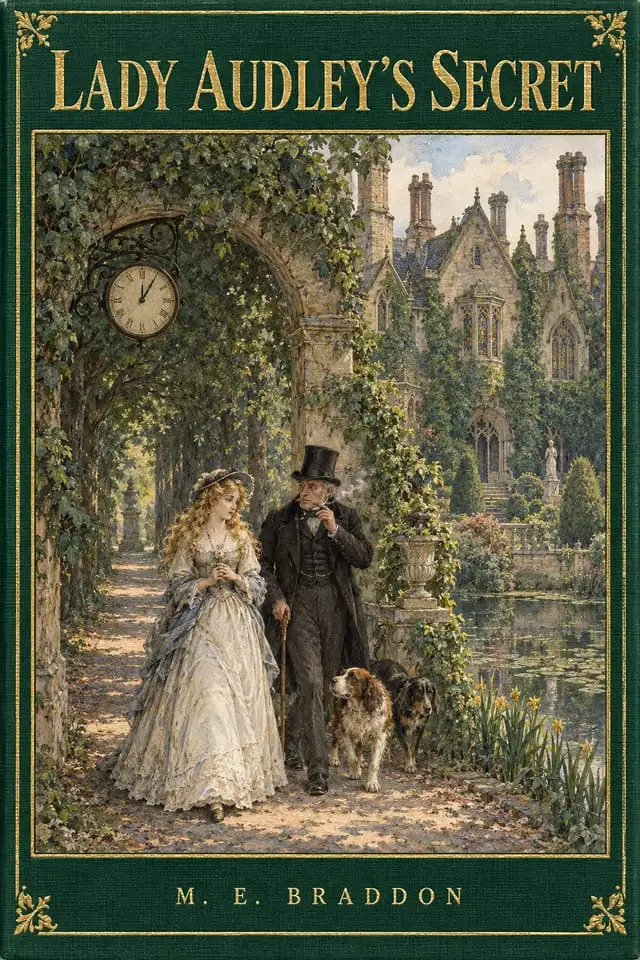
Characters
- Helen TalboysConfined in Belgium under the assumed name Mrs Taylor. She has told Robert that she removed a spindle and caused George to fall into the old well, where she believes his body remains.First appears: Chapter 1: Lucy
- Sir Michael AudleyHas heard his wife's confession and asked Robert to arrange her safety and comfort. Unable to say farewell, he prepares to leave the Court.First appears: Chapter 1: Lucy
- Alicia AudleyHas accepted Robert's affection as brotherly and agreed to accompany her father. She knows that Lady Audley caused his sorrow but has not been told the confession's details.First appears: Chapter 1: Lucy
- Mr DawsonThe village surgeon who employs Lucy Graham as governess to his daughters.First appears: Chapter 1: Lucy
- Mrs DawsonThe surgeon's wife, in whose household Lucy Graham works.First appears: Chapter 1: Lucy
- George TalboysHas returned from New York and explained his climb out of the well. His need for Robert's friendship brought him back to England.First appears: Chapter 2: On Board the Argus
- Miss MorleyA reserved governess travelling home on the Argus after a long absence from England.First appears: Chapter 2: On Board the Argus
- Helen TalboysHas confessed that she is Lady Audley. The woman buried at Ventnor under her name was Matilda Plowson, whose identity was concealed to mislead George.First appears: Chapter 2: On Board the Argus
- Captain MaldonA shabby, foppish old man who looks frightened when he recognises George, seems eager to see him go back to Australia, and always has plenty of sovereigns in his purse.First appears: Chapter 2: On Board the Argus
- GeorgeyA small boy with his father's brown eyes and dark hair, who pushes George away and stays with his grandfather, with Robert as his guardian.First appears: Chapter 2: On Board the Argus
- Phoebe MarksNow widowed. Luke says that she witnessed the encounter by the well and used what she saw to gain power over Lady Audley; he kept George's survival and letters secret from her.First appears: Chapter 3: Hidden Relics
- Luke MarksBefore dying, disclosed that he helped George after the fall and concealed the letters George asked him to deliver. He says he kept Helen and Phoebe believing George dead to preserve his hold over them.First appears: Chapter 3: Hidden Relics
- Robert AudleyHas become engaged to Clara and returned to find George alive in his chambers. George's account explains his escape from the well and his journey to New York.First appears: Chapter 4: In the First Page of the Times
- The landlady at VentnorThe talkative landlady at Lansdowne Cottage in Ventnor, where Captain Maldon is lodging.First appears: Chapter 5: The Headstone at Ventnor
- Mrs VincentNow runs a smaller school in Peckham after financial difficulties. She says she never sent the message summoning Lucy to London and accepted her as a teacher without a reference.First appears: Chapter 7: After a Year
- Mrs MaloneyThe woman who attends to Robert's chambers in Figtree Court.First appears: Chapter 12: Still Missing
- Sir Harry TowersA young local sportsman who pays attention to Alicia.First appears: Chapter 15: On the Watch
- Mr WhiteA locksmith who has previously done work for Robert.First appears: Chapter 19: The Writing in the Book
- Mrs PlowsonA woman Robert finds looking after Georgey at Maldon's lodgings.First appears: Chapter 20: Mrs. Plowson
- MatildaThe dying daughter of Mrs Plowson, taken to Ventnor and buried under Helen Talboys's name as part of the deception.First appears: Chapter 20: Mrs. Plowson
- Harcourt TalboysHas admitted his anxiety about George and says he will welcome him home. He receives Robert warmly, though he continues to condemn the private settlement of Helen's case.First appears: Chapter 2: On Board the Argus
- Mr MarchmontA schoolmaster in Southampton whom Robert consults about Georgey's education.First appears: Chapter 21: Little Georgey Leaves His Old Home
- Clara TalboysHas become engaged to Robert while planning to search for George together. Her father now admits affection for his son and hopes for his return.First appears: Chapter 22: Coming to a Standstill
- Miss TonksA teacher employed by Mrs Vincent, whose detailed memory contrasts with the schoolmistress's vagueness.First appears: Chapter 26: So Far and No Farther
- Mrs BarkambThe owner of the cottage in Wildernsea where Maldon and his daughter lived.First appears: Chapter 27: Beginning at the Other End
- Mrs MartynClara's friend and hostess, the wife of the rector at Mount Stanning.First appears: Chapter 28: Hidden in the Grave
- Dr Alwyn MosgraveDescribes Lady Audley as dangerous despite denying that she is presently mad. He recommends a Belgian institution and questions whether Robert's suspicions supply adequate evidence of murder.First appears: Chapter 35: The Hush That Succeeds the Tempest
Themes
- Secrets and hidden pasts
- Appearance and deception
- Money, class and ambition
- Marriage and women's dependence
- Love, loss and grief
- Audley Court and the Gothic
- Friendship and duty
Chapter summaries
Chapter 1: Lucy
The novel opens with a long description of Audley Court, a lovely but confusing old house full of secret corners, a dark lime-tree walk and a disused well. Sir Michael Audley, a widower with an eighteen-year-old daughter, Alicia, has married a young second wife who came to the village as a governess, and about whom no one knows anything beyond a single reference. Everyone praises Lucy Graham's sweetness, but the narrator calls her charm a 'power of fascination'. When Mrs Dawson raises the match, Lucy flushes, then turns pale, and twists a black ribbon at her throat with a half-angry gesture. Her answer to Sir Michael's proposal is strikingly frank about poverty and self-interest, and he walks away knowing he will be married for his fortune. The chapter ends with her alone, glad to be free of dependence, holding the ring and paper that are the only clues to her identity she has kept.
Chapter 2: On Board the Argus
The scene moves to the Argus, ten days from England, where George Talboys is the most popular passenger on board. Miss Morley, going home to the man she has not seen for fifteen years, admits that she dreads disappointment. George protests that his wife's heart is 'as true as the light of Heaven', then tells his history: a love match, his rich father cutting him off, money spent in Italy and taken by his father-in-law, and his secret departure for the goldfields while his wife slept. He has not written to her once in three and a half years, except for a letter sent the night before he left Sydney. Braddon contrasts George's open, boyish confidence with Miss Morley's quiet anxiety, and by the end his trust has begun to crack. His certainty that he would 'fall down dead' if anything had happened to his wife leaves the reader anxious about what he will find.
Chapter 3: Hidden Relics
Braddon links the two settings with the same sunset, but at Audley Court the stillness feels deathlike, and the red light makes the old well look 'flecked with blood'. Phoebe Marks, pale and self-controlled, was a nursemaid at the Dawsons' and is now Lady Audley's maid. Talking to Luke, a coarse cousin who expects to marry her, she keeps coming back to her mistress, who only three months before was 'a servant like me'. Inside the house, Luke covets a diamond bracelet, but Phoebe is horrified at the idea of taking it. Yet when a secret drawer reveals a baby's worsted shoe and a lock of fine yellow hair, she takes them and asks Luke to bear witness where she found them. Phoebe seems to judge that a secret may be worth more than a jewel, and the chapter shows how differences of class breed envy and watchfulness below stairs.
Chapter 4: In the First Page of the Times
Robert Audley is introduced with gentle comedy: a barrister in name only, he lives on four hundred a year, smokes his German pipe, reads French novels and fills his chambers with stray dogs. He took the news of his uncle's marriage calmly, though his cousin Alicia wrote angrily about the 'wax-dollish' new wife. A chance collision in the City reunites him with George Talboys, and for a moment Robert's usual indifference gives way to real warmth. George pours out his plans for a happy life with his wife, so the empty letter rack is a hard blow. The chapter ends abruptly on the death notice, a single plain line in a newspaper, which turns George's hope into shock. Braddon builds suspense through coincidence and the cold, public form of the news.
Chapter 5: The Headstone at Ventnor
George once said that bad news of his wife would make him fall down dead; instead he faints, and wakes stunned and helpless. Robert, 'the most vacillating and unenergetic of men', takes charge, nursing George in his chambers and leading the search at Ventnor. At Captain Maldon's shabby lodgings George finds his own portrait in uniform, but the portrait of his wife that used to hang beside it is not there. The landlady has heard from Captain Maldon that George deserted his wife cruelly, and George has to defend himself. The landlady says that Helen spoke of her mother, not of him, when her mind wandered at the end; George notices that the lock of her hair is smooth and straight, though it used to wave; the landlady says illness changes hair. The chapter is full of George's grief and Robert's quiet care, and ends with the plain, formal words of the headstone.
Chapter 6: Anywhere, Anywhere Out of the World
Captain Maldon greets George with a ceremonious bow and nervous chatter about his beard, and Robert privately suspects that he treated his daughter badly and is 'half afraid of George'. Georgey, who has his father's eyes and hair, pushes George away and says he loves his grandpa. George arranges for a hundred a year from the interest on his money to pay for the boy's education, with Robert as trustee and guardian, and Captain Maldon seems eager to see him leave England. The landlady's remark that the captain always has plenty of sovereigns puzzles George, but he is too broken to ask more. A missed sailing keeps George in London, where Robert's quiet determination persuades him to travel to Russia. Alicia's letter closes the chapter with news of Audley Court, describing her stepmother as agreeable to everyone but 'childish and silly'.
Chapter 7: After a Year
George's recovered appearance conceals the grief he describes as a bullet carried inside him. Robert persuades him to visit Essex, although Alicia reports that Lady Audley is too ill to entertain them. At the inn, they learn that the family has instead spent the day at the races. Robert admires his aunt when the carriage stops, but Sir Michael prevents the proposed introduction to George in response to her signs of fatigue. At home, her lively conversation with Phoebe complicates that public exhaustion, and their discussion of beauty reduces their differences to changeable colouring. A private commission sends the maid to London before a message summons Lady Audley there herself. Her deliberate locking of the apartments ends the chapter with an act of exclusion whose purpose remains unestablished.
Chapter 8: Before the Storm
Alicia's efforts to attract Robert meet his continuing indifference, while George describes his grief through an image of a rising tide. Lady Audley's letter asks particularly about the visitors' departure, but Robert admires its handwriting without questioning the inquiry. His headache then overturns their announced travel plans. The visit to the Court moves from the gloomy lime-walk to the blocked entrance of the apartments, until Alicia remembers the secret passage. The portrait within gives Lady Audley's familiar beauty a sinister expression, presenting an image whose relationship to her character is disputed. George's long silence and hoarse reply receive Robert's ordinary explanation of a cold. Alicia suggests that a painter may reveal a possible expression unseen in daily life, but Robert refuses the speculation.
Chapter 9: After the Storm
Robert interprets George's pallor and anger as fear of lightning, an explanation George accepts when he apologises the following morning. Lady Audley's fear similarly interrupts her usual appearance, which Sir Michael celebrates seeing restored by daylight. She has discovered the visitors' entry into her apartments and found George's glove beside the portrait. While Robert sleeps during their fishing expedition, George walks alone to the Court and learns that Lady Audley is in the lime-walk. The narrative then leaves an interval before showing her return from the opposite direction, without describing any encounter. Her sharp instructions about the glove lead to a question about Phoebe's whereabouts. The maid's answer that she worked at her bedroom window precedes a conspicuous promise of future friendship and money.
Chapter 10: Missing
The abandoned fishing-rod begins an absence that Robert initially treats as an inconvenience. Finding no George at the inn turns that annoyance into active concern. A servant fixes George's visit to the Court at about two o'clock, but supplies no account of what followed. Robert's quickened walking marks how strongly attachment can move him beyond his habitual indolence. At the station he converts the clerk's vague description of a bearded passenger into confident identification. His reassuring explanation closes the search for the evening without firmly establishing that George took a train.
Chapter 11: The Mark Upon My Lady’s Wrist
Lady Audley's charm fails to distract Robert completely from his missing friend. Her account of the unsuccessful London journey explains the return without providing any new contact with Mrs Vincent. His fears move between ordinary travel and the possibility that grief has driven George to harm himself. While she plays, a slipped bracelet exposes marks on her wrist, and Robert questions the explanation she gives. The description suggests the pressure of fingers and a ring, while stopping short of identifying a cause or a person. Robert leaves determined to search London and Southampton. The narrator recasts his usual concentration on very little as a capacity for persistent attention when he is finally engaged.
Chapter 12: Still Missing
The untouched rooms and Mrs Maloney's testimony remove Robert's hope of finding George at home. Maldon's account initially offers reassurance by placing him alive in Southampton and bound for Liverpool. Yet Robert finds the abrupt departure inconsistent with their friendship and George's abandoned belongings. Georgey's recollection of a richly dressed visitor introduces another account that his grandfather quickly explains for him. The pawned watch and Maldon's complaints reveal money pressures without establishing their connection to George. A burnt dispatch repeats the travel story with its date and sender missing, turning an ordinary scrap into evidence of an unexplained communication.
Chapter 13: Troubled Dreams
Exhaustion brings Robert dreams that mix the grave, Lady Audley and images of judgement, exposing his anxiety without proving its suggestions. An unknown caller leaves while he is asleep, adding another lost opportunity for information. At Liverpool the passenger list contains no Talboys; the clerks recall a late passenger named Thomas Brown whose arm was in a sling, but Robert does not identify him as George. Robert turns from searching places to arranging the evidence already available. His numbered journal includes events with no apparent connection, allowing their sequence to suggest relationships. The official-looking record also awakens a sense of professional capacity in the idle barrister. He decides that the remaining mystery requires a closer search in Essex.
Chapter 14: Phoebe’s Suitor
The family reads the missing-person advertisement without treating George's absence as an urgent mystery. Alicia continues to challenge her father's judgement of Lady Audley, while the latter increasingly relies on Phoebe for companionship. Autumn prompts fears about ageing and a remembered romance in which a woman's hidden crime is exposed late in life. Phoebe's wish to marry Luke then exposes the coercion beneath an apparently voluntary engagement: she fears his violence if she withdraws. Lady Audley recognises that marriage would not remove that danger but eventually agrees to assist the couple financially. Luke responds to her offer with an insolent demand for twice as much. Her accusation and Phoebe's apology confirm that he has learned something she wished concealed, though its content remains unstated.
Chapter 15: On the Watch
The bleak wedding contrasts Luke's satisfaction with Phoebe's tears and continued fear. Lady Audley's payment secures the public house, but the exchange has left the couple's knowledge a source of pressure. At the Court, Robert's apparent inactivity provokes Alicia, who mistakes his attention to Lady Audley for another rejection of herself. Her charge of selfishness sits uneasily beside the reader's knowledge of his continuing search. Lady Audley's amusement at her rise from poverty leads Robert to remark on what someone might do to achieve such a change. When she asks about George, he questions Maldon's account and describes how tiny circumstances can form a chain of proof. Her fainting strengthens his suspicion, but the chapter closes on his conclusion rather than a demonstrated account of George's fate.
Chapter 16: Robert Audley Gets His Congé
The departure of the other guests leaves Robert's continued presence unusually conspicuous. Sir Harry's genuine distress at rejection contrasts with his assumption that wealth and position should have secured Alicia's consent. Robert can infer the proposal from small signs, yet handles Alicia's feelings with patronising confidence. His suggestion that the man she prefers will eventually make an excellent husband leaves her angrier rather than reassured. Lady Audley then directs Sir Michael's attention to the apparent impropriety of a young nephew's attentions to his aunt. The baronet reverses his invitation for Robert to make the Court his home and asks him to leave. Robert's emotional appeal about protecting his uncle's honour suggests the conflict that continued investigation creates, while his move to Mount Stanning keeps him within reach.
Chapter 17: At the Castle Inn
The inn's flimsy partitions make the talk in the bar available to Robert in the adjoining room. Phoebe meanwhile sends a carefully managed private message, ensuring that Lady Audley knows of his arrival. Her measured answers about Lucy Graham impress Robert as testimony difficult to shake under questioning. Luke's loud dissatisfaction presents a more promising opening than his wife's reserve. Phoebe tries to remove him from the conversation on the pretext of securing the brew-house, but he refuses and complains that she continually checks his speech. Robert uses the complaint about inadequate money to suggest that the couple have power over its source. Phoebe's visible reaction supplies another sign for him to interpret, while the secret itself remains undisclosed.
Chapter 18: Robert Receives a Visitor Whom He Had Scarcely Expected
Lady Audley presents the broken family circle as the result of her husband's anxiety rather than her own intervention. Robert rejects a romantic explanation for his attention and directs their exchange towards concealed danger. Her response to his interest in Luke makes the conversation more openly hostile. He announces a timetable for judging the missing man's silence and describes the difficulty of recognising crime beneath familiar appearances. His intention to examine George's correspondence brings Mrs Talboys's handwriting into the discussion. Neither speaker states the connection being tested, leaving questions and compliments to carry the confrontation. Lady Audley's unexpected departure for London then sends Robert after her.
Chapter 19: The Writing in the Book
Meeting Lady Audley at the London station, Robert notices a renewed confidence that he attributes to a successfully completed purpose. Mrs Maloney then describes admitting a locksmith under supposed instructions from him. The man's account of a mistaken address does not resolve Robert's doubts, and the letters he hoped to compare are absent. The search becomes a moral struggle as he considers abandoning an inquiry that threatens people he loves. He resolves to place justice before mercy and examines George's surviving books. A curled lock differs in texture from the hair given at Ventnor, while an inscription by Helen Maldon produces a decisive reaction whose full explanation the narrative withholds. His next resolution is to remove Georgey from Maldon's care.
Chapter 20: Mrs. Plowson
Remembering the father's refusal to assist, Robert plans to consult him again about whether the search should continue. His immediate concern is Georgey, whose surroundings provoke a stronger sense of his responsibility as guardian. Mrs Plowson's attempts to remove the child attract Robert's suspicion, though he initially doubts that she knows Maldon's secrets. The watch leads Georgey to describe a woman visiting by night, crying and leaving her gift beneath his pillow. He notices the widow's efforts to stop him and then mentions her daughter Matilda. Maldon's arrival brings the conversation to a halt before these connections are explained. Robert reads both adults' behaviour as evidence that his inquiry has disturbed something concealed.
Chapter 21: Little Georgey Leaves His Old Home
Robert accuses Maldon of repeating a travel story dictated by the dispatch, producing anguish rather than a clear confession. The old man insists that George is not dead and protests against being questioned without warning while affected by drink. His suffering makes Robert anticipate the pain that discovery may bring Sir Michael. Robert offers an unnamed person an opportunity to flee before the inquiry reaches its end, revealing the strain between exposure and mercy. Removing Georgey becomes an act of protection, although the child's affection complicates a simple picture of his grandfather's neglect. Robert promises not to exploit the boy's innocent talk and restricts access to him at the new school. The closing mention of Matilda's son adds another incomplete connection as Robert turns towards George's family.
Chapter 22: Coming to a Standstill
Harcourt's square house and uncompromising habits externalise a character proud of its own rigidity. The narrator questions whether his apparent heartlessness conceals regret made inexpressible by vanity. Robert hopes to transfer the burden of deciding whether to continue to George's father. Instead, Harcourt treats both the disappearance and the suggestion of murder as attempts to manipulate his feelings. Robert recounts the evidence while withholding the Audley names, and Clara listens with her face hidden in her hands. The father's refusal to acknowledge danger gives Robert the release he has sought. Yet his judgement that Clara is equally unfeeling depends on an outward stillness whose meaning he has not established.
Chapter 23: Clara
Robert's relief at abandoning the inquiry is interrupted by Clara's pursuit of his carriage. Her explanation overturns his reading of her composure: silence within her father's house was a means of protecting George's interests. She insists on action and declares that her independence and money will enable her to search if Robert refuses. His resistance gives way to admiration and a renewed promise to discover what happened. Their common belief does not yet become proof, and he still withholds the suspect's name. Clara nevertheless infers Essex from his reaction to her proposed visit there. The resemblance to George makes her immediately dear to Robert, while her passionate demand for revenge intensifies the inquiry's moral pressure.
Chapter 24: George’s Letters
Robert's journey becomes an extended meditation on chance, happiness and the consequence of meeting Clara. His recognition that he misjudged her shows how a small alteration in timing can change his understanding of another person. He then recasts his reluctant commitment through sweeping complaints about women's energy and men's submission, exposing his own assumptions about authority and gender. The lonely chambers complicate his insistence that female influence is merely a nuisance. Clara's actual note is concise, contradicting his expectation of a long exhortation. George's description of his bride turns affectionate writing into potential evidence, and Robert's repeated reading makes its new purpose distressingly clear without yet stating the conclusion.
Chapter 25: Retrograde Investigation
Robert's fear for his uncle makes him question whether his attempt to spare the family has itself created danger. The sickroom appears tender and harmonious, but Lady Audley privately reminds him that an attack on her will also wound her husband. Dawson confirms that Sir Michael is improving, removing the immediate medical alarm. He initially resists questions about Lady Audley as improper, then agrees to supply the limited facts he knows. His recruitment of Lucy depended on a written reference from Mrs Vincent, leaving earlier years unexamined. Robert therefore plans a London inquiry while withholding its purpose from the women. Alicia reads his distraction as romantic neglect, while Clara's remembered appeal keeps him committed to the search.
Chapter 26: So Far and No Farther
The failed school's debts initially seem to make Mrs Vincent impossible to find, but a sympathetic creditor supplies her new address. The schoolmistress's good health and denial of any communication directly undermine the explanation for Lady Audley's earlier London journey. Her imprecise memory contrasts with Miss Tonks's recollection that Lucy arrived in August 1854. Mrs Vincent admits accepting her without a reference because she offered to work without salary. Miss Tonks's resentment supplies useful persistence, while also giving Robert reason to judge her evidence carefully. A surviving box turns remembered impressions into a material trace, with an older label concealed beneath the Graham address. Robert removes that label privately, and the narrative again shows his reaction before disclosing what he has read.
Chapter 27: Beginning at the Other End
Unable to trace Lucy farther backwards, Robert changes direction and follows Helen's life forward from George's departure. Clara supplies the town's name, and the landlord's recollections direct him towards the family's former landlady. Mrs Barkamb describes Helen's music teaching, a quarrel with her father and her abrupt departure without the child. A surviving letter dates that departure to 16 August 1854, bringing it within two days of Lucy's arrival in Brompton. Helen's own note speaks of severing the past and refers to a secret shared with her father whose nature Robert cannot explain. Handwriting and dates strengthen his identification, while leaving the reported death a further problem. The bleak setting and Robert's disturbing dream reflect the emotional cost of making these connections.
Chapter 28: Hidden in the Grave
Robert considers whether his accumulated suspicions might be a construction of his own mind before reaffirming the force of the handwriting evidence. Music in the church offers temporary relief, but its player proves to be Clara, whose presence renews his sense of obligation. He acknowledges further progress without revealing the suspect's name. His explanation makes the central hypothesis explicit: the supposedly dead Helen and a living woman are the same person. Clara accepts his commitment, while he states the cost he expects discovery to impose on his family. Her subsequent questions to Mrs Martyn bring the name and appearance of Lady Audley into relation with George's letter. The reader sees Clara beginning to make a connection that Robert has attempted to keep from her.
Chapter 29: In the Lime-Walk
The confrontation moves from indirect warnings to an explicit identification of Lucy Graham with Helen Talboys. Robert explains how local news could have warned her of George's return and treats the false death notice as part of a conspiracy. Lady Audley challenges the force of individual coincidences, while he insists that their combination establishes identity. The concealed address label finally names Mrs George Talboys, but she refuses to supply witnesses to her earlier life. Her suggestion of confinement in an asylum makes Robert fear that her influence could overpower his evidence. When he threatens a physical search for George's body, she threatens to kill him, yet the encounter yields no account of the disappearance. Afterwards she converts Alicia's description of Robert's eccentricity into an allegation of madness and asserts her control over Sir Michael's belief.
Chapter 30: Preparing the Ground
Lady Audley begins with embarrassment and then breaks into distress that the narrator explicitly identifies as genuine. Her real suffering nevertheless serves her purpose by making Sir Michael anxious to protect her. She turns his casual remark about Robert being half mad into the opening for a detailed theory of mental disorder. Her argument recasts an investigation as obsessive distortion and leaves its supporting evidence out of account. Sir Michael initially resists, then finds the accusation of a murder at the Court so implausible that he accepts the need for medical inquiry. His own illness prevents the immediate conversation with Robert he proposes. Lady Audley leaves encouraged by his loyalty and imagines reversing the balance of fear between herself and her adversary.
Chapter 31: Phoebe’s Petition
The narrator contrasts Lady Audley's luxurious setting with an anguish that its possessions cannot relieve. Her own reflections minimise deliberate plotting and describe her worst acts as impulses, revealing the account she gives herself of responsibility. Phoebe's arrival makes her instantly adopt the appearance of relaxed reading. Further financial demands expose how the secret has turned the expected security of wealth into continuing dependence on Luke. Phoebe explains both his drinking and the repeated danger caused by carelessly placed candles in the fragile inn. Lady Audley initially disregards this danger, then imagines the building burning and wishes Luke had died there. Robert's short letter adds the prospect of identification by a living witness, bringing renewed pressure at the close.
Chapter 32: The Red Light in the Sky
After destroying Robert's letter, Lady Audley considers escape but rejects the prospect of renewed poverty. Her insistence on personally paying the debt supplies a public purpose for a secret night journey. At the inn she pays the bailiff despite Luke's insolence, then claims faintness and asks which room Robert occupies. Upstairs she double-locks that room and places a candle close to the muslin around Phoebe's mirror. She later says that the wind extinguished it, an assurance Phoebe anxiously seeks before leaving. The blaze visible during their walk turns the girl's earlier account of accidental fire into suspicion of a deliberate act. Lady Audley answers her appeal with accusations of madness and walks towards home, leaving both the fire's consequences and the lodger's fate unknown.
Chapter 33: The Bearer of the Tidings
Breakfast allows the family to continue talking about Robert while Lady Audley privately anticipates news of his death. Sir Michael's doubts about his nephew are entangled with expectations about Alicia, whose disappointment Robert cannot turn into love. Upstairs, Lady Audley locks herself away, considers the opium bottle and sleeps briefly after taking a little of its contents. Her dreams repeatedly imagine barriers that might prevent the expected messenger from reaching the Court. Later she dresses with care because beauty has become a weapon rather than a source of pleasure. Alicia's private fantasy of illness beside her goes unrecognised, making their shared walk a scene of separate preoccupations. Robert's living presence finally overturns Lady Audley's expectation without yet explaining his escape.
Chapter 34: My Lady Tells the Truth
Robert survived because he slept downstairs rather than in the prepared bedroom, and he reports rescuing the others, including the badly burnt Luke. Lady Audley admits killing George but disputes the moral description of murder by asserting insanity. Her history links childhood poverty, fear of inheriting her mother's illness and the expectation that marriage would determine her future. She acknowledges abandoning her family, assuming Lucy's name and marrying Sir Michael while reasoning that George might be dead. The account of the false death explains how Matilda Plowson died under Helen's identity, with the child coached to call her mother. Her explanations combine admissions with appeals to circumstance and fate, which must be distinguished from an independent judgement of responsibility. Sir Michael cannot hear more and asks Robert to provide for her safety and comfort before preparing to leave.
Chapter 35: The Hush That Succeeds the Tempest
Robert fears that Sir Michael's calm conceals rather than lessens the force of the revelation. Alicia immediately sets aside her grievance when asked to support her father. Their exchange clarifies Robert's affection as brotherly, while giving her an active place in repairing the damaged family. Sir Michael confirms that the discovery was necessary but asks that kindness to the woman he loved guide what follows. The servants' guesses about money and bereavement show how little the outward events reveal to those outside the confession. Alone with responsibility for Lady Audley, Robert interprets his burden as a corrective to his former life of avoidance. He seeks a physician experienced in mania and able to preserve secrecy, rather than deciding the question unaided.
Chapter 36: Dr. Mosgrave’s Advice
Robert wants a professional opinion that might explain the crimes and spare the family public disgrace. His initial account withholds both the disappearance and the fire, forcing Mosgrave to insist on fuller confidence. The physician argues that intelligent choices for material advantage do not themselves prove madness. After interviewing Lady Audley, he nevertheless describes a latent inherited condition and distinguishes present sanity from potential danger. His proposed confinement promises to prevent further harm and permanently seal her secrets. The language of burial alive exposes the severity of an arrangement offered as protection. His claims about heredity and public safety remain the judgement of this character, while his discussion of insufficient evidence leaves the difference between suspicion and legal proof unresolved.
Chapter 37: Buried Alive
The journey turns Robert's roles as accuser and judge into that of jailer, as the narrator explicitly observes. Institutional courtesies and promises of comfort contrast with Helen's recognition that she is being permanently shut away. The assumed name Taylor continues concealment even after her earlier identities have been exposed. Robert calls the arrangement a light penance and a protection, while she describes it as burial alive. Her final account supplies the missing encounter in the gardens: George confronted her, seized her wrist and threatened exposure. She says she removed the loose spindle on which he leaned, heard him fall and left after hearing no further cry. Robert accepts this as the explanation of his friend's death, but the account remains her report of what she did and heard.
Chapter 38: Ghost-Haunted
The return journey makes Robert feel uncomfortably like someone who has secretly removed a woman, even as he regards his duty as completed. His belief that George lies in the well creates a new conflict between burial and the public inquiry it would provoke. Alicia's letter describes her practical care of Sir Michael, while his own letter authorises generous provision and asks never to hear Helen's name again. Clara's summons brings Robert back to Luke's bedside, where Phoebe first seeks to protect her former mistress from further accusation. Luke's gratitude for the rescue motivates an effort to disclose something, but Robert repeatedly stops him. His certainty that the whole truth is already known becomes a barrier to receiving evidence. Luke's distinction between two secrets leaves that certainty unsettled at the chapter's close.
Chapter 39: That Which the Dying Man Had to Tell
Luke's mother remembers sheltering an injured stranger, overturning Robert's certainty that George died at the Court. Two letters supply further evidence, their unfamiliar writing explained by George's use of his left hand after breaking his arm. Luke recounts finding him outside the well, caring for him and accompanying him to a surgeon before his departure. The passenger with an arm in a sling now becomes a clue Robert had previously dismissed. Phoebe's report of the encounter convinced Luke that both women believed George dead, and he withheld the letters to preserve their profitable fear. Gratitude to Robert finally releases knowledge that threats and questioning had failed to obtain. Luke dies later that day, and Robert sends the account to Helen in the hope that survival may offer some comfort.
Chapter 40: Restored
News of George's survival softens his father into admitting affection and regret, though Harcourt remains severe about Helen's treatment. At Grange Heath, Robert's wish for Clara's companionship develops into an offer to search abroad, followed by a proposal of marriage. Their imagined joint recovery of George becomes unnecessary when Robert finds him waiting at the chambers. George's own account completes the evidence of escape: he climbed the rough sides of the well despite his injuries and hid until darkness. His change of ship explains why the Australian advertisements produced no answer. The desire for Robert's friendship finally brought him back, restoring a bond that the new marriage will enlarge rather than displace.
Chapter 41: At Peace
The final chapter translates Robert's imagined cottage into a family home, connecting professional purpose with domestic happiness. George lives with his sister and friend, while his son's visits bring the generations together. A brief retrospective notice records Helen's peaceful death after illness, without reopening her perspective. Sir Michael has survived his grief but refuses to return to the Court, whose covered portrait and neglected pictures retain traces of the past. Alicia's coming marriage offers him another household nearby. The narrator hopes that George's pain will fade and explicitly defends a conclusion in which the good are happy, making the moral arrangement of the ending itself a final subject for judgement.
Key quotes
Miss Lucy Graham was blessed with that magic power of fascination, by which a woman can charm with a word or intoxicate with a smile.
The narrator praises Lucy, but words like 'fascination' and 'intoxicate' suggest a power over others, not simple goodness.
Appearance and deception
I cannot be disinterested; I cannot be blind to the advantages of such an alliance. I cannot, I cannot!
Lucy openly admits that money matters to her in marriage, which shocks Sir Michael's romantic hopes and shows how poverty has shaped her.
Money, class and ambitionMarriage and women's dependence
No more dependence, no more drudgery, no more humiliations," she said; "every trace of the old life melted away—every clue to identity buried and forgotten—except these, except these.
Alone, Lucy reveals that she has a past she wants buried, and that marriage means escape from dependence as much as love.
Secrets and hidden pastsMarriage and women's dependence
to a girl whose heart is as true as the light of Heaven; and in whom I no more expect to find any change than I do to see another sun rise in tomorrow’s sky
George's complete faith in his wife is built on a memory three and a half years old, and the grand comparison shows how much he has staked on it.
Love, loss and griefMarriage and women's dependence
I dread the end as much as if I knew that I was going to England to attend a funeral.
Miss Morley's fear of disappointment after a long absence plants the first doubt in George's mind.
Love, loss and grief
Miss Morley, if, when I get to England, I hear that anything has happened to my wife, I shall fall down dead.
George's sudden dread replaces his confidence, and his words make the reader fear for what waits for him in England.
Love, loss and griefMarriage and women's dependence
you felt as if a corpse must be lying somewhere within that gray and ivy-covered pile of building—so deathlike was the tranquillity of all around.
The peaceful house is described in Gothic terms, so that its stillness feels threatening rather than restful.
Audley Court and the Gothic
What was she but a servant like me? Taking wages and working for them as hard, or harder, than I did.
Phoebe sees how thin the line is between servant and lady, and her envy shows how closely servants watch the people they serve.
Money, class and ambitionAppearance and deception
I’d rather have this than the diamond bracelet you would have liked to take,” she answered; “you shall have the public house, Luke.
Phoebe values the hidden baby things above diamonds, which suggests she believes her mistress's secret can be turned into money.
Secrets and hidden pastsMoney, class and ambition
He was a handsome, lazy, care-for-nothing fellow, of about seven-and-twenty
Robert is first presented as idle and aimless, which makes any later energy he shows stand out.
Friendship and duty
A man who would never get on in the world; but who would not hurt a worm.
The benchers' verdict sets Robert's lack of ambition against his kindness, a mix that shapes how he treats his friend.
Friendship and duty
On the 24th inst., at Ventnor, Isle of Wight, Helen Talboys, aged 22.
George's dream of a happy return ends in one bare line of print, and the flat newspaper style makes the shock harder.
Love, loss and grief
Robert Audley, the most vacillating and unenergetic of men, found himself called upon to act for another. He rose superior to himself, and equal to the occasion.
Friendship draws the idle Robert into action for the first time, a change in him that the narrator points out directly.
Friendship and duty
To think that she should remember her and speak of her, but never once of me.
George's grief is sharpened by the hurt of being forgotten by the wife he worked for.
Love, loss and griefMarriage and women's dependence
But it always had a rippling wave in it then, and now it seems smooth and straight.
George holds on to physical details of his wife, and his close memory of her hair shows the depth of his love.
Love, loss and grief
I’ve a strong notion that that old man didn’t treat his daughter too well,” thought Robert, as he watched the half-pay lieutenant. “He seems, for some reason or other, to be half afraid of George.
Robert, once so indifferent, begins to watch people closely and to judge them for himself.
Appearance and deceptionFriendship and duty
though the captain dresses shabby, he has always plenty of sovereigns in his purse. The poor lady wanted for nothing.
The landlady's comfort raises a question about money that George notices but is too grief-stricken to follow.
Money, class and ambitionAppearance and deception
not that she is disagreeable to me, for, as far as that goes, she makes herself agreeable to everyone; but she is so irretrievably childish and silly.
Alicia's letter gives an outsider's view of Lady Audley that is less admiring than the village's, though she admits her stepmother charms everyone.
Appearance and deception
I’ve had my wound, Bob; I carry the bullet still, and I shall carry it into my coffin.
George's image separates outward recovery from continuing inward pain, challenging the assumption that a healthy appearance reveals emotional health.
Love, loss and griefAppearance and deception
This door once locked cut off all access to my lady’s apartments.
The closing sentence makes a physical barrier the final focus of suspense, without yet explaining why Lady Audley wants it secured.
Secrets and hidden pastsAudley Court and the Gothic
It was so like, and yet so unlike.
The portrait disturbs the link between likeness and knowledge: precise resemblance produces an unfamiliar impression of its subject.
Appearance and deceptionSecrets and hidden pasts
We have never seen my lady look as she does in that picture; but I think that she could look so.
Alicia offers an interpretation of a possible hidden expression rather than proof about Lady Audley's behaviour.
Appearance and deceptionSecrets and hidden pasts
the eyes of the two women met.
The exchanged look makes the unspoken implications of Phoebe's answer more prominent than any explicit explanation.
Secrets and hidden pastsAppearance and deception
while I live and am prosperous, you shall never want a firm friend or a twenty-pound note.
Lady Audley links affection to material reward immediately after asking where Phoebe has been, inviting suspicion without establishing what either woman knows.
Secrets and hidden pastsMoney, class and ambition
Yet here he was, flurried and anxious, bewildering his brain by all manner of conjectures about his missing friend
The narrator makes Robert's concern a contradiction of his professed indifference, showing feeling through the effort of inquiry.
Friendship and dutySecrets and hidden pastsAppearance and deception
To think,” he said, meditatively, “that it is possible to care so much for a fellow!
Robert's surprised recognition of his attachment explains the energy that his search is beginning to demand.
Friendship and dutyAppearance and deceptionSecrets and hidden pasts
It isn’t like him,” he said, “it isn’t like George Talboys.
Robert's knowledge of his friend resists the apparently plausible account, making character a basis for further inquiry rather than immediate acceptance.
Friendship and dutySecrets and hidden pastsMoney, class and ambition
inclusive of Facts which have no apparent Relation to that Circumstance
The journal's heading makes room for details that may acquire significance later, showing investigation as a process of connection rather than instant recognition.
Secrets and hidden pastsFriendship and dutyAppearance and deception
Do you think, then, if murder is in him, you would be any safer as his wife?
Lady Audley challenges the assumption that fulfilling a marriage promise will protect Phoebe from a violent man.
Marriage and women's dependenceMoney, class and ambition
Phoebe Marks, you have told this man!
The abrupt accusation turns a discussion of a marriage gift into confirmation that concealed knowledge gives Luke leverage.
Secrets and hidden pastsMoney, class and ambition
that wonderful fabric which is built out of straws collected at every point of the compass, and which is yet strong enough to hang a man.
Robert's image makes apparently fragile details threatening when combined, while the reference to execution gives the conversation force beyond abstract legal theory.
Secrets and hidden pastsAppearance and deception
God forbid, my dear uncle, that I should ever bring trouble upon such a noble heart as yours!
Robert's attachment to Sir Michael makes the pursuit of his friend's disappearance an emotional conflict as well as an intellectual task.
Friendship and dutySecrets and hidden pasts
That,” he thought, “is a woman who could keep a secret.
Robert treats Phoebe's self-control as a barrier to investigation, while the reader has already seen her act to warn Lady Audley.
Secrets and hidden pastsAppearance and deception
I believe that we may look into the smiling face of a murderer, and admire its tranquil beauty.
Robert challenges the reassuring connection between beauty and innocence that has protected Lady Audley from suspicion.
Appearance and deceptionSecrets and hidden pasts
Justice to the dead first,” he said; “mercy to the living afterward.
Robert formulates his conflict as an order of duties, deciding to continue despite the suffering he anticipates discovery may cause.
Friendship and dutySecrets and hidden pasts
Gran’pa told me not to tell anybody
The child's simple account exposes an instruction to conceal information, making his trust in Robert important to the inquiry.
Secrets and hidden pastsFriendship and duty
I will not seek to come one step nearer the secret through him.
Robert imposes a limit on his own investigation, distinguishing his duty to protect Georgey from his desire to obtain evidence.
Friendship and dutySecrets and hidden pasts
There were no shady nooks in his character into which one could creep for shelter from his hard daylight.
The description makes Harcourt's clarity oppressive rather than reassuring, suggesting that judgement without sympathy can become a form of cruelty.
Appearance and deceptionFriendship and duty
I have grown up in an atmosphere of suppression
Clara explains how enforced restraint has intensified feeling rather than removed it, correcting Robert's earlier assumption of indifference.
Appearance and deceptionLove, loss and griefFriendship and duty
I took her for a stately and heartless automaton; I know her now to be a noble and beautiful woman.
Robert explicitly revises his judgement of Clara, showing the limitations of reading feeling from outward conduct.
Appearance and deceptionFriendship and duty
Those who strike me must strike through him.
Lady Audley makes Sir Michael's love a defence against investigation, exploiting the same attachment that makes Robert reluctant to act.
Marriage and women's dependenceSecrets and hidden pastsFriendship and duty
Miss Graham waived the question of salary; I could not do less than waive the question of reference.
Mrs Vincent's reciprocal phrasing disguises a financial convenience as generosity, explaining how an unverified history acquired a respectable recommendation.
Money, class and ambitionAppearance and deceptionSecrets and hidden pasts
I am weary of my life here, and wish, if I can, to find a new one.
Helen's note makes departure a deliberate attempt at self-reinvention, connecting personal distress with the wish to escape an established identity.
Secrets and hidden pastsMarriage and women's dependenceMoney, class and ambition
What if this chain of evidence which I have constructed link by link, is woven out of my own folly?
Robert momentarily turns suspicion upon his own reasoning, making the reliability of the investigator part of the mystery.
Appearance and deceptionSecrets and hidden pasts
But if a series of such coincidences lead up to the same point
Robert answers the dismissal of each fact in isolation by making their combined direction the basis of his accusation.
Secrets and hidden pastsAppearance and deception
he will believe anything that I tell him
Lady Audley presents Sir Michael's trust as power she can use against the investigator.
Marriage and women's dependenceAppearance and deceptionSecrets and hidden pasts
It was a storm of real anguish and terror, of remorse and misery.
The narrator distinguishes genuine emotion from pretence without making that emotion proof of innocence.
Appearance and deceptionSecrets and hidden pasts
He looks at a common event with a vision that is diseased
Lady Audley attacks the reliability of the observer rather than answering the details he has assembled. Her claim functions as a defence, not an established diagnosis.
Appearance and deceptionSecrets and hidden pasts
My worst wickednesses have been the result of wild impulses, and not of deeply-laid plots.
Lady Audley distinguishes impulse from planning in an attempt to judge her own conduct less harshly; the claim belongs to her self-examination.
Secrets and hidden pastsAppearance and deception
I will not go back
Her rejection of the old life of poverty makes social position part of the motive for persisting in the struggle with Robert.
Money, class and ambitionSecrets and hidden pasts
the starched muslin seemed to draw the flame toward it
The decorative fabric becomes a source of danger, making the apparently domestic setting central to the threatened violence.
Audley Court and the GothicAppearance and deception
she looked upon that beauty as a weapon
The narrator makes explicit the defensive purpose of her appearance, separating polished dress from inner composure.
Appearance and deceptionSecrets and hidden pasts
Fate would not suffer me to be good. My destiny compelled me to be a wretch.
Her explanation transfers agency to destiny even while the surrounding confession describes choices, concealments and arrangements she made.
Secrets and hidden pastsMarriage and women's dependenceMoney, class and ambition
you will not be cruel
Sir Michael's parting request makes compassion a continuing obligation even after the exposure of deception.
Love, loss and griefFriendship and dutyMarriage and women's dependence
The lady is not mad; but she has the hereditary taint in her blood.
Mosgrave's formulation holds together a denial of present madness and an assertion of inherited danger, creating tension in the justification for confinement.
Appearance and deceptionSecrets and hidden pasts
Whatever secrets she may have will be secrets forever!
The promised institution closes an inquiry as well as restricting a person, linking family privacy to permanent exclusion.
Secrets and hidden pastsAppearance and deception
and have brought me to a living grave.
Helen challenges Robert's account of mercy by defining confinement as a form of death, forcing attention onto the cost of the private settlement.
Secrets and hidden pastsAudley Court and the Gothic
I know exactly what it is worth.
Her final judgement measures his mercy against his wish to spare his uncle public disgrace, questioning the motives behind apparently humane action.
Secrets and hidden pastsFriendship and duty
but suppose my lady had one secret and I another. How then?
Luke introduces a possible limit to the confession Robert has treated as complete, showing how certainty can obstruct further discovery.
Secrets and hidden pastsAppearance and deception
So I kep’ the letter and kep’ my secret, and my lady kep’ hern.
Luke's parallel phrasing exposes how separate bodies of knowledge sustained the apparent murder and made concealment profitable.
Secrets and hidden pastsMoney, class and ambition
I yearned for the strong grasp of your hand, Bob
George explains his return through the need for friendship, making emotional attachment the final force behind reunion after the failed geographical search.
Friendship and dutyLove, loss and griefMarriage and women's dependence
the end of it leaves the good people all happy and at peace.
The narrator openly describes and defends the ending's moral distribution of happiness, inviting assessment of what this closure includes and leaves behind.
Friendship and dutyLove, loss and griefMarriage and women's dependenceAppearance and deception
Talking points
These questions consider the whole novel, including Helen's confinement, George's survival and the final household. Distinguish established events from the explanations characters offer for them.
How does the novel make beauty both persuasive and difficult to interpret?
Compare Lucy's introduction, the portrait and Lady Audley's careful appearance while waiting for news of the fire.
Look again at: Chapter 1: Lucy, Chapter 8: Before the Storm, Chapter 33: The Bearer of the Tidings
What changes Robert from an observer into someone who acts?
Follow his care for George, his numbered record and Clara's challenge to his decision to stop.
Look again at: Chapter 5: The Headstone at Ventnor, Chapter 13: Troubled Dreams, Chapter 23: Clara
How does knowledge become a form of power?
Compare Phoebe's discovery in the jewel case, Luke's demands and the letters he withholds.
Look again at: Chapter 3: Hidden Relics, Chapter 14: Phoebe’s Suitor, Chapter 39: That Which the Dying Man Had to Tell
How do poverty and the wish for security shape the novel's marriages?
Set Lucy's answer to Sir Michael beside Phoebe's fear of refusing Luke and Helen's account of her earlier marriage.
Look again at: Chapter 1: Lucy, Chapter 14: Phoebe’s Suitor, Chapter 34: My Lady Tells the Truth
What are the strengths and limits of circumstantial evidence here?
Trace the handwriting, labels and passenger's injured arm, considering how later testimony changes their interpretation.
Look again at: Chapter 13: Troubled Dreams, Chapter 19: The Writing in the Book, Chapter 26: So Far and No Farther, Chapter 29: In the Lime-Walk, Chapter 39: That Which the Dying Man Had to Tell
How should a reader assess the competing accounts of madness and responsibility?
Compare the attempt to discredit Robert, Helen's confession and Mosgrave's reasoning before and after his interview.
Look again at: Chapter 30: Preparing the Ground, Chapter 34: My Lady Tells the Truth, Chapter 36: Dr. Mosgrave’s Advice
Whom does the private resolution protect, and at what cost?
Consider Sir Michael's request, Robert's arrangements and Helen's description of the institution.
Look again at: Chapter 35: The Hush That Succeeds the Tempest, Chapter 36: Dr. Mosgrave’s Advice, Chapter 37: Buried Alive, Chapter 38: Ghost-Haunted
How complete is the happiness offered by the ending?
Compare the reunited riverside household with the death notice, the closed Court and the narrator's explicit defence of the conclusion.
Look again at: Chapter 40: Restored, Chapter 41: At Peace