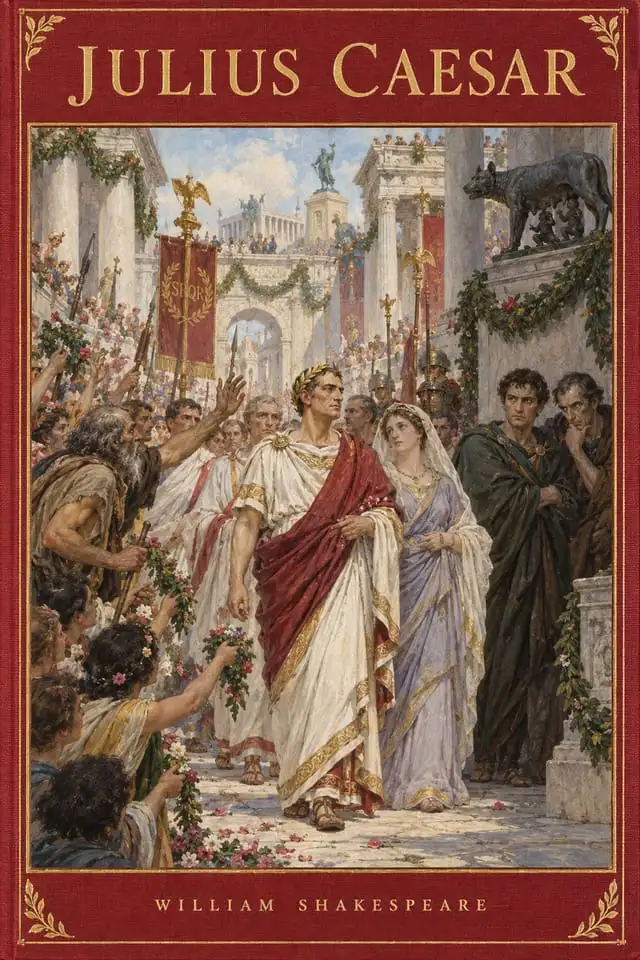
Characters
- FlaviusHas been put to silence with Marullus for removing decorations from images of Caesar, according to Casca.First appears: Act 1, Scene 1
- MarullusHas been put to silence with Flavius for removing decorations from images of Caesar, according to Casca.First appears: Act 1, Scene 1
- First CommonerA carpenter among the commoners whom Flavius and Marullus confront in the street.First appears: Act 1, Scene 1
- Second CommonerA cobbler who answers the questioning with puns before explaining that the commoners are celebrating Caesar's triumph.First appears: Act 1, Scene 1
- CaesarAppears as a ghost to Brutus, calls himself Brutus's evil spirit and says they will meet at Philippi.First appears: Act 1, Scene 2
- AntonyPraises the dead Brutus as the noblest Roman and says that he alone among the conspirators acted for the common good rather than envy.First appears: Act 1, Scene 2
- CalpurniaFrightened by strange sights and a dream of Caesar's statue bleeding, she briefly persuades him to stay at home before Decius changes his mind.First appears: Act 1, Scene 2
- PortiaHas died after swallowing fire, according to Brutus, who attributes her distress to his absence and the strength of Antony and Octavius.First appears: Act 1, Scene 2
- Decius BrutusHelps arrange Metellus Cimber's approach to Caesar and joins the conspirators in killing him.First appears: Act 1, Scene 2
- CiceroHas been put to death by proscription, as both Brutus's letters and Messala report.First appears: Act 1, Scene 2
- BrutusReports a second visit from Caesar's ghost, runs onto his sword with Strato's help and is praised by Antony for joining the conspiracy for the common good.First appears: Act 1, Scene 2
- CassiusBelieves Pindarus's mistaken report that Titinius is captured and has Pindarus kill him with the sword that struck Caesar.First appears: Act 1, Scene 2
- CascaStrikes Caesar first, beginning the attack in which the other conspirators and Brutus join.First appears: Act 1, Scene 2
- SoothsayerAnswers Caesar's remark that the ides of March have come by reminding him that they have not yet gone.First appears: Act 1, Scene 2
- CinnaJoins the attack on Caesar and immediately calls for the streets to hear that tyranny is dead.First appears: Act 1, Scene 3
- LuciusFalls asleep while playing music for Brutus and, when awakened after the ghost's visit, says he saw nothing.First appears: Act 2, Scene 1
- Metellus CimberKneels to seek his brother Publius Cimber's return from banishment as the conspirators gather around Caesar, then joins their attack.First appears: Act 2, Scene 1
- TreboniusDraws Antony away before the attack on Caesar and returns to report that Antony has fled home and the streets are in panic.First appears: Act 2, Scene 1
- Caius LigariusIll when he visits Brutus, he declares himself ready to follow him in an honourable enterprise without yet knowing what it is.First appears: Act 2, Scene 1
- Caesar's servantCarries Caesar's instructions to the priests and reports their advice to stay at home after they find no heart in the sacrificial animal.First appears: Act 2, Scene 2
- PubliusIs bewildered by Caesar's killing, and Brutus and Cassius urge him to leave safely because he has no part in their deed.First appears: Act 2, Scene 2
- ArtemidorusUrgently asks Caesar to read his warning first, but Caesar puts aside the personal request and dismisses his insistence.First appears: Act 2, Scene 3
- LepidusConsents to his brother's death on condition that Antony's nephew Publius also dies, then leaves to fetch Caesar's will.First appears: Act 3, Scene 1
- Popilius LenaWishes Cassius's enterprise success and approaches Caesar, briefly alarming the conspirators before Brutus reassures Cassius.First appears: Act 3, Scene 1
- Antony's servantCarries Antony's request for safe passage and an explanation of Caesar's death to Brutus, then leaves to fetch his master.First appears: Act 3, Scene 1
- Octavius's servantReports that Octavius is approaching Rome, weeps at Caesar's body and stays to help Antony carry it to the market-place before taking news back.First appears: Act 3, Scene 1
- First CitizenCalls for Cinna to be torn to pieces on hearing his name, declaring him a conspirator.First appears: Act 3, Scene 2
- Second CitizenThreatens Cinna with a blow after twisting his statement that he is a bachelor into an insult to married men.First appears: Act 3, Scene 2
- Third CitizenUrges the citizens to tear Cinna and carry firebrands to the conspirators' houses.First appears: Act 3, Scene 2
- Fourth CitizenCalls for Cinna to be torn for his verses and dismisses his denial of being the conspirator because he shares the name.First appears: Act 3, Scene 2
- Cinna the poetGoes out despite an unsettling dream and faces citizens calling for him to be torn to pieces even after he explains that he is a poet rather than the conspirator.First appears: Act 3, Scene 3
- OctaviusOffers employment to Brutus's surviving followers and orders an honourable burial for Brutus after the victory.First appears: Act 4, Scene 1
- LuciliusLets enemy soldiers take him for Brutus and offers money to be killed, but Antony recognises him and orders that he be treated kindly.First appears: Act 4, Scene 2
- TitiniusReturns from friendly troops to find Cassius dead, crowns him with the wreath sent by Brutus and kills himself with Cassius's sword.First appears: Act 4, Scene 2
- PindarusMistakes Titinius's welcome for capture, kills Cassius at his command and leaves intending to escape to a place where no Roman will know him.First appears: Act 4, Scene 2
- First SoldierPasses on the command to halt when the armies meet before Brutus's tent.First appears: Act 4, Scene 2
- Second SoldierRepeats the command to halt as it passes along the troops.First appears: Act 4, Scene 2
- Third SoldierRepeats the command to halt before the generals begin their dispute.First appears: Act 4, Scene 2
- PoetInsists on entering the generals' tent to urge friendship in rhyme, but Brutus and Cassius send him away.First appears: Act 4, Scene 3
- MessalaLearns how Strato helped Brutus die and recommends him to Octavius for this last service to his master.First appears: Act 4, Scene 3
- VarroSleeps in Brutus's tent, says he saw nothing when awakened and is sent with Claudius to tell Cassius to advance early.First appears: Act 4, Scene 3
- ClaudiusSleeps in Brutus's tent, denies seeing anything and is sent with Varro to carry Brutus's marching instructions to Cassius.First appears: Act 4, Scene 3
- MessengerWarns Antony and Octavius that the enemy is approaching with its battle signal displayed and that immediate action is needed.First appears: Act 5, Scene 1
- Young CatoProclaims himself Marcus Cato's son and an enemy of tyrants before falling in battle, where Lucilius praises his brave death.First appears: Act 5, Scene 3
- StratoHolds the sword on which Brutus kills himself and agrees to serve Octavius if Messala recommends him.First appears: Act 5, Scene 3
- VolumniusBrutus appeals to their old school friendship for help in dying, but he refuses on the grounds that this is no task for a friend.First appears: Act 5, Scene 3
- First enemy soldierThreatens Lucilius with death but then refuses to kill him, believing him to be the valuable prisoner Brutus, and announces the supposed capture to Antony.First appears: Act 5, Scene 4
- Second enemy soldierCalls for Antony to be told that Brutus has been captured, mistaking Lucilius for him.First appears: Act 5, Scene 4
- ClitusRefuses Brutus's whispered request, observes his tears and repeatedly urges him to flee before leaving with Dardanius and Volumnius.First appears: Act 5, Scene 5
- DardaniusRecoils from Brutus's request to kill him, tells Clitus what was asked and leaves when Brutus sends his companions away.First appears: Act 5, Scene 5


Themes
- Power and tyranny
- Honour and duty to Rome
- Persuasion and manipulation
- The crowd and public opinion
- Appearance and reality
- Fate, omens and choice
- Friendship and political loyalty
Context
- A cobbler
- The word can mean a shoe repairer or a clumsy workman, allowing the Second Commoner to answer without immediately making his trade clear. Act 1, Scene 1
- The holy chase
- Caesar invokes an inherited belief that a runner's touch during the ceremony can cure childlessness; this explains his instruction to Antony about Calpurnia. Act 1, Scene 2
- The sacrifice
- The priests examine a sacrificed animal for signs of whether Caesar should go out; the missing heart is the basis of their warning. Act 2, Scene 2
Chapter summaries
Act 1, Scene 1
Flavius and Marullus challenge workers dressed for a holiday in a Roman street, and a carpenter and a cobbler answer them. The cobbler's puns frustrate their questioning before he admits that the commoners have come to celebrate Caesar's triumph. Marullus recalls their earlier enthusiasm for Pompey and condemns their present celebrations as ingratitude towards him. His repeated questions turn a comic encounter into an accusation of political disloyalty. After the commoners leave without answering this rebuke, Flavius proposes removing decorations from images of Caesar and driving his supporters from the streets. His image of clipping a bird's wings presents public honours as the means by which Caesar could rise above other Romans and make them fearful subjects.
Act 1, Scene 2
Caesar directs Antony to touch Calpurnia during the ceremonial race, then dismisses the Soothsayer who warns him about the ides of March. Left with Brutus while the others attend the games, Cassius presents himself as a mirror of Brutus's worth and tells stories of Caesar's physical weakness to challenge his elevated status. Brutus says he loves Caesar but opposes his becoming king, and sets honour and the general good above fear of death without yet committing himself to action. Shouts from the unseen crowd repeatedly interrupt their conversation, giving public approval a powerful presence on stage. Returning with his company, Caesar calls Cassius dangerous while insisting that he himself is unafraid. Casca's scornful report describes three refusals of a coronet, which he interprets as reluctant, as well as Caesar's collapse, some onlookers' forgiveness and the silencing of Marullus and Flavius. Once Brutus leaves, Cassius's soliloquy reveals a plan to imitate several citizens' handwriting in letters praising Brutus and hinting at Caesar's ambition, exposing the manipulation behind his appeal to friendship.
Act 1, Scene 3
Casca enters with his sword drawn during thunder and lightning and tells Cicero of fire, an unharmed burning hand, a lion and other strange sights. He treats these as divine warnings, while Cicero cautions that people can give events meanings of their own. After Cicero leaves, Cassius claims to have exposed himself fearlessly to the storm and interprets its disturbances as warnings against an unnaturally powerful man whom Casca identifies as Caesar. Casca reports a rumour that the senators intend to make Caesar king outside Italy, and Cassius declares that suicide would let him escape subjection. Cassius calls Roman submission womanish and compares Romans to sheep to challenge Casca's courage, and Casca pledges to act with him. Cinna arrives and agrees to leave one paper in the praetor's chair, throw another through Brutus's window and fasten a third to old Brutus's statue. Cassius and Casca then leave to visit Brutus, whose public reputation they believe can make their enterprise appear virtuous.
Act 2, Scene 1
Alone in his orchard before dawn, Brutus argues that Caesar must die, although he admits he knows no personal reason against him and has not seen his feelings override his reason. His image of a serpent's egg turns a possible future danger into a reason for immediate violence. Lucius brings a paper urging action, part of Cassius's scheme to imitate appeals from citizens, and Brutus answers it with a promise to act for Rome. Cassius arrives with the conspirators, but Brutus takes a leading role by rejecting an oath, excluding Cicero and insisting that Antony should live. He describes the killing as a sacrifice and urges the men to disguise their purposes, making public appearances part of his claim to act honourably. After the conspirators leave, Portia challenges her exclusion from her husband's secrets and cites a wound she has given herself as proof of her endurance, winning his promise to confide in her. Ligarius then agrees to join an undertaking whose details he does not yet know, trusting Brutus's reputation for honour.
Act 2, Scene 2
Thunder and lightning accompany Caesar's entrance, and he sends a servant to ask the priests about a sacrifice while Calpurnia urges him to stay at home. Caesar presents death as unavoidable and fear as cowardice, interpreting even the absence of a heart in the sacrificial animal as a challenge to his courage. Calpurnia persuades him to remain indoors by offering to let her fear take the blame, but he insists that his will alone should satisfy the senate. Decius reinterprets her dream of Caesar's bleeding statue as a promise that Rome will draw renewed life from him. He then claims the senate intends to crown Caesar and imagines the ridicule that staying away could bring, prompting Caesar to dismiss Calpurnia's fears and ask for his robe. Publius, several conspirators and Antony arrive, and Caesar's invitation to drink wine as friends contrasts with the asides of Trebonius and Brutus, which reveal danger and divided loyalty beneath the courtesies.
Act 2, Scene 3
Artemidorus enters alone near the Capitol and reads a paper addressed to Caesar. The warning names Brutus, Cassius and their allies, offering specific information rather than an unexplained omen. Artemidorus intends to approach Caesar as a suitor and give him the paper when he passes. His warning that complacency allows conspiracy challenges Caesar's confidence in his safety. The closing conditional lines present reading the paper as a possible means of survival, while also imagining the Fates working with the traitors if Caesar does not read it.
Act 2, Scene 4
Portia enters with Lucius and orders him to hurry to the senate-house before she has explained his errand. Her difficulty giving clear instructions and her appeal for constancy expose the strain of keeping her thoughts hidden. She asks for news of Brutus and Caesar, then thinks she hears a disturbance from the Capitol that Lucius cannot hear. The Soothsayer arrives and explains that he wants to speak to Caesar away from the press of the crowd, admitting that he fears harm but knows nothing certain will happen. Once he leaves, Portia wishes Brutus success in his enterprise, fears Lucius heard her and appears to cover her words by saying Brutus has a request Caesar will refuse. Her instruction to say she is merry directly conflicts with her declared faintness, making concealment visible in her speech.
Act 3, Scene 1
As Caesar approaches the Capitol with the conspirators and other Romans, he dismisses Artemidorus's urgent request and treats the arrival of the ides of March as an answer to the Soothsayer's warning. Trebonius draws Antony away while the conspirators use Metellus Cimber's petition to gather around Caesar, who compares his own firmness to the northern star before they stab him. Brutus urges them to bathe their hands in Caesar's blood and proclaim peace and liberty, while Cassius imagines future performances celebrating them as liberators. Antony returns after obtaining a promise of safety, shakes their bloody hands and asks to speak at Caesar's funeral. Cassius's aside warns that Antony may move the people, but Brutus believes speaking first and setting conditions will protect their cause. Once the others leave, Antony's soliloquy calls them butchers and imagines Caesar's revenge bringing widespread civil violence, exposing the hostility beneath his apparent reconciliation. Octavius's servant arrives with news that his master is near Rome, and Antony keeps him to help carry the body to the market-place before reporting how the crowd receives his speech.
Act 3, Scene 2
Brutus and Cassius divide the citizens between them, and Brutus addresses those who remain in the Forum by asking them to trust his honour and judge his reasons. He sets love of Rome above love of Caesar and presents the choice as Caesar's death or Roman slavery. The citizens cheer him, but their wish to make him Caesar shows how readily their enthusiasm attaches itself to another individual. After Brutus leaves, Antony repeatedly calls the conspirators honourable while giving examples that challenge the claim that Caesar was ambitious. He pauses in grief, delays reading the will and brings the citizens close to the body, using the damaged mantle and wounds to turn political disagreement into pity and anger at betrayal. His claim to be a plain speaker conflicts with the careful way he directs their attention, and the will's gifts of money and public recreation grounds strengthen their determination to take revenge. The citizens carry away Caesar's body, declaring that they will burn it and use the burning wood to set fire to the conspirators' houses, while Antony welcomes news of Octavius's arrival and hears that Brutus and Cassius have fled.
Act 3, Scene 3
Cinna the poet enters alone, troubled by a dream of feasting with Caesar and unable to explain why he goes out despite his reluctance. Four citizens question him and demand answers that are direct, brief, wise and true. His attempt to follow their instructions becomes dangerous when the Second Citizen twists his statement that he is a bachelor into an insult to married men. Cinna says that he is going to Caesar's funeral as a friend, but his name immediately prompts a demand to tear him to pieces as a conspirator. Even his repeated identification as the poet fails to stop the threats, because the Fourth Citizen substitutes bad verses and then the shared name as reasons for violence. The Third Citizen ends by calling for attacks on the conspirators' houses, linking their threats against an uninvolved man to the crowd's wider pursuit of revenge.
Act 4, Scene 1
Antony, Octavius and Lepidus sit at a table deciding who shall die, and consent to the deaths of Lepidus's brother and Antony's nephew Publius. The brief exchange makes family ties subordinate to their agreement over the killings. Antony sends Lepidus to fetch Caesar's will so that they can reduce the cost of its legacies, treating as an expense the gifts he earlier used to win the crowd. Once Lepidus leaves, Antony questions his fitness to share power and compares him to an ass carrying gold and a horse directed by its rider. Octavius points out that Antony has accepted Lepidus's vote on the death list and defends him as a brave, experienced soldier. Antony urges preparations against the forces being raised by Brutus and Cassius, while Octavius fears that even smiling faces may conceal enemies.
Act 4, Scene 2
Brutus enters with Lucilius, Lucius and soldiers, and meets Titinius and Pindarus outside his tent near Sardis. Pindarus brings Cassius's greeting and defends his master's honour, but Brutus attributes his grievances either to a change in Cassius or to others acting for him. Lucilius reports a courteous reception without the easy friendship Cassius once showed, which Brutus interprets as affection giving way to ceremony. Brutus compares unreliable friends to horses whose fine appearance fails under pressure. When Cassius arrives, he accuses Brutus of doing him wrong and says that Brutus's restrained manner hides it. Brutus stops the public argument because their armies should see only love between them, and the commanders arrange privacy for a meeting inside the tent.
Act 4, Scene 3
Inside Brutus's tent, Cassius protests against the condemnation of Lucius Pella for bribery, while Brutus accuses Cassius himself of selling offices. Brutus invokes justice as the reason for killing Caesar and declares that he will not raise money dishonestly, yet also complains that Cassius has failed to send money to pay his troops, a refusal Cassius denies. Their dispute becomes a test of friendship, reaching Cassius's offer of his dagger and exposed breast before Brutus admits his own anger and they reconcile. After a poet interrupts to urge peace and is sent away, Brutus tells Cassius that Portia died by swallowing fire in distress at his absence and their enemies' growing strength. Messala confirms Cicero's execution and Portia's death, and Brutus presents his acceptance of inevitable death as a means of enduring grief, despite having already disclosed his suffering to Cassius. Cassius argues for waiting and tiring the enemy, but Brutus wins agreement to march to Philippi by arguing that their own strength has reached its height and comparing opportunity to a rising tide. After the others leave, Brutus lets his tired attendants sleep and tries to read, but Caesar's ghost appears and promises another meeting at Philippi, leaving him to question attendants who say they saw nothing.
Act 5, Scene 1
Octavius and Antony enter with their army, and a messenger announces the enemy's approach before Octavius insists on taking the right side of the field against Antony's instructions. Brutus and Cassius come forward to talk, but the meeting becomes an exchange of insults about Caesar's killing, Antony's words and the opposing leaders' courage. Cassius reproaches Brutus for sparing Antony, while Octavius draws his sword and vows revenge for Caesar or death himself. After Antony and Octavius leave, Cassius tells Messala that it is his birthday and that he is reluctantly staking their liberties on one battle. He partly accepts the replacement of friendly eagles by birds looking down as if on prey as an omen of death, although he insists that his courage remains firm. Brutus condemns ending life out of fear of possible suffering, yet his refusal to be paraded captive through Rome leaves a tension between endurance and his sense of honour. He and Cassius exchange farewells in case they never meet again, and Brutus wishes he could know the day's outcome before leading the men away.
Act 5, Scene 2
Brutus and Messala enter the battlefield amid alarms. Brutus orders Messala to ride to the legions on the other side with written instructions to attack at once. He bases the order on his judgement that Octavius's wing lacks spirit and will give way to a sudden assault. The repeated command to ride and the louder alarm make the brief scene urgent, while the result of the order remains unseen when both men leave.
Act 5, Scene 3
Cassius and Titinius enter amid retreat, and Titinius says that Brutus attacked too early, his soldiers turned to plunder and Antony surrounded Cassius's men. Pindarus reports that Antony is in the tents, and Cassius sends Titinius to identify nearby troops while using Pindarus as his lookout because his own sight is poor. Pindarus mistakes a welcome by friendly horsemen for capture, and Cassius, unwilling to outlive his friend's supposed loss, invokes his bondman's oath and orders him to strike with the sword that killed Caesar. Pindarus obeys and leaves, free but wishing he had not gained freedom in this way, before Titinius and Messala return with news that Brutus has defeated Octavius. On finding Cassius dead, they blame the disaster on error, and, once Messala goes to fetch Brutus, Titinius places the victory wreath on Cassius and kills himself with his sword. Brutus arrives with his companions and interprets the deaths as Caesar's spirit turning their weapons against them, rather than treating the killing of Caesar as a completed act. He postpones fuller mourning, sends Cassius's body to Thasos to spare the camp's morale and orders another battle before night.
Act 5, Scene 4
Soldiers fight as Brutus and young Cato urge their countrymen to stand firm. Cato repeatedly declares that he is Marcus Cato's son and an enemy of tyrants, while Brutus proclaims his own name before leaving. Lucilius praises the fallen Cato's brave death, then offers money to an enemy soldier and presents himself as Brutus in asking to be killed. The soldiers instead preserve the supposed noble prisoner and announce his capture to Antony. Lucilius insists that Brutus will never be taken alive and will remain true to himself, but Antony recognises the captive and values him as a man he would prefer as a friend. Antony's order to treat Lucilius kindly turns the encounter from threatened killing to respect for an opponent, while Brutus's whereabouts remain unknown.
Act 5, Scene 5
Brutus rests with Dardanius, Clitus, Strato and Volumnius, and his whispered requests for help in dying horrify Clitus and Dardanius. He tells Volumnius that Caesar's ghost has appeared twice, at Sardis and Philippi, takes this as proof that his hour has come and argues that choosing death is worthier than waiting for the enemy to force it on him. Brutus appeals to their school friendship, but Volumnius refuses to hold his sword, declaring that this is no task for a friend. As alarms and cries urge flight, Brutus bids his companions farewell, claims greater glory in defeat than his enemies will gain in victory, and persuades Strato to hold the sword on which he runs. His last words address Caesar and say that he kills himself more willingly than he killed him. Octavius, Antony, Messala and Lucilius arrive, and Strato describes the death as freedom from bondage before Messala recommends him for Octavius's service. Antony distinguishes Brutus's concern for the common good from the envy he attributes to the other conspirators, and Octavius closes the scene by ordering a respectful burial and rest for the army.
Key quotes
a mender of bad soles.
The pun on soles and souls lets the cobbler sound like someone who repairs moral faults. His verbal confidence unsettles the men demanding a direct answer.
Persuasion and manipulation
You blocks, you stones, you worse than senseless things!
Marullus strips the commoners of judgement and feeling through a sequence of insults. His anger at their changed allegiance also shows his contempt for the people he addresses.
The crowd and public opinionFriendship and political loyalty
These growing feathers pluck’d from Caesar’s wing Will make him fly an ordinary pitch,
Flavius imagines public honours as feathers that enable Caesar to rise above everyone else. Removing the decorations becomes a practical attempt to limit his power.
Power and tyrannyThe crowd and public opinion
I would not, Cassius; yet I love him well.
Brutus's answer separates his affection for Caesar from his opposition to kingship. The brief qualification makes his political judgement a conflict of loyalties.
Friendship and political loyaltyHonour and duty to RomePower and tyranny
The fault, dear Brutus, is not in our stars, But in ourselves, that we are underlings.
Cassius rejects fate as an excuse for political submission. His inclusive language makes Brutus share responsibility for resisting Caesar's dominance.
Fate, omens and choicePower and tyrannyPersuasion and manipulation
Well, Brutus, thou art noble; yet, I see, Thy honourable metal may be wrought From that it is disposed:
Alone, Cassius treats Brutus's honour as metal that can be reshaped. The image exposes a wish to manipulate the man he has praised as a friend.
Honour and duty to RomePersuasion and manipulationAppearance and realityFriendship and political loyalty
But men may construe things after their fashion, Clean from the purpose of the things themselves.
Cicero distinguishes events from the meanings people give them. His caution invites scrutiny of Cassius's confident political interpretation of the same storm.
Fate, omens and choiceAppearance and realityPersuasion and manipulation
Poor man! I know he would not be a wolf, But that he sees the Romans are but sheep:
Cassius makes Caesar's power depend on Roman submission rather than superior strength. The animal contrast shames Casca towards resistance.
Power and tyrannyPersuasion and manipulation
And that which would appear offence in us, His countenance, like richest alchemy, Will change to virtue and to worthiness.
Casca imagines Brutus's support transforming the public meaning of their actions. The alchemy comparison makes reputation seem capable of turning apparent wrongdoing into virtue.
Honour and duty to RomeAppearance and realityThe crowd and public opinion
And therefore think him as a serpent’s egg Which, hatch’d, would, as his kind, grow mischievous, And kill him in the shell.
Brutus imagines Caesar as a danger that has not yet developed. The comparison helps him justify killing a man for what he might become rather than what he has done.
Power and tyrannyHonour and duty to Rome
Let us be sacrificers, but not butchers, Caius.
Brutus uses the language of religious sacrifice to distinguish their intended killing from uncontrolled violence. His concern with how the act will appear to others complicates his claim to moral purity.
Honour and duty to RomeAppearance and realityThe crowd and public opinion
Within the bond of marriage, tell me, Brutus, Is it excepted I should know no secrets That appertain to you?
Portia treats knowledge of her husband's secrets as a right of marriage. Her question challenges the gap between his declarations of love and his refusal to trust her.
Friendship and political loyaltyHonour and duty to Rome
Cowards die many times before their deaths; The valiant never taste of death but once.
Caesar presents fear as repeated suffering and courage as freedom from it. This sharp distinction makes taking precautions seem shameful.
Fate, omens and choiceHonour and duty to RomeAppearance and reality
Your wisdom is consumed in confidence.
Calpurnia separates sound judgement from the confidence Caesar displays. Her direct criticism questions whether his boldness helps him judge the danger.
Persuasion and manipulationAppearance and reality
Signifies that from you great Rome shall suck Reviving blood,
Decius turns the dream's blood from a sign of danger into an image of Caesar sustaining Rome. The flattering interpretation offers Caesar a reason to accept the dream while ignoring Calpurnia's warning.
Persuasion and manipulationFate, omens and choicePower and tyranny
security gives way to conspiracy.
The warning identifies complacency as an opening for those plotting against Caesar. It makes attention and caution practical defences against danger.
Appearance and realityPower and tyranny
If thou read this, O Caesar, thou mayst live; If not, the Fates with traitors do contrive.
The repeated conditions place an ordinary act of reading beside the power of fate. Artemidorus still presents survival as possible, so the lines express uncertainty rather than a settled outcome.
Fate, omens and choiceFriendship and political loyalty
O constancy, be strong upon my side, Set a huge mountain ’tween my heart and tongue!
Portia imagines a mountain blocking her feelings from becoming speech. The scale of the image conveys how hard she finds keeping silent while she waits for news.
Appearance and realityHonour and duty to RomeFriendship and political loyalty
None that I know will be, much that I fear may chance.
The Soothsayer distinguishes what he knows from what he fears. His uncertainty sustains tension without confirming any outcome.
Fate, omens and choice
But I am constant as the northern star, Of whose true-fix’d and resting quality There is no fellow in the firmament.
Caesar makes his refusal a claim to stand above other men in firmness. The image presents resistance to persuasion as a unique greatness, just before his enemies answer him with violence.
Power and tyrannyAppearance and reality
And, waving our red weapons o’er our heads, Let’s all cry “Peace, freedom and liberty!”
Brutus joins a cry of peace to the visible display of bloodied weapons. The contrast makes the conspirators' claim to have freed Rome open to question.
Honour and duty to RomeThe crowd and public opinionAppearance and reality
O, pardon me, thou bleeding piece of earth, That I am meek and gentle with these butchers!
Antony's word 'butchers' rejects Brutus's earlier claim that they would be sacrificers. Spoken alone, the condemnation exposes his hostility beneath the handshake.
Friendship and political loyaltyAppearance and realityHonour and duty to Rome
Not that I loved Caesar less, but that I loved Rome more.
Brutus balances personal affection against public duty in a compact contrast. It states his justification without proving that Caesar's survival would have made Romans slaves.
Honour and duty to RomeFriendship and political loyaltyPersuasion and manipulation
But Brutus says he was ambitious; And Brutus is an honourable man.
Antony repeats the appeal to Brutus's honour beside evidence that questions his judgement of Caesar. What sounds like respect becomes an invitation to doubt him.
Honour and duty to RomePersuasion and manipulationAppearance and reality
I am no orator, as Brutus is; But, as you know me all, a plain blunt man, That love my friend;
Antony claims the authority of simple friendship while delivering a speech that has already changed the crowd's allegiance. Denying his skill helps him present his persuasion as unvarnished feeling.
Persuasion and manipulationFriendship and political loyaltyAppearance and realityThe crowd and public opinion
I am Cinna the poet, I am Cinna the poet.
The repeated identification is a desperate attempt to make the citizens recognise the difference between two men. Their response shows that accurate information cannot restrain their desire to attack.
The crowd and public opinionAppearance and reality
It is no matter, his name’s Cinna; pluck but his name out of his heart, and turn him going.
The Fourth Citizen dismisses the distinction between the poet and the conspirator. His grotesque instruction turns a shared name into a reason to destroy a person's body.
The crowd and public opinionAppearance and reality
He shall not live; look, with a spot I damn him.
Antony condemns his own nephew by marking a name. The small physical action makes the power to order a death seem routine.
Power and tyrannyFriendship and political loyalty
How to cut off some charge in legacies.
Antony now treats Caesar's gifts as costs to reduce, after presenting them to the citizens as proof of Caesar's love. The change exposes a gap between his public appeal and his private priorities.
Appearance and realityThe crowd and public opinionPower and tyranny
And though we lay these honours on this man, To ease ourselves of divers slanderous loads, He shall but bear them as the ass bears gold,
Antony imagines Lepidus carrying the blame attached to power without controlling it. The animal comparison turns an apparent partner into a burden-bearing servant.
Power and tyrannyAppearance and realityFriendship and political loyalty
When love begins to sicken and decay, It useth an enforced ceremony.
Brutus treats formal politeness as a symptom of failing affection. The language of sickness makes a change in behaviour seem like damage within the friendship.
Friendship and political loyaltyAppearance and reality
Before the eyes of both our armies here, Which should perceive nothing but love from us, Let us not wrangle:
Brutus separates what the soldiers should see from what the generals need to discuss. Maintaining the appearance of friendship becomes part of military leadership.
Friendship and political loyaltyAppearance and realityPower and tyranny
Did not great Julius bleed for justice’ sake?
Brutus uses the declared purpose of Caesar's killing as a standard for judging their present conduct. His question makes accepting corruption a betrayal of the cause he claims to serve.
Honour and duty to RomePower and tyranny
There is a tide in the affairs of men, Which, taken at the flood, leads on to fortune;
Brutus pictures opportunity as a tide that must be used at the right moment. The image makes immediate action seem necessary, but remains his argument for a choice Cassius has questioned.
Fate, omens and choicePersuasion and manipulation
Thy evil spirit, Brutus.
The ghost's answer ties the apparition to Brutus personally, although the stage direction identifies it as Caesar. Its disturbing presence interrupts the quiet of reading and sleep after the generals' decisions about war.
Fate, omens and choiceAppearance and reality
I do not cross you; but I will do so.
Octavius answers Antony's protest with a denial followed by an assertion of his own will. His refusal to accept the order reveals competing wills within their alliance.
Power and tyrannyFriendship and political loyalty
now I change my mind, And partly credit things that do presage.
Cassius admits that his beliefs have shifted under pressure, but 'partly' keeps his acceptance of omens uncertain. His account shows him interpreting the birds rather than receiving an unquestionable prediction.
Fate, omens and choiceAppearance and reality
No, Cassius, no: think not, thou noble Roman, That ever Brutus will go bound to Rome;
Brutus's emphatic refusal sets a limit on his earlier promise to endure what the higher powers send. The prospect of public captivity challenges his commitment to patient acceptance.
Honour and duty to RomeFate, omens and choice
Let them set on at once; for I perceive But cold demeanour in Octavius’ wing, And sudden push gives them the overthrow.
Brutus moves from his perception of weakness to confidence that an immediate attack will succeed. The speed of the order leaves no onstage discussion of his judgement.
Power and tyrannyAppearance and reality
O hateful error, melancholy’s child, Why dost thou show to the apt thoughts of men The things that are not?
Messala personifies error as a child of melancholy that shows receptive minds false images. His explanation connects Cassius's despair with the readiness to believe a mistaken report.
Appearance and realityFate, omens and choice
Alas, thou hast misconstrued everything!
Titinius addresses a dead friend who cannot hear the correction. The welcome and victory wreath expose how completely Cassius mistook the signs of friendship for defeat.
Appearance and realityFriendship and political loyalty
O Julius Caesar, thou art mighty yet! Thy spirit walks abroad, and turns our swords In our own proper entrails.
Brutus gives the suicides a meaning that reaches beyond the mistaken report. He interprets Cassius's and Titinius's deaths as signs of Caesar's continuing power.
Power and tyrannyFate, omens and choice
A foe to tyrants, and my country’s friend;
Cato defines his identity through opposition to tyranny and service to his country. His repeated announcement of his father's name ties that claim to family honour.
Power and tyrannyHonour and duty to Rome
I had rather have Such men my friends than enemies.
Antony recognises value in the loyalty of a man fighting on the other side. His wish to make such men friends joins respect for Lucilius to the advantage of gaining dependable allies.
Friendship and political loyaltyHonour and duty to RomePower and tyranny
That’s not an office for a friend, my lord.
Volumnius rejects Brutus's appeal to their shared past. His refusal makes friendship a reason to preserve Brutus's life, while Strato later accepts helping him die as a final service.
Friendship and political loyaltyHonour and duty to Rome
Caesar, now be still: I kill’d not thee with half so good a will.
Brutus's final address keeps Caesar present at the moment of his own death. His greater willingness to kill himself makes Caesar's killing the measure against which he judges his final act.
Fate, omens and choiceHonour and duty to RomeFriendship and political loyalty
This was the noblest Roman of them all:
Antony now gives Brutus explicit praise, explaining it through his motive of public service. The judgement comes from a victorious enemy and distinguishes honourable intention from success in the struggle for power.
Honour and duty to RomePower and tyranny