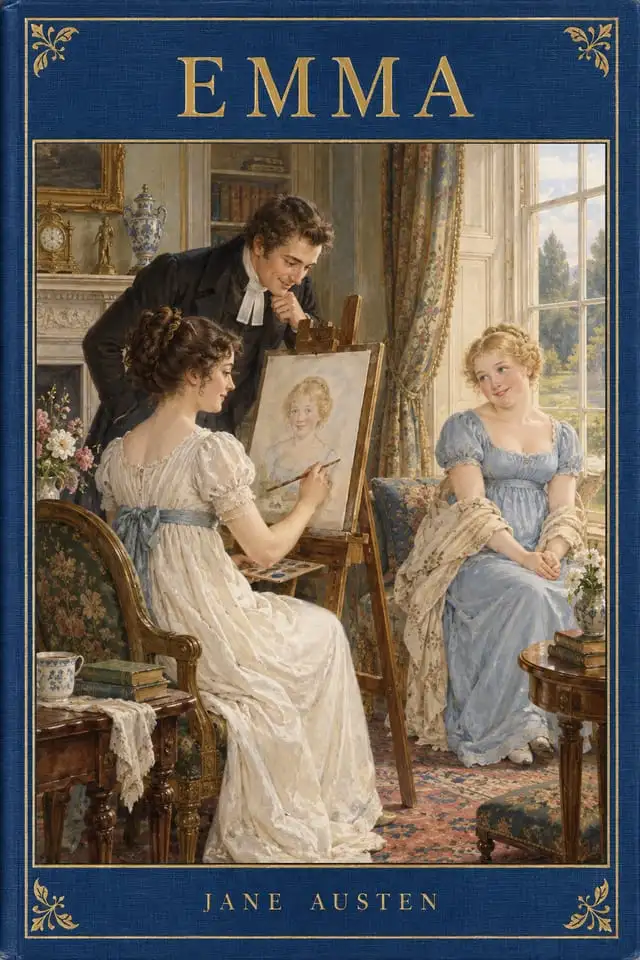
Characters
- Emma WoodhouseLearning that Harriet hopes to marry Mr Knightley makes her recognise her own love for him and the harm caused by her assumptions.First appears: Chapter 1
- Mr WoodhouseEmma's father, a kind, nervous man who worries constantly about health, hates change of every kind and pities "poor Miss Taylor" for getting married.First appears: Chapter 1
- Mrs WestonShe defends Emma's friendship with Harriet against Mr Knightley, and keeps to herself certain hopes that she and her husband share about Emma's future.First appears: Chapter 1
- Mr WestonBorn in Highbury, a former militia captain who let his first wife's rich family bring up his son, then made his fortune in trade, bought Randalls and married Miss Taylor.First appears: Chapter 1
- Mr KnightleyHe proposes living at Hartfield after marriage so that Emma need not leave her father.First appears: Chapter 1
- Mr EltonHe declares his love to Emma, denies having courted Harriet and dismisses a marriage to Harriet as beneath his level.First appears: Chapter 1
- IsabellaVisiting Hartfield with her husband and five children, she is gentle and devoted, sees no fault in her family, and shares her father's anxious care about health.First appears: Chapter 1
- Frank ChurchillThe secret engagement between Jane and Frank, formed at Weymouth in October, is revealed after Mr Churchill gives his consent.First appears: Chapter 2
- Mr PerryThe Highbury apothecary, an intelligent, gentlemanlike man whose frequent visits are one of Mr Woodhouse's comforts.First appears: Chapter 2
- Harriet SmithRevealed as a tradesman's daughter, she marries Robert Martin and spends less time at Hartfield as her life with his family begins.First appears: Chapter 3
- Miss BatesSingle, poor and no longer young, she cares for her old mother, talks a great deal about little things and is liked by everyone for her goodwill.First appears: Chapter 2
- Mrs BatesThe very old widow of a former vicar of Highbury, who lives with her daughter on a small income.First appears: Chapter 2
- Mrs GoddardThe motherly mistress of an established boarding school in Highbury, and a regular guest at Hartfield.First appears: Chapter 3
- Robert MartinRefused by Harriet, he is, Mr Knightley tells Emma, as bitterly disappointed as a man can be.First appears: Chapter 4
- Jane FairfaxThe secret engagement between Jane and Frank, formed at Weymouth in October, is revealed after Mr Churchill gives his consent.First appears: Chapter 10
- John KnightleyFond of his brother beneath a cool manner, he loses his temper when Mr Woodhouse quotes Mr Perry against the family's autumn at South End.First appears: Chapter 1
- Mrs EltonMarried to Mr Elton, she repeatedly praises Maple Grove and her rich relations, and assumes she can introduce Emma to superior society.First appears: Chapter 21
Themes
- Marriage and matchmaking
- Class and social rank
- Self-knowledge and misjudgement
- Influence and control
- Women, money and independence
- Highbury and village society
Chapter summaries
Chapter 1
The opening sentence presents Emma as handsome, clever and rich, but the narrator quickly names her real dangers: having too much her own way and thinking too well of herself. Miss Taylor's wedding leaves Emma facing long evenings with a father who is kind but anxious, hates change and cannot match her in conversation. Mr Knightley, an old friend and the elder brother of Isabella's husband, arrives from London and is one of the few people who sees Emma's faults and says so. Emma claims credit for the Westons' marriage, and Mr Knightley replies that she made only a lucky guess and may have done herself more harm than good by interfering. Unmoved, she announces she will find a wife for Mr Elton, the young man who conducted the wedding. The chapter contrasts Emma's confidence in her own judgement set against the warnings of Mr Knightley.
Chapter 2
Mr Weston, from a respectable Highbury family, joined the militia of his county and married Miss Churchill of a great Yorkshire family against the wishes of her proud brother and his wife. The marriage was not happy, as she wanted both her husband and the luxuries of Enscombe, and after her death the Churchills took charge of the little boy, Frank. Mr Weston then made a modest fortune in trade in London, bought Randalls, and married Miss Taylor, who brings no fortune but promises to make him happier than ever. Frank, brought up as the Churchills' heir, has never visited Highbury, yet the whole village takes pride in him, and for days every visit includes talk of his handsome letter. Mrs Weston is content, while Mr Woodhouse goes on pitying her and tries to stop anyone eating the wedding-cake. The chapter shows how money, rank and marriage shape lives, and how Highbury makes everyone's business its own.
Chapter 3
Mr Woodhouse's circle is small and must visit on his terms, so Emma's evenings are often spent with three ladies whose quiet talk bores her. Miss Bates, poor, plain and unmarried, is nonetheless liked by everyone because of her cheerful goodwill. Harriet Smith, the "natural daughter of somebody", charms Emma with her beauty and her grateful deference. Emma at once plans to improve Harriet's manners and opinions and to detach her from the Martins, a farming family she assumes must be coarse, although she knows Mr Knightley thinks highly of them. Emma calls this a kind undertaking, but it is also a way to fill her own empty days. At supper Mr Woodhouse, torn between hospitality and fear for his guests' health, comically offers them only a small egg, a very little tart and half a glass of wine in water.
Chapter 4
Emma values Harriet as someone she can be useful to and can summon for walks, unlike Mrs Weston, whom she respects. Harriet's happy stories of Abbey-Mill Farm reveal Robert Martin's kindness: he went three miles round to bring her walnuts, reads aloud in the evenings, and, Harriet believes, is well spoken of by everyone. Emma openly scorns the yeomanry, tells Harriet she must be a gentleman's daughter, and warns her that low acquaintances would give people the chance to degrade her. When they meet Mr Martin, Emma finds him plain and "clownish" and compares him unfavourably with Mr Knightley, Mr Weston and Mr Elton. She then turns Harriet's thoughts to Mr Elton, the vicar, whom she has meant for Harriet's husband since their first evening, judging the match natural and desirable. The chapter exposes Emma's snobbery and her readiness to decide what other people feel.
Chapter 5
Mr Knightley believes Emma has been spoiled by being the cleverest of her family and mistress of the house since she was twelve. He recalls her many well-chosen reading lists that came to nothing and says she will never submit to steady work. Harriet, he argues, is the worst companion Emma could have, because her ignorance is a constant flattery, and Harriet herself will only learn to be uncomfortable among the people she belongs with. Mrs Weston, who loves Emma, defends her as a good daughter, sister and friend who will make no lasting blunder. Both praise Emma's beauty, and Mr Knightley adds that her vanity "lies another way". He says it would do Emma good to fall in love and be unsure of a return. The chapter gives two outside views of the heroine, one critical and one fond, so the reader can weigh them.
Chapter 6
Mr Elton praises the improvement Emma has made in Harriet, and Emma takes his warmth as proof of his love for her friend. Emma proposes a portrait, and Mr Elton begs her to do it. Her portfolio shows many unfinished drawings: she has talent, but has never kept at anything long, and she does not mind her reputation being higher than it deserves. She makes Harriet taller and more elegant than she really is; Mr Knightley says she has made her too tall, while Mr Elton defends every detail. Mr Woodhouse worries that the girl in the picture will catch cold. Emma thinks Mr Elton's sighs and compliments excessive, but she explains them away to fit her plan, putting his praise of her down to gratitude on Harriet's account.
Chapter 7
Robert Martin's letter is so well written that Emma first suggests one of his sisters helped him, then admits it is a man's style and shows good sense and strong feeling. Harriet is pleased and unsure, and asks Emma what to do. Emma insists she will not advise her, then lays down a rule that a woman who doubts should refuse, and hints that Harriet may be thinking of someone else. Once Harriet decides to refuse, Emma reveals that she could never have visited "Mrs. Robert Martin, of Abbey-Mill Farm", which shocks Harriet and confirms her decision. Emma then shapes every sentence of the refusal while claiming not to help. Harriet still feels for Mr Martin and his family, and Emma turns her thoughts to Mr Elton, imagining him showing Harriet's picture to his mother and sisters. The chapter shows how far Emma's influence reaches while she believes she leaves Harriet free.
Chapter 8
Harriet now spends long visits at Hartfield. Mr Knightley praises her improvement, then reveals that Robert Martin consulted him before proposing and that he approved the match as a piece of good luck for Harriet. When Emma tells him the offer has been refused, he blames her at once and says that Harriet, a girl of unknown birth with little sense and no useful education, could not hope for better. Emma insists that Harriet is a gentleman's daughter whose beauty and sweet temper give her the right to choose, while Mr Knightley warns that she is filling Harriet with vanity and that Mr Elton knows the value of a good income too well to marry her. Emma laughs off the hint and claims to have given up matchmaking, though she remains sure of Mr Elton's love for Harriet. Left alone she feels uneasy, but convinces herself she was right, and Harriet arrives with Miss Nash's story that Mr Elton has gone to London carrying something "exceedingly precious". Both argue about social standing, but Mr Knightley also offers knowledge of Robert Martin's character that challenges Emma's assumptions.
Chapter 9
Emma's plan to improve Harriet's mind with reading has never gone beyond a few first chapters, and the girls collect riddles instead. Asked for contributions, Mr Elton leaves a charade on the word "courtship", claiming a friend wrote it for a young lady he admires. Emma reads it as a declaration to Harriet, explains every line, and tells her that marriage to Mr Elton would give her consideration, independence and a home close to Hartfield. Harriet, who believes that whatever Emma says is right, now thinks Robert Martin's plain letter a poor thing beside verses. Mr Woodhouse, delighted by the compliment to women, struggles to remember an old riddle and frets about Isabella's coming visit and his son-in-law's roughness with the children. Emma does all the reading and judging here, and Harriet simply accepts it.
Chapter 10
Walking down Vicarage Lane, Emma teases Harriet that she will live there one day. Asked why she does not marry, Emma says she needs neither fortune, employment nor consequence, and could never be as important in a husband's eyes as she is in her father's. When Harriet fears she will become an old maid like Miss Bates, Emma argues that only poverty makes a single woman ridiculous, and she dismisses Miss Bates's niece, Jane Fairfax, as a bore. Her visit to the sick cottagers shows real kindness and good sense, though she wonders herself how long the impression will last, and as soon as Mr Elton appears she is scheming again. She pretends to fix her boot, walks with a child from the cottage to stay behind, and finally breaks her lace and throws it in a ditch to get Harriet into the Vicarage. The trick gives the pair ten minutes together, but nothing serious is said, and Emma decides Mr Elton is simply cautious. The chapter shows Emma at her most generous and her most managing on a single walk.
Chapter 11
Emma decides that Mr Elton and Harriet must manage without her, since her sister's family will fill her time. Isabella is pretty, gentle and devoted, but like her father she is anxious about health and trusts her own Mr Wingfield in London as he trusts Mr Perry. John Knightley is clever and respectable but reserved and sometimes short-tempered, and Emma watches him closely for any lack of patience with her father. Mr Woodhouse still mourns "poor Miss Taylor", and Emma points out that they have seen the Westons on every day but one since the wedding. Mr Woodhouse recalls Frank Churchill's letter, and Isabella is shocked that any father could give up his child. John Knightley replies that Mr Weston is an easy, sociable man rather than one of strong feelings, and Emma, though she dislikes the remark, keeps the peace. The chapter brings new observers into Highbury, each judging others through their own temper.
Chapter 12
Emma invites Mr Knightley partly to end their quarrel, and holding her baby niece helps; they shake hands, though neither gives way on the main point. He tells her that if she judged men and women by nature rather than by fancy and whim, they would always agree, and reminds her that he is sixteen years older. The brothers greet each other with a calm that hides real attachment, and talk of farming at Donwell and points of law, for Mr Knightley is a magistrate. Meanwhile Mr Woodhouse recommends gruel, doubts the sea air and sets Mr Perry's opinions against Isabella's Mr Wingfield, while Emma steers the talk away from danger. Isabella praises Jane Fairfax as accomplished and exactly Emma's age, and Emma, glad of a safe subject, joins in. When Mr Woodhouse repeats that South End was a bad choice, John Knightley snaps at Mr Perry's interference and his brother turns the talk to a footpath. The comedy shows how much tact Emma and Mr Knightley need to keep the family at peace.
Chapter 13
Harriet is too ill to join the party and Emma consoles her by predicting Mr Elton's disappointment. Mr Elton instead worries about Emma catching the infection. Emma suggests he should stay at home, assuming he will want to hear news of Harriet, but he promptly accepts John Knightley's offer of a carriage seat. John Knightley remarks that Mr Elton labours to please women and suggests that Emma is his object. Emma rejects the idea and congratulates herself on understanding circumstances better than her brother-in-law. The differing responses to snow and social visiting show how each traveller's desires shape what seems reasonable.
Chapter 14
Emma delights in Mrs Weston's company, but Mr Elton's persistent compliments prevent her listening to news about Frank. She wonders whether John Knightley's suggestion is right, though she still imagines Mr Elton's feelings as a transfer from Harriet. Despite declaring she will never marry, she has already pictured Frank as someone suitable for her. Mr Weston confidently predicts his son's visit while admitting that he has never been to Enscombe himself. Mrs Weston explains the dependence on Mrs Churchill's wishes and refuses to share that confidence. Their conversation asks how securely anyone can judge the conduct of people whose household they do not know.
Chapter 15
Mr Elton's concern about infection centres insistently on Emma rather than Harriet. John Knightley's alarming account of the snow upsets Mr Woodhouse and Isabella, while Mr Weston's wish to prolong the visit ignores their distress. Mr Knightley examines the road himself and supplies practical reassurance. A change in carriage arrangements leaves Emma alone with Mr Elton, who seizes her hand and declares his passion. Emma first blames drink or a change of affections, but he insists that all his attentions have been directed at her. His contemptuous dismissal of Harriet as an unequal match exposes the social assumptions beneath his gallantry. Emma rejects him and must conceal her agitation when she reaches the peaceful family at Hartfield.
Chapter 16
Alone after the party, Emma is most distressed by the disappointment she has prepared for Harriet. She remembers the picture and charade, acknowledging that she made events bend to her original idea. The Knightley brothers' warnings now seem more perceptive than her own observations. Her anger at Mr Elton's social ambition also exposes her conviction that he is beneath her in family, money and understanding. She admits that her attentions could reasonably have encouraged his mistake. Her resolution to abandon matchmaking remains incomplete: she still approves the refusal of Robert Martin and momentarily starts considering another man. The snow postpones difficult meetings without resolving her responsibility for Harriet's hurt.
Chapter 17
Mr Elton's letter pointedly excludes Emma while remaining ceremoniously polite to her father. Mr Woodhouse notices only the journey's dangers, giving the same message a different meaning from Emma's. Emma at last confesses her mistaken predictions to Harriet. Harriet's modesty and absence of blame make Emma value her above her own cleverness. She resolves to show affection through steady kindness rather than matchmaking. Yet she continues to underestimate how long Harriet's love may last, while recognising that their shared neighbourhood makes future meetings unavoidable.
Chapter 18
The expected visit fails when Frank writes that he cannot be spared. Mr Weston recovers quickly by imagining a longer visit in better weather, while his less hopeful wife feels the disappointment more deeply. Emma wants quiet after her own mistakes, yet expresses more concern than she feels and becomes drawn into defending Frank. Mr Knightley argues that a grown man should fulfil his duty to his father despite pressure from his guardians. Emma answers that habits of dependence and gratitude make such independence harder than Mr Knightley understands. Their debate distinguishes pleasing manners from consideration for others while also exposing how strongly both judge someone they have never met.
Chapter 19
Emma knows she neglects the Bateses but usually avoids a visit she expects to find boring. Her immediate motive for calling is to distract Harriet, rather than simply to please their hosts. Miss Bates welcomes them warmly and describes Jane's letter in such detail that escaping the letter itself scarcely saves Emma time. Jane has been unwell and chooses to visit Highbury instead of accompanying the Campbells to Ireland. Miss Bates describes the Dixons' pressing invitation and Mr Dixon's rescue of Jane during a sailing party. Emma turns those particulars into suspicion, probing the comparison between Jane's beauty and Mrs Dixon's without evidence of a romance.
Chapter 20
Orphaned as a small child, Jane was first cared for by her grandmother and aunt, then educated with Colonel Campbell's daughter. The Campbells love her but cannot provide an independent fortune, so her accomplishments prepare her to teach for a living. Her friend's marriage contrasts financial security with Jane's approaching need to work. Emma recognises Jane's beauty and difficult position, while partly admitting that jealousy may explain her dislike. Sympathy does not last through an evening of music and cautious conversation. Jane refuses to offer definite judgements about Mr Dixon or Frank Churchill, and Emma treats that reserve as evidence of concealment rather than respecting its limits.
Chapter 21
Mr Knightley interprets Emma's behaviour as a welcome improvement in her treatment of Jane. Miss Bates brings thanks for the Woodhouses' gift of pork and news of Mr Elton's engagement. The exchange mixes material generosity with the rapid circulation of private news through Highbury. Emma expects Harriet to be distressed by the engagement, but Harriet instead describes meeting the Martins while sheltering from rain. Their kindness unsettles Emma, who recognises wounded affection but then dismisses Harriet's judgement and suspects social ambition. She tells Harriet about Mr Elton sooner than intended to redirect her attention, and is reassured when the Martins again lose their hold on the conversation.
Chapter 22
Highbury praises Miss Hawkins before knowing her, and Mr Elton returns eager to display his successful engagement. The account joins his satisfaction in being loved with the practical attraction of her fortune. Emma welcomes the marriage as a way of reducing their awkward intimacy, but dismisses Augusta's family connections through guesses about her relatives' occupations. Harriet continues to encounter reminders of Mr Elton throughout the village. Elizabeth Martin's visit and note offer a competing claim on her feelings. Emma recognises that ignoring the Martins would be ungrateful, yet plans to control the length and meaning of Harriet's return visit so that it cannot restore their former friendship.
Chapter 23
A recollection of Robert measuring Harriet's height helps turn the Martins' cautious welcome into renewed affection. Emma's punctually returning carriage interrupts that recovery and makes the visit seem deliberately distant. She understands their hurt but still insists that the friendship must be broken because of rank. The Westons' certainty that Frank is coming distracts her from this discomfort. His early arrival, lively conversation and praise of Mrs Weston immediately please her. She notices how well he understands what will flatter his listeners, while remaining uncertain what his manner implies about herself. Mr Weston urges him to visit Jane promptly so that her poorer circumstances in Highbury do not expose her to a slight.
Chapter 24
Emma takes Frank's attentiveness to Mrs Weston and interest in his father's old home as proof of good feeling. His enthusiasm for a ball surprises her because he seems less concerned than she is about mixing ranks. Asked about Jane, he criticises her complexion and later says they often met at Weymouth. He reports that Mr Dixon preferred Jane's playing to that of the woman he was engaged to marry. Emma treats this musical preference as potentially revealing, though she has no knowledge of Jane's feelings. Their agreement about reserve draws them closer, and Frank's praise of the vicarage as a sufficient home for a loving couple leads Emma to imagine him willing to sacrifice wealth for marriage.
Chapter 25
Emma finds Frank's expensive and apparently trivial excursion hard to reconcile with the moderation she had attributed to him. His reported admiration of her helps restore a lenient view. Mr Knightley interprets the same action through his existing dislike. Emma considers the prosperous Coles socially inferior and imagines teaching them their place by refusing dinner. The prospect of missing friends and a possible dance soon makes exclusion more painful than accepting their hospitality. Their considerate invitation and the Westons' encouragement let her change her mind, while Mr Woodhouse's worries require patient arrangements at Hartfield.
Chapter 26
Frank's easy manner makes Emma excuse the London excursion she had criticised. News of Jane's anonymous gift gives her imagination fresh material, and Frank follows her suggestions about the Dixons without establishing who sent it. Mrs Weston interprets Mr Knightley's carriage arrangements for Jane and Miss Bates as evidence of love. Emma credits simple kindness instead and protests that marriage would displace her nephew Henry as heir to Donwell. She ridicules Miss Bates while imagining the connection, earning Mrs Weston's rebuke. During the music, Mr Knightley's practical concern for Jane's tiring voice contrasts with Frank's eagerness for another song. Emma enjoys dancing with Frank and treats Mr Knightley's failure to ask Jane as reassurance about an anxiety she has framed in terms of family inheritance.
Chapter 27
Emma's misgivings about gossip compete with the flattery of Frank's agreement. She is less doubtful about Jane's musical superiority and responds with vigorous practice. Harriet's praise cannot erase that difference, while news of Robert Martin makes Emma watchful about another accidental meeting. Miss Bates's rambling invitation reveals practical acts of kindness around her household, including Mr Knightley's gift of all his remaining store apples, rather than simply supplying the romantic explanations Emma seeks.
Chapter 28
Frank explains that repairing the spectacles has also allowed time to steady Jane's instrument. His questions about the present force Jane to insist that its origin remains conjecture until she hears from Colonel Campbell. Emma recognises the cruelty of pressing her, yet reads a smile as permission to continue enjoying the speculation. The plainly overheard conversation with Mr Knightley contrasts his practical concern and offer of help with the hints and interpretations inside the room.
Chapter 29
The projected party expands as more neighbours become impossible to exclude. Frank repeatedly agrees with Emma's objections while persisting in the arrangement he wants, and she notices self-will beneath his gallantry. The Crown offers more space, but persuading Mr Woodhouse requires appeals to safety, familiar care and the convenience of the horses. The organisers' eagerness turns obstacles into small matters, while Miss Bates is welcomed chiefly for the approval she gives rather than advice they still require.
Chapter 30
Emma resents Mr Knightley's indifference to the ball and treats Jane's enthusiasm as further evidence against his supposed attachment to her. The summons from Enscombe then makes Frank's immediate departure necessary. His unfinished remarks at Hartfield leave Emma to supply their meaning, and she interprets his embarrassment as stronger love than she expected. Her own boredom after he goes becomes evidence of affection, though her qualification that it may last only a few weeks makes that self-diagnosis uncertain.
Chapter 31
Emma enjoys inventing declarations and tender farewells but notices that none involves a painful sacrifice. She remains confident of Frank's love while doubting its constancy. His compliment to Harriet becomes material for another speculative match, despite Emma's awareness of the danger. When ordinary reasoning does not quiet Harriet's distress about Mr Elton, Emma invokes her own remorse and Harriet's duty of affectionate consideration, making gratitude a powerful means of influence.
Chapter 32
The first visit revives Emma's memory of her errors, while Harriet continues to admire Mr Elton and his wife. A longer conversation at Hartfield lets Mrs Elton display her pride in wealthy relations and her assumption that she can improve Emma's social opportunities. Her surprise that a former governess should be so ladylike particularly insults Emma's loyalty to Mrs Weston. Emma's private anger is expressed through her own insistence on rank and elegance, while her father's mild judgement shows how differently the same visit can be understood.
Chapter 33
The narration confirms much of Emma's judgement of Mrs Elton's self-importance. Her promised help for Jane combines admiration with an uninvited claim to manage her opportunities and future employment. Emma sees the humiliation in this patronage but remains baffled by Jane's refusal to visit Ireland. Mr Knightley asks her to consider Jane's restricted choices and her own failure to offer companionship, before distinguishing his respect for Jane from a romantic attachment.
Chapter 34
Hosting the Eltons lets Emma fulfil social expectations, while inviting Jane begins to repair a neglect she admits. John Knightley's conversation with Jane reveals how separation from loved people gives letters a value his settled home life can obscure. Mrs Elton turns concern about a wet walk into a decision to take over Jane's errand, ignoring her refusal. Jane insists on keeping the walk, and Emma exercises restraint by leaving her suspicions unspoken rather than risking another hurtful hint.
Chapter 35
Mrs Elton treats Jane's refusal of help as inexperience rather than a decision deserving respect. Jane's comparison between governess employment and trade in people expresses her dread, while explicitly distinguishing the guilt involved. Mrs Elton's pride in fashionable households misses Jane's fear of humiliation through comparison. Mr Weston's arrival replaces this difficult conversation with his own expectation that news of Frank must delight everyone.
Chapter 36
Mr Weston and Mrs Elton each use the other's remarks as openings for their preferred subject. His complaints about Mrs Churchill's pride meet her own stories of neighbours who supposedly claim too much consequence. John Knightley's concern about the boys rests on a picture of Emma's expanding amusements that she disputes with specific examples. The conversation again shows how expectations and selected incidents can turn limited observations into a confident account of another person's life.
Chapter 37
Emma interprets her anxiety about Frank's return as concern for his feelings rather than her own. His restlessness and rapid departure are absorbed into a story of diminishing but lingering love. Frank insists that his aunt really is unwell, resisting his father's assumption that her complaints are imaginary. Mr Weston transforms the move to Richmond into another assurance of happiness, and the practical chance of a full day's visit finally secures the ball.
Chapter 38
Emma discovers that Mr Weston has invited several supposedly special advisers early, reducing the distinction she imagined was hers. Frank's restless attention to arrivals and his reaction to Mrs Elton remain difficult for her to understand. Mr Elton's public refusal of Harriet turns social form into deliberate humiliation, encouraged by his wife. Mr Knightley's intervention offers practical kindness rather than display, and his later conversation with Emma combines criticism of her mistake with recognition of Harriet's real merits.
Chapter 39
Emma begins the morning pleased with her improved understanding with Mr Knightley and hopeful that Harriet has seen Mr Elton's faults. Frank's unexpected arrival with Harriet replaces that satisfaction with a dramatic new incident. The account explains how Harriet's cramp prevented flight and how Frank's delayed departure brought him to her aid. Emma turns coincidence and gratitude into a possible romance, distinguishing a supposedly passive scheme from the interference she has renounced while still assuming she knows both people's feelings.
Chapter 40
Harriet's piece of court-plaster and worn pencil show how ordinary objects acquired intense private significance. Remembering how she manipulated the court-plaster incident renews Emma's shame. When Harriet describes another man's kindness, both women proceed without stating a name, leaving Emma's interpretation untested. Emma warns against excessive confidence but also praises Harriet's choice, so her claim of non-interference still carries encouragement and assumptions about what will improve her friend's mind.
Chapter 41
The narration follows Mr Knightley's observations while preserving his uncertainty about what they mean. Frank attributes private information about the Perrys to a dream after Mrs Weston denies telling him, and Miss Bates reveals that the plan was known in her household. During the letter game, the words 'blunder' and 'Dixon' carry meanings not shared by the whole table and visibly disturb Jane. Emma conceals the speculation behind the second word and dismisses Mr Knightley's warning, leaving two observers with incompatible explanations of the same conduct.
Chapter 42
Mr Weston combines the proposed Box Hill parties despite Emma's private dislike of the arrangement. At Donwell, Mr Knightley's preparations make Mr Woodhouse comfortable without deceiving him about the visit. Emma admires the estate and sees Harriet talking easily with its owner, while Mrs Elton continues pressing Jane towards a post she does not want. Jane's request for solitude briefly receives the respect she asks for, but Emma explains both Jane's distress and Frank's later irritability through assumptions that do not establish their causes.
Chapter 43
Good weather and careful arrangements cannot make the group enjoy itself together. Emma and Frank entertain one another through exaggerated gallantry and a demand that the rest provide clever remarks. Emma's response to Miss Bates turns the older woman's self-deprecation into public humiliation. Mr Knightley insists that Emma's wealth, influence and long acquaintance make the cruelty especially serious, and her attempt to dismiss it as irresistible wit gives way to an acknowledgement of its truth.
Chapter 44
Emma resolves on regular kindness rather than a single compensating gesture. At the Bateses', she notices a painful reserve that makes their gratitude harder to bear. Jane's acceptance of the position reverses her repeated refusal, and Miss Bates's assurances of excellent prospects sit beside evidence of tears and illness. The contrast between Mrs Churchill's power and Jane's restricted choices brings Emma to reflect on unequal destinies rather than treating Jane chiefly as a romantic puzzle.
Chapter 45
Emma interprets Mr Knightley's almost-kiss of her hand as evidence that he understands her penitence. Mrs Churchill's death overturns easy dismissals of her complaints, while also prompting Emma to imagine fewer obstacles to a match between Frank and Harriet. Jane's worsening condition gives Emma an urgent wish to repair past neglect. Her help is consistently rejected, however, and the discovery that Jane can walk while refusing her carriage makes Emma recognise that good intentions do not guarantee welcome or trust.
Chapter 46
Mr Weston's mysterious request first makes Emma fear harm to the Knightleys. The true disclosure overturns her confident explanations of Jane and Frank, while her own romantic indifference relieves the Westons. Emma objects that Frank could not know whether his flirtation would injure her, and remembers with shame her talk of Mr Dixon. Mrs Weston asks for fuller explanation before condemning him and urges consideration of Jane's restricted situation, leaving sympathy and moral judgement in tension.
Chapter 47
Emma prepares to console Harriet about Frank and discovers that their unnamed confidences concerned different men. Harriet meant Mr Knightley's invitation to dance when she described a rescue from misery. Her hope of returned affection forces Emma to recognise the importance of Mr Knightley in her own life. Self-knowledge arrives with painful recognition of her responsibility, though her horror of the unequal match still mingles remorse with wounded pride and social prejudice.
Chapter 48
Emma's desire for Mr Knightley competes with her fear of abandoning her father and her belief that his recent rebuke excludes romantic love. Jane's account of concealment presents suffering as a consequence of wrongdoing rather than an excuse that cancels it. Emma regrets choosing to shape Harriet instead of trying to know Jane, though that reflection still includes distinctions of birth and education. A gloomy evening makes her imagine the loss of all her closest companions, leaving better conduct and clearer self-knowledge as the only consolation she can claim.
Chapter 49
Each begins the walk fearing that the other loves someone else. Emma's attempt to stop a confession she thinks concerns Harriet is received by Mr Knightley as rejection of himself. Their willingness to speak honestly finally reveals the attachment already present on both sides. The narration explains his jealousy of Frank and departure for London, while Emma's decision not to expose Harriet limits the completeness of their disclosure without making their mutual love uncertain.
Chapter 50
Emma's joy is qualified by responsibilities to her father and the friend she has hurt. Frank's letter offers a competing retrospective account of the events she misunderstood. He admits using attentions to Emma as a disguise, yet claims he believed she was indifferent and partly understood him. Jane's decision to end the engagement and take a post, together with his accidentally unsent answer, exposes consequences of his self-will that he now acknowledges more directly.
Chapter 51
Emma's own happiness inclines her towards forgiveness, while Mr Knightley weighs the risks Frank imposed on others against the favourable outcome. His criticism of the surprise pianoforte focuses on Jane's wishes rather than the giver's intention. Their own practical difficulty is answered by his willingness to surrender familiar independence at Donwell. Emma also recognises that her former concern for Henry's inheritance concealed personal objections to Mr Knightley's marrying someone else.
Chapter 52
Harriet's departure serves both a practical dental need and Emma's desire for distance from her friend's pain. Emma delays telling her father of her own engagement until Mrs Weston has recovered from childbirth. At the Bateses', Mrs Elton performs her supposed discretion through repeated hints and confidently mistakes the day of a meeting. Jane's private conversation with Emma replaces artificial manners with acknowledged fault and mutual goodwill, offering the closer acquaintance Emma had previously failed to seek.
Chapter 53
The new baby prompts affectionate disagreement about how much guidance corrected Emma's faults. Mr Knightley questions the value of his interference, while Emma admits its benefit more readily than before. Announcing the marriage requires patient attention to Mr Woodhouse's fears rather than treating consent as a simple formality. The village's responses again reflect its members' own interests, with Mrs Elton interpreting the match as a loss of access and consequence for herself.
Chapter 54
Mr Knightley mistakes Emma's surprise at Harriet's engagement for continued opposition. The account of renewed meetings in London reveals how a relationship Emma imagined impossible has developed without her direction. Both acknowledge changed opinions of Harriet and Robert, though Emma is especially relieved that Harriet's happiness resolves her own guilt. Frank's revived jokes about Dixon and the invented dream make Jane uncomfortable, leaving Emma able to enjoy his company while distinguishing playful charm from considerate conduct.
Chapter 55
Emma now recognises Harriet's enduring liking for Robert Martin and learns how unfounded her certainty about a gentleman father was. She approves Robert's character after finally becoming acquainted with him. The withdrawal of Harriet's daily presence restores a social distance presented as natural, leaving class boundaries alongside the happy marriages. Mr Woodhouse's familiar fears enable the wedding when reassurance alone has failed, and Mrs Elton's criticism of its lack of display contrasts with the satisfaction of the couple's close friends.
Key quotes
Emma Woodhouse, handsome, clever, and rich, with a comfortable home and happy disposition, seemed to unite some of the best blessings of existence
The opening lists Emma's advantages, but "seemed" leaves room for a difference between her circumstances and her judgement.
Self-knowledge and misjudgementClass and social rank
The real evils, indeed, of Emma's situation were the power of having rather too much her own way, and a disposition to think a little too well of herself
The narrator names Emma's faults at once: too much freedom and too much self-regard. The reader is invited to watch for them while Emma herself does not.
Self-knowledge and misjudgementInfluence and control
I promise you to make none for myself, papa; but I must, indeed, for other people. It is the greatest amusement in the world!
Emma treats other people's marriages as a game for her own entertainment, and promises to make no match for herself.
Marriage and matchmakingInfluence and control
must give him the pleasantest proof of its being a great deal better to choose than to be chosen, to excite gratitude than to feel it.
Mr Weston's first marriage, to a woman above him, was unequal; in marrying Miss Taylor he is the one who chooses. Austen weighs the balance of power and gratitude inside a marriage.
Marriage and matchmakingClass and social rank
Mr. Frank Churchill was one of the boasts of Highbury, and a lively curiosity to see him prevailed, though the compliment was so little returned that he had never been there in his life.
Highbury is proud of a young man it has never seen. The gentle irony shows a village that builds its opinions from report and gossip.
Highbury and village society
His own stomach could bear nothing rich, and he could never believe other people to be different from himself.
Mr Woodhouse's kindness is real, but he cannot imagine that others feel differently from him. His "gentle selfishness" is played for comedy.
Self-knowledge and misjudgementHighbury and village society
Harriet Smith was the natural daughter of somebody.
The repeated "somebody" in the paragraph stresses how little anyone knows about Harriet's birth. Emma begins planning Harriet's future without knowing her family.
Class and social rank
She would notice her; she would improve her; she would detach her from her bad acquaintance, and introduce her into good society; she would form her opinions and her manners.
The repeated "she would" shows Emma treating Harriet as a project. Emma decides everything about another person's life after a single evening.
Influence and controlClass and social rankSelf-knowledge and misjudgement
Her daughter enjoyed a most uncommon degree of popularity for a woman neither young, handsome, rich, nor married.
The sentence lists everything that normally gave a woman standing, and Miss Bates has none of it. Her place in Highbury rests only on her good nature.
Women, money and independenceHighbury and village society
For Mrs. Weston there was nothing to be done; for Harriet everything.
Emma likes Harriet because Harriet needs her. The friendship is built on Emma's wish to be useful and in charge.
Influence and control
The yeomanry are precisely the order of people with whom I feel I can have nothing to do.
Emma dismisses a whole class of people in one sentence. Her snobbery is plain, though she presents it as good sense.
Class and social rankSelf-knowledge and misjudgement
There can be no doubt of your being a gentleman's daughter, and you must support your claim to that station by everything within your own power
Emma has no evidence about Harriet's father, yet speaks with total certainty. She uses fear of losing rank to push Harriet away from Robert Martin.
Class and social rankInfluence and controlSelf-knowledge and misjudgement
She will never submit to anything requiring industry and patience, and a subjection of the fancy to the understanding.
Mr Knightley's key charge: Emma lets her imagination ("fancy") rule her reason ("understanding"). This is exactly how she has been judging Harriet and Robert Martin.
Self-knowledge and misjudgement
Her ignorance is hourly flattery.
Harriet does not mean to flatter, but her admiration feeds Emma's self-regard. Mr Knightley sees that the friendship is harmful because it is so pleasing to Emma.
Influence and controlSelf-knowledge and misjudgement
I should like to see Emma in love, and in some doubt of a return; it would do her good.
Mr Knightley thinks Emma needs to feel uncertainty herself, instead of arranging other people's feelings.
Marriage and matchmakingSelf-knowledge and misjudgement
She was not much deceived as to her own skill either as an artist or a musician, but she was not unwilling to have others deceived, or sorry to know her reputation for accomplishment often higher than it deserved.
Emma knows her limits but enjoys being overpraised. The narrator shows a small vanity alongside her real talent.
Self-knowledge and misjudgement
You have made her too tall, Emma
Mr Knightley's plain remark punctures the praise. Emma has improved Harriet in the picture, just as she is trying to improve her in life.
Influence and controlSelf-knowledge and misjudgement
This man is almost too gallant to be in love
Emma notices something odd in Mr Elton's manner, then talks herself out of it because it does not fit her plan.
Self-knowledge and misjudgementMarriage and matchmaking
I lay it down as a general rule, Harriet, that if a woman doubts as to whether she should accept a man or not, she certainly ought to refuse him.
Emma presents a general rule as neutral wisdom, but she uses it to push Harriet towards the answer she wants.
Influence and controlMarriage and matchmaking
I could not have visited Mrs. Robert Martin, of Abbey-Mill Farm. Now I am secure of you forever.
Only after Harriet decides does Emma reveal the cost of accepting: losing Emma's friendship because of rank. The fear of losing Hartfield, a matter of class rather than feeling, fixes Harriet's choice.
Class and social rankInfluence and control
though Emma continued to protest against any assistance being wanted, it was in fact given in the formation of every sentence.
The narrator's dry irony exposes the gap between what Emma says and what she does.
Influence and controlSelf-knowledge and misjudgement
Emma, your infatuation about that girl blinds you.
Mr Knightley names what the reader has watched since chapter 3: Emma's fondness for her project stops her seeing Harriet or Robert Martin clearly.
Self-knowledge and misjudgementInfluence and control
Till you chose to turn her into a friend, her mind had no distaste for her own set, nor any ambition beyond it.
He blames Emma for teaching Harriet to look down on the people she grew up among. Harriet's sense of her own rank, he says, has been given to her by Emma.
Class and social rankInfluence and control
Elton may talk sentimentally, but he will act rationally.
Mr Knightley judges Mr Elton by what he says about money among men, not by his romantic manner. Emma decides he spoke only in anger and sets the warning aside.
Marriage and matchmakingClass and social rankSelf-knowledge and misjudgement
It was much easier to chat than to study; much pleasanter to let her imagination range and work at Harriet's fortune, than to be labouring to enlarge her comprehension or exercise it on sober facts
The narrator confirms Mr Knightley's earlier charge that Emma lets fancy rule over steady work. Imagining Harriet's future is more fun than educating her.
Self-knowledge and misjudgementInfluence and control
Receive it on my judgment.
Emma asks Harriet to trust her completely, and Harriet does. The friendship runs on Emma's confidence and Harriet's dependence.
Influence and controlSelf-knowledge and misjudgement
it will fix you in the centre of all your real friends, close to Hartfield and to me, and confirm our intimacy forever.
Emma's praise of the match ends with what it would give her: Harriet kept close at hand. Her matchmaking serves her own wishes as well as her friend's.
Marriage and matchmakingInfluence and control
Fortune I do not want; employment I do not want; consequence I do not want: I believe few married women are half as much mistress of their husband's house as I am of Hartfield
Emma lists the usual reasons a woman marries, money, an occupation and status, and says she has them all already. Her wealth gives her a freedom most women in the novel lack.
Women, money and independenceMarriage and matchmakingClass and social rank
it is poverty only which makes celibacy contemptible to a generous public!
Emma connects the respectability of an unmarried woman with her money. Her explanation protects her own position while recognising Miss Bates as an exception to her general claims about poverty.
Women, money and independenceClass and social rank
he advances inch by inch, and will hazard nothing till he believes himself secure.
When her scheme produces no proposal, Emma finds an explanation that keeps her belief in Mr Elton's love intact.
Self-knowledge and misjudgementMarriage and matchmaking
There are people, who the more you do for them, the less they will do for themselves.
Emma's reason for leaving the lovers alone is a general rule, but it could describe her own management of Harriet just as well.
Influence and controlSelf-knowledge and misjudgement
She could never see a fault in any of them.
Isabella loves without judging. She is the opposite of Emma, who notices every fault in John Knightley: "Nothing wrong in him escaped her."
Self-knowledge and misjudgement
Mr. Weston is rather an easy, cheerful-tempered man, than a man of strong feelings
John Knightley gives a cool, unflattering reason why Mr Weston could part with his son. It differs sharply from Highbury's warm opinion of him.
Highbury and village societySelf-knowledge and misjudgement
If you were as much guided by nature in your estimate of men and women, and as little under the power of fancy and whim in your dealings with them
Mr Knightley repeats his central charge: Emma judges children by nature but adults by fancy. It is the same complaint he made to Mrs Weston.
Self-knowledge and misjudgementInfluence and control
Little Emma, grow up a better woman than your aunt. Be infinitely cleverer and not half so conceited.
Emma jokes about her own conceit, which lets her admit a fault lightly while conceding nothing about Harriet.
Self-knowledge and misjudgement
Why does he make it any business of his, to wonder at what I do?
John Knightley's outburst breaks the peace of the evening. The narrator adds that Mr Woodhouse has been putting his own feelings into Mr Perry's mouth.
Highbury and village society
Emma, too eager and busy in her own previous conceptions and views to hear him impartially, or see him with clear vision
The narrator explicitly identifies Emma's expectations as an obstacle to observing Mr Elton accurately.
Self-knowledge and misjudgement
You had better look about you, and ascertain what you do, and what you mean to do.
John Knightley asks Emma to examine both her intentions and the impression her conduct gives.
Self-knowledge and misjudgementInfluence and control
what is the certainty of caprice?
Mrs Weston exposes the contradiction in relying confidently on an unpredictable person's behaviour.
Self-knowledge and misjudgement
One ought to use the same caution, perhaps, in judging of the conduct of any one individual of any one family
Mrs Weston recommends knowledge of particular circumstances before judging someone's choices.
Self-knowledge and misjudgementHighbury and village society
Everybody has their level
Mr Elton's appeal to rank makes explicit why he considers a match with Harriet beneath him.
Class and social rankMarriage and matchmaking
I have been in a most complete error with respect to your views, till this moment.
Emma finally acknowledges that she has misunderstood the intentions she had confidently explained to Harriet.
Self-knowledge and misjudgementInfluence and control
She had taken up the idea, she supposed, and made everything bend to it.
Emma identifies the process by which an attractive assumption distorted her reading of evidence.
Self-knowledge and misjudgement
Oh! that I had been satisfied with persuading her not to accept young Martin. There I was quite right.
Her remorse has limits: she continues to defend the earlier interference that separated Harriet from Robert Martin.
Class and social rankInfluence and controlSelf-knowledge and misjudgement
Where the wound had been given, there must the cure be found if anywhere
Hartfield has encouraged Harriet's attachment, so Emma now feels responsible for helping her recover there.
Influence and controlSelf-knowledge and misjudgement
Not one of them had the power of removal, or of effecting any material change of society.
Their confined social world makes a private misunderstanding a continuing practical difficulty.
Highbury and village societyMarriage and matchmaking
We are both prejudiced; you against, I for him; and we have no chance of agreeing till he is really here.
Emma explicitly acknowledges how their opposed expectations precede direct knowledge of Frank.
Self-knowledge and misjudgement
You do not know what it is to have tempers to manage.
Emma challenges Mr Knightley's assumption that a dependent person has the same freedom to act as he does.
Influence and controlClass and social rank
she seldom went near them
The plain admission qualifies Emma's self-image as a generous neighbour: she lets boredom outweigh duties she recognises.
Highbury and village societySelf-knowledge and misjudgement
with the insidious design of farther discovery
The narration marks the concealed purpose beneath Emma's apparently polite questions about Jane.
Self-knowledge and misjudgementInfluence and control
while Jane Fairfax had yet her bread to earn.
The contrast with her friend's secure marriage reduces Jane's uncertain future to the practical need to earn a living.
Women, money and independenceClass and social rankMarriage and matchmaking
These were her reasons
The paragraph's account of Emma's dislike offers defensive explanations rather than convincing faults in Jane.
Self-knowledge and misjudgement
What arises from discretion must be honoured.
Mr Knightley distinguishes a proper refusal to disclose everything from a fault Emma is entitled to overcome.
Self-knowledge and misjudgementHighbury and village society
there had been an interesting mixture of wounded affection and genuine delicacy in their behaviour.
Emma can recognise the Martins' feeling and tact even while resisting the implications for her own advice.
Class and social rankSelf-knowledge and misjudgement
vanity and prudence were equally contented.
Mr Elton's satisfaction combines personal flattery with the security of a wealthy match.
Marriage and matchmakingClass and social rank
something of ingratitude, merely glossed over
Emma's own conscience detects the unkindness hidden beneath her carefully managed social formality.
Influence and controlSelf-knowledge and misjudgement
They must be separated; but there was a great deal of pain in the process
Emma sees the suffering her control causes but continues to treat separation as necessary.
Influence and controlClass and social rank
He understood what would be welcome; he could be sure of little else.
The narration distinguishes Frank's skill in pleasing Emma from secure knowledge of the people he praises.
Self-knowledge and misjudgementHighbury and village society
There is safety in reserve, but no attraction.
Frank presents openness as attractive while acknowledging the protection that reticence offers.
Self-knowledge and misjudgementHighbury and village society
one may guess what one chooses.
Emma claims freedom to invent motives from Jane's conduct instead of establishing what Jane actually feels.
Self-knowledge and misjudgement
she wanted exactly the advice they gave.
The narrator exposes how Emma's request for advice supports a decision she already wishes to make.
Self-knowledge and misjudgement
she should like to have had the power of refusal
Her resentment reveals the pleasure of exercising social power even before she considers enjoying the party.
Class and social rankInfluence and control
I smile because you smile, and shall probably suspect whatever I find you suspect
Frank makes agreement itself part of his pleasing manner rather than supplying independent evidence for Emma's suspicion.
Self-knowledge and misjudgementInfluence and control
For shame, Emma! Do not mimic her.
Mrs Weston checks Emma's use of Miss Bates's speech as a source of amusement, while admitting she too finds the imitation funny.
Highbury and village societyClass and social rank
Surprises are foolish things. The pleasure is not enhanced, and the inconvenience is often considerable.
Mr Knightley judges the mysterious present by its effect on its recipient rather than its romantic appearance.
Highbury and village societySelf-knowledge and misjudgement
My playing is no more like hers, than a lamp is like sunshine.
Emma recognises a genuine difference in skill despite Harriet's uncritical preference for her.
Self-knowledge and misjudgement
the duty of woman by woman
Her unease concerns loyalty to another woman whose private feelings she has made a subject of speculation.
Women, money and independenceHighbury and village society
mine was a random guess. Do not distress her.
Emma briefly acknowledges the uncertainty of the story she has encouraged Frank to believe.
Self-knowledge and misjudgementInfluence and control
It must be all conjecture.
Jane states a limit to what can honestly be known while the others continue treating suggestion as insight.
Self-knowledge and misjudgement
the nature of his gallantry was a little self-willed
Emma detects that Frank's wish to please her does not prevent him pressing his own preference.
Self-knowledge and misjudgementInfluence and control
As a counsellor she was not wanted; but as an approver, (a much safer character,) she was truly welcome.
The distinction exposes how a social group can seek reassuring agreement rather than useful judgement.
Highbury and village societySelf-knowledge and misjudgement
I must be in love; I should be the oddest creature in the world if I were not
Emma reasons towards a feeling she thinks circumstances require rather than simply recognising an unquestionable attachment.
Self-knowledge and misjudgementMarriage and matchmaking
I would much rather have been merry than wise.
Being right about the risk of disappointment offers less comfort than the pleasure Emma has lost.
Self-knowledge and misjudgementHighbury and village society
I certainly will not persuade myself to feel more than I do.
Emma recognises a temptation to manufacture feelings to fit an attractive story about herself.
Self-knowledge and misjudgement
I mention no names; but happy the man who changes Emma for Harriet!
Her denial of a specific scheme barely conceals the imagined transfer of Frank's attachment.
Influence and controlMarriage and matchmaking
she appears so truly good
Mrs Elton's approval of Mrs Weston sounds generous but belongs to a judgement that also assumes a governess's manners are surprising.
Class and social rankHighbury and village society
A bride, you know, my dear, is always the first in company, let the others be who they may.
Mr Woodhouse treats the bride's precedence as a duty of courtesy even though he dislikes marriage itself.
Marriage and matchmakingHighbury and village society
she receives attentions from Mrs. Elton, which nobody else pays her.
Mr Knightley shifts the question from Jane's supposed bad taste to the alternatives actually offered to her.
Women, money and independenceHighbury and village society
She has not the open temper which a man would wish for in a wife.
His explanation separates admiration for Jane's qualities from the disposition he would seek in marriage.
Marriage and matchmakingSelf-knowledge and misjudgement
it is not age, but situation.
Jane challenges the assumption that everyone's attachments and needs change in the same way with time.
Women, money and independenceHighbury and village society
I cannot by any means consent to such an arrangement
Her clear refusal exposes the difference between offering assistance and respecting the recipient's wishes.
Influence and controlWomen, money and independence
it would be no object to me to be with the rich; my mortifications, I think, would only be the greater
Jane separates material splendour from personal comfort and dignity in employment.
Women, money and independenceClass and social rank
I am very serious in not wishing anything to be attempted at present for me.
Her insistence makes clear that Mrs Elton's continuing activity overrides an expressed choice.
Influence and controlWomen, money and independence
I am no flatterer.
Mrs Elton claims independent judgement while preparing to approve a man she has not yet met.
Self-knowledge and misjudgement
happiness must preclude false indulgence and physic.
Emma answers the warning about spoiling the boys by defining care as more than giving in to them or dosing them.
Highbury and village societyInfluence and control
She had no doubt as to his being less in love
The certainty belongs to Emma's interpretation of a short and restless visit, rather than an explicit account from Frank.
Self-knowledge and misjudgementMarriage and matchmaking
Better than nearer!
Mr Weston's delighted response finds an advantage even in the remaining distance between the families.
Highbury and village societySelf-knowledge and misjudgement
Not your vain spirit, but your serious spirit.
Mr Knightley distinguishes Emma's capacity for honest reflection from the pride that misleads her.
Self-knowledge and misjudgement
With you, if you will ask me.
Emma's direct request follows gratitude and frank conversation, making their mutual ease visible through a simple exchange.
Highbury and village societyMarriage and matchmaking
There could be no harm in a scheme, a mere passive scheme.
The distinction lets Emma preserve the pleasure of matchmaking while claiming to have abandoned its dangers.
Self-knowledge and misjudgementInfluence and control
So Emma thought, at least.
The qualification separates Emma's certainty about romantic consequences from what the narration can establish.
Self-knowledge and misjudgementMarriage and matchmaking
Let no name ever pass our lips.
The rule meant to prevent meddling also prevents the women from checking whether they mean the same person.
Influence and controlSelf-knowledge and misjudgement
I shall be happier to burn it
Harriet values release from a painful association more than the object's remaining practical use.
Self-knowledge and misjudgementMarriage and matchmaking
seemed confined to you and Mr. Churchill.
Mr Knightley challenges amusement shared by two people at another person's expense, refusing to accept that calling it a joke makes it harmless.
Highbury and village societyInfluence and control
I will answer for the gentleman's indifference.
Emma's assurance exceeds what she can prove and prevents serious consideration of another reading of Frank's conduct.
Self-knowledge and misjudgement
The greatest kindness you can show me, will be to let me have my own way
Jane defines helpfulness as respecting her decision rather than managing her comfort for her.
Women, money and independenceInfluence and control
He was invited on good faith.
Mr Knightley's arrangements respect Mr Woodhouse's known needs instead of luring him into unwanted pleasures.
Highbury and village societyInfluence and control
Her situation should secure your compassion.
Mr Knightley grounds his rebuke in Miss Bates's poverty and declining circumstances, making kindness a responsibility attached to Emma's privilege.
Class and social rankHighbury and village society
She felt it at her heart.
Emma's response is more than fear of being criticised: the account shows the judgement reaching her feelings and conscience.
Self-knowledge and misjudgement
it should be the beginning, on her side, of a regular, equal, kindly intercourse.
Emma imagines reparation as an ongoing change in how she relates to Miss Bates, rather than a display of generosity.
Self-knowledge and misjudgementHighbury and village society
one was everything, the other nothing
The comparison concerns the unequal importance society gives Mrs Churchill and Jane, despite the intensity of Jane's suffering.
Women, money and independenceClass and social rank
She had never been admitted before to be seriously ill.
The death exposes how confidently others had dismissed suffering they could not measure.
Self-knowledge and misjudgementHighbury and village society
Jane was resolved to receive no kindness from her.
Emma confronts a limit to her influence: she cannot restore friendship simply by deciding to offer assistance.
Influence and controlSelf-knowledge and misjudgement
I thought I knew him.
Mrs Weston's shock exposes the distance between intimate confidence and knowledge when important facts are concealed.
Self-knowledge and misjudgementHighbury and village society
How could he tell what mischief he might be doing?
Emma judges the deception by the risk imposed on someone else's feelings, even though she herself has escaped heartbreak.
Influence and controlMarriage and matchmaking
Mr. Knightley must marry no one but herself!
The sudden inward declaration reveals the personal desire concealed beneath Emma's earlier objections to his marriage.
Self-knowledge and misjudgementMarriage and matchmaking
she had been risking her friend's happiness on most insufficient grounds.
Emma recognises that her confidence has exposed Harriet to consequences unsupported by reliable knowledge.
Influence and controlSelf-knowledge and misjudgement
Pain is no expiation.
Jane refuses to treat suffering as automatic release from responsibility for a decision she judges wrong.
Self-knowledge and misjudgementMarriage and matchmaking
more rational, more acquainted with herself
Emma imagines moral improvement even if it cannot secure the happiness she wants.
Self-knowledge and misjudgement
If I loved you less, I might be able to talk about it more.
Mr Knightley distinguishes the difficulty of expressing strong feeling from the ease of polished romantic speech.
Marriage and matchmakingSelf-knowledge and misjudgement
Seldom, very seldom, does complete truth belong to any human disclosure
The narrator complicates the ideal of perfect openness even at a moment of mutual recognition.
Self-knowledge and misjudgementHighbury and village society
It is very difficult for the prosperous to be humble.
Frank recognises that success and forgiveness can make honest self-judgement harder, even while asking for more indulgence.
Self-knowledge and misjudgement
I behaved shamefully.
The blunt admission interrupts his more elaborate explanations and accepts responsibility for the quarrel.
Self-knowledge and misjudgementInfluence and control
Too much indebted to the event for his acquittal.
Mr Knightley refuses to let a fortunate ending prove that the earlier risk was justified.
Self-knowledge and misjudgementInfluence and control
it should be his likewise.
Making Hartfield his home turns affection into a concrete adjustment to Emma's duty and her father's needs.
Marriage and matchmakingHighbury and village society
Let us forgive each other at once.
Emma answers Jane's self-reproach by accepting responsibility on both sides rather than requiring a one-sided apology.
Highbury and village societySelf-knowledge and misjudgement
I had always a part to act.
Jane explains her coldness as the burden of concealment rather than the absence of feeling Emma had imagined.
Self-knowledge and misjudgementWomen, money and independence
My interference was quite as likely to do harm as good.
Mr Knightley's self-questioning complicates any simple account of him as an infallible instructor.
Influence and controlSelf-knowledge and misjudgement
Why could not they go on as they had done?
Mr Woodhouse values familiar security, so even an arrangement meant to preserve it feels like threatening change.
Highbury and village societyMarriage and matchmaking
for at that time I was a fool.
Emma accepts that her earlier opposition required correction rather than defending it as she once did.
Self-knowledge and misjudgement
How you can bear such recollections, is astonishing to me!
Jane refuses Frank's treatment of past suffering and deception as an uncomplicated source of amusement.
Highbury and village societySelf-knowledge and misjudgement
Such was the blood of gentility which Emma had formerly been so ready to vouch for!
The discovery exposes how confidently Emma turned an unknown parent into a socially convenient fact.
Class and social rankSelf-knowledge and misjudgement
their friendship must change into a calmer sort of goodwill
The ending qualifies reconciliation by reducing the intimacy that had crossed ordinary social boundaries.
Class and social rankHighbury and village society
Talking points
These questions consider the whole novel, including its ending. Compare what people observe, what they imagine and what they finally learn about one another.
How far does Emma learn to distinguish evidence from an attractive story?
Compare her explanations of Mr Elton's attentions, her suspicions about Jane and her recognition of her own feelings. Look for moments when the narrator qualifies her certainty.
Look again at: Chapter 6, Chapter 16, Chapter 24, Chapter 47
Does the novel present helping other people as a form of kindness, control, or both?
Set Emma's management of Harriet beside Mrs Elton's plans for Jane and Mr Knightley's practical arrangements for Mr Woodhouse. Consider whether the recipient's wishes are heard.
Look again at: Chapter 7, Chapter 34, Chapter 35, Chapter 42
What changes when Mr Knightley explains why the joke at Box Hill matters?
Examine Miss Bates's response, Emma's first excuse, the account of unequal circumstances and the following visit. Distinguish remorse from the wish to recover someone else's approval.
"Her situation should secure your compassion."
Look again at: Chapter 43, Chapter 44, Chapter 45
What freedoms do Emma and Jane have, and what limits each woman's choices?
Compare Emma's reasons for remaining unmarried, Jane's preparation for employment, the pressure to accept a post and the arrangement allowing Emma to remain at Hartfield.
Look again at: Chapter 10, Chapter 20, Chapter 35, Chapter 51
How much should Frank's explanation alter judgement of his conduct?
Read his letter alongside Jane's account of suffering and Mr Knightley's comments. Ask whether admitting fault, loving sincerely and reaching a fortunate ending provide the same kind of justification.
"Too much indebted to the event for his acquittal."
Look again at: Chapter 48, Chapter 50, Chapter 51
How does the novel reveal the strengths and limits of Mr Knightley's judgement?
Compare his advice about Robert Martin with his interpretation of Frank, his jealousy and his later reflections on lecturing Emma. Consider where the narration supports him and where personal feeling enters.
Look again at: Chapter 8, Chapter 18, Chapter 41, Chapter 49, Chapter 53
Do the final marriages change Highbury's divisions of class?
Consider Emma's changing judgement of Robert Martin, the disclosure of Harriet's parentage, Jane's changed prospects and the quieter relationship between Emma and Harriet. Ask what is repaired and what remains unequal.
"their friendship must change into a calmer sort of goodwill"
Look again at: Chapter 4, Chapter 20, Chapter 54, Chapter 55
What does openness require in a community where private news circulates quickly?
Compare the charade, the word game, secret engagements and the announcement of Emma's marriage. Include the narrator's qualification about complete truth and Emma's protection of Harriet's confidence.
Look again at: Chapter 9, Chapter 41, Chapter 46, Chapter 49, Chapter 53