Author
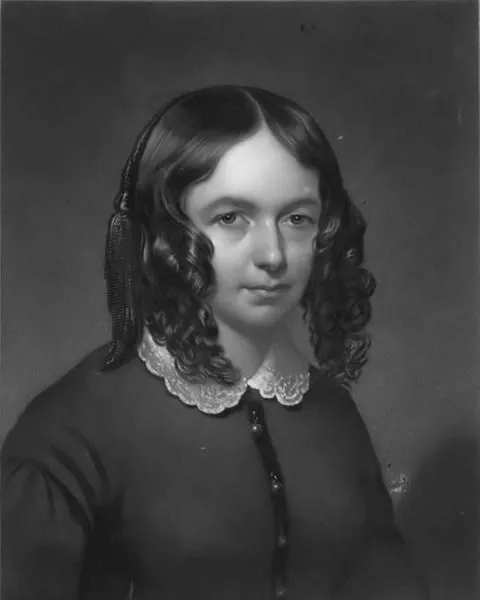
Elizabeth Barrett Browning
1806-1861
English poet of the Victorian era, popular in Britain and the United States in her lifetime, who wrote Sonnets from the Portuguese and the verse novel Aurora Leigh.
Born Elizabeth Barrett Browning-Moulton.
Elizabeth Barrett was born at Coxhoe Hall in County Durham, the eldest of 12 children. Her father's wealth came mainly from slave plantations in Jamaica. In 1809 the family moved to Hope End in Herefordshire, where she was educated at home and wrote verse from an early age. At about 15 she fell ill with head and spinal pain lasting the rest of her life.
Her mother died in 1828, and her father's losses forced the sale of Hope End. In 1838 the family settled at 50 Wimpole Street in London, and The Seraphim and Other Poems became her first mature collection under her own name. "The Cry of the Children" (1843) condemned child labour, and her Poems (1844) made her one of the more popular writers in the country and led Robert Browning to write to her.
They met in May 1845 and married in secret, knowing her father would disapprove; he disinherited her. In September 1846 they moved to Italy, and in 1849 their son Pen was born. At Robert's insistence, the love sonnets she had written after meeting him appeared in the 1850 edition of her Poems as Sonnets from the Portuguese, raising her popularity and critical standing. Her verse novel Aurora Leigh (1856), about a woman writer balancing work and love, was her most ambitious work.
She died in Florence on 29 June 1861 and was buried in the city's Protestant English Cemetery. Her poetry influenced Edgar Allan Poe and Emily Dickinson, and feminist scholarship in the 1970s and 1980s renewed attention to her work.
Sources: wikipedia.org